



This is part 2 of a series on the Future of CXOs in the AI Era. Read the Architect CMO here.
The Chief Revenue Officer (CRO) role is being redesigned. For decades, revenue leadership meant managing pipelines, arguing over forecast math, judgment calls, and carrying a number into a board meeting. The CRO was the overall quota owner and enforcer.
AI agents change that entirely. When agents absorb the invisible work of selling, the Orchestrator role emerges: designing an intelligent revenue system where humans and machines co-own outcomes.
I recently sat down with Abhijit Mitra, CEO of Outreach, to talk about where sales is heading. One point stood out to me: the best-orchestrated revenue system wins.
The future CRO becomes the Chief Revenue Orchestrator.
Today’s revenue teams operate across a patchwork of tools. CRM acts as the system of record, while much of the actual selling happens in email, spreadsheets, and disconnected applications. Forecasts often depend on rep updates and last-minute judgment calls.
AI agents introduce a new layer of revenue orchestration that continuously monitors deals, buyers, and signals across the stack.
The future CRO with agents looks very different. They design which decisions get automated, which get AI-assisted, and which stay human. They govern a fleet of agents operating across sales, marketing, customer support, and revenue operations. They optimize the revenue engine the way a control systems engineer tunes a machine.
This shift is already underway. In our 2026 Mayfield CXO survey of enterprise leaders, 46% of AI buying decisions are now made by business leaders, not IT. The CRO is increasingly the buyer. As Abhijit observed, unless AI transformation is pushed from the top, it will not happen. But when it does, it will be met with bottom-up adoption because it can make everyone’s job more impactful.
In the agentic era, the CRO becomes the orchestrator of the revenue system:
A large portion of a seller’s time goes into work that never shows up in a deal review: account research, meeting prep, stakeholder mapping, CRM hygiene, and follow-up coordination. It is tedious, chronically underdone, and invisible to everyone watching the scoreboard. It is also exactly what agents were built for, and the first thing SDRs and AEs want help with.
Where agents add leverage
The shift moves sales from activity-heavy execution to decision-driven selling. The real shift is from point AI solutions to end-to-end revenue orchestration, where AI coordinates inbound, outbound, and deal execution as a unified system.
Bottom line: AI only creates real value in sales when it orchestrates the full revenue workflow, not when it accelerates isolated steps.
AI restructures today’s B2B sales work around strategy, orchestration, and trust. The meta-pattern: AI handles sense-making and analysis.
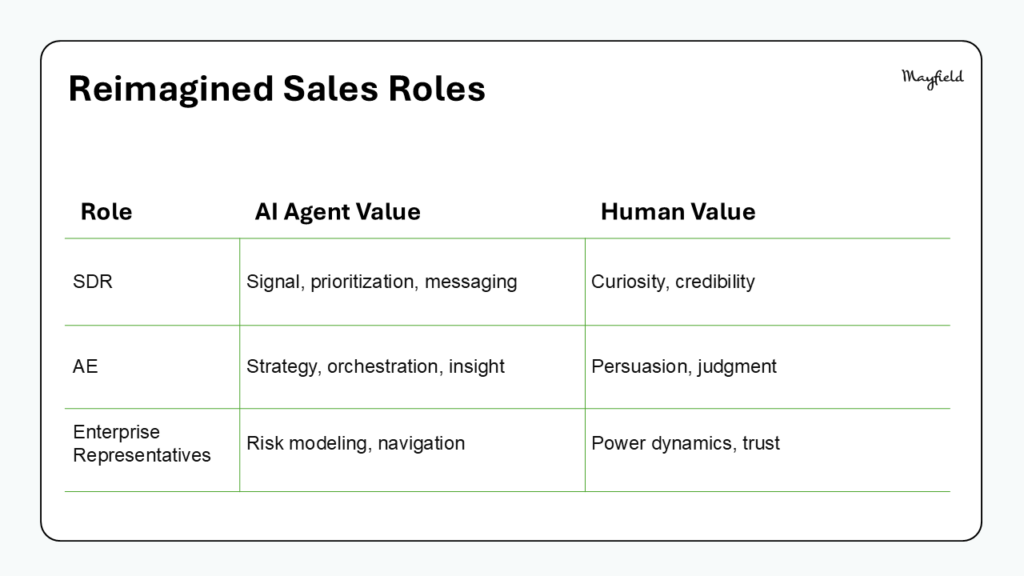
New roles are also emerging:
These roles emerge because AI lowers the cost of outreach but raises the premium on judgment, timing, and trust.
The day for the Revenue Orchestrator starts with an AI-generated revenue brief, not an inbox full of rep updates. That brief surfaces what changed overnight: which deals became riskier or stronger, where human judgment is required, and where the system is behaving as expected. No dashboards to hunt through. Just exceptions and decisions.
Forecast reviews become system diagnostics. The CRO reviews agent-predicted close probabilities, which reps are over- or under-leveraged, examines overrides made in the last 24 hours, and asks whether the system is drifting. Debates about numbers are replaced by structured conversations about system behavior.
Deal interventions are selective. Instead of jumping into dozens of accounts, the CRO focuses on two or three high-stakes situations where agents have flagged stakeholder gaps and need increased coverage, timeline risk, or decision blockers. The time saved goes to strategic work: refining ICPs, experimenting with pricing and packaging, preparing board-level narratives and scenario analyses, and shaping the next generation of the revenue engine. And over time, as AI agents learn, they will continue to help with all of these areas as well.
What disappears: chasing CRM hygiene, arguing over forecast math, sitting through performative pipeline reviews, and reacting late to deal risk. Those were symptoms of low signal. Agents eliminate the signal problem.
The Revenue Orchestrator’s role is intense, but controlled. They have earlier visibility, fewer surprises, and authority rooted in evidence.
The shift from traditional SaaS sales software to intelligent revenue systems is a big company-building opportunity. Here is the advice I am sharing with founders building in this space:
Build for decisions, not activity. AI handles research, admin, and pattern detection. The value has shifted to prioritization, judgment, and strategy. Winning products help revenue teams make better decisions earlier, not generate more activity.
Design for systems, not features. Point solutions create bottlenecks. The Outreach thesis is exactly right: the opportunity is to build revenue systems that coordinate the full workflow from prospecting through forecasting, managing the entire customer lifecycle, and continuously adapting. Products that automate one step without integrating the others just relocate the problem.
Build for the Revenue Orchestrator and the organization around them. The CRO buying AI today is not buying a tool. They are investing in infrastructure for an intelligent revenue system and in the changing roles within their revenue organization. Products need to support governance, visibility, and security from the start. In our CXO survey, trust and governance are the top gating factors for enterprise AI adoption.
Price to outcomes. Seat-based pricing made sense when software was passive. As AI makes software more active, pricing models need to reflect the value it delivers. The hybrid of seat and consumption is the current transition. A combination of outcome-based and skill-based pricing is where this lands.
Design trust from day one. Explainability, security, and compliance are table stakes. AI is now part of the customer-facing experience. Buyers in regulated industries are asking directly: how does your AI make decisions, and what happens when it fails? Build the answer into the product.
Bottom line: The winners will orchestrate entire revenue workflows, improve decisions at every stage, and deliver outcomes that business leaders can measure and defend to their boards.
I’m optimistic about the future of SaaS in the AI era. The narrative that AI is killing SaaS mistakes disruption for evolution. Essentially, AI is making SaaS move from Systems of Record to Systems of Work.
The revenue teams that lean into this transition gain a structural advantage: faster learning cycles, better decisions, and more predictable outcomes.
Abhijit said it well near the end of our conversation. The winners are not the companies adding AI features to existing workflows. They are the ones reimagining SaaS in the AI era and building an intelligent revenue system that compounds.
That is the opportunity. And it is wide open.
This is part 2 of a series on the Future of CXOs in the AI Era. Part 1 covered the Architect CMO. In part 3, I will explore the Future of the CIO and how the infrastructure of enterprise AI is being redesigned from the inside.
Watch the highlights from my conversation with Abhijit Mitra, CEO of Outreach, below.