



This year, we surveyed over 266 CIOs, CTOs, CAIOs, CISOs, and CDOs from Mayfield’s CXO Network about AI agents in the enterprise. You can find the full Mayfield CXO survey results here.
Key Findings
Founder Insights to Build, Sell, and Scale
The winning formula for founders is deceptively simple: Build products that make experimentation safe, customization straightforward, and value unmistakably clear. Sell through hands-on proof rather than presentations. Prioritize data readiness over feature depth. Enable self-service trials that deliver real outcomes in days, not months.
As adoption grows, scale by embedding trust, governance, and compliance into the product itself—not into contract negotiations. Continuously surface ROI through dashboards that speak directly to business outcomes and functional leaders.
Enterprises aren’t buying novelty. AI represents a transformation project, not a technology purchase. CIOs, CTOs, and business heads are investing in integration, security, and measurable impact.
2026 will be a breakout year for founders who understand what enterprise buyers truly need: demonstrable impact, architectural fit, governance, and scalability.
This playbook distills how to build, sell, and scale AI agents in the enterprise with actionable guidance for founders at every stage.
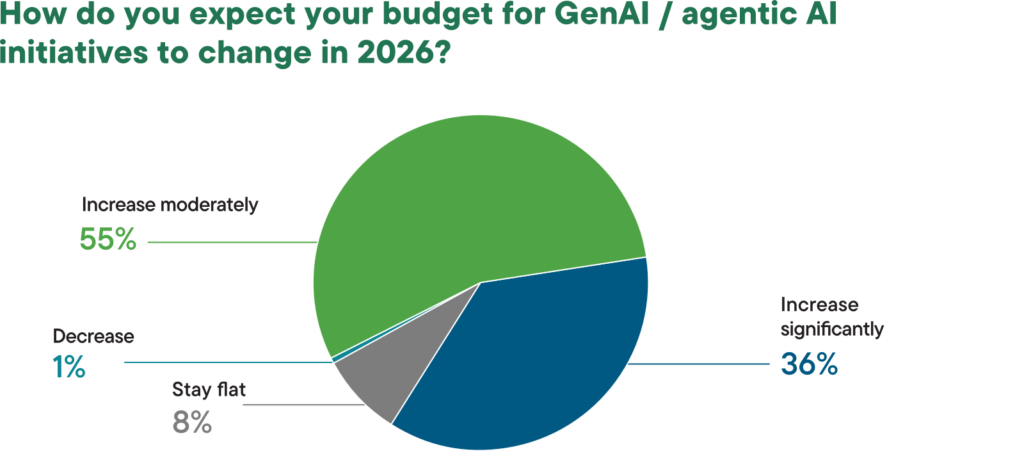
91% of CXOs plan to increase budgets for agentic AI initiatives (55% moderately, 36% significantly). Broader IT budgets are rising too, with larger shares devoted to AI-driven modernization: data infrastructure, automation, and intelligent security.
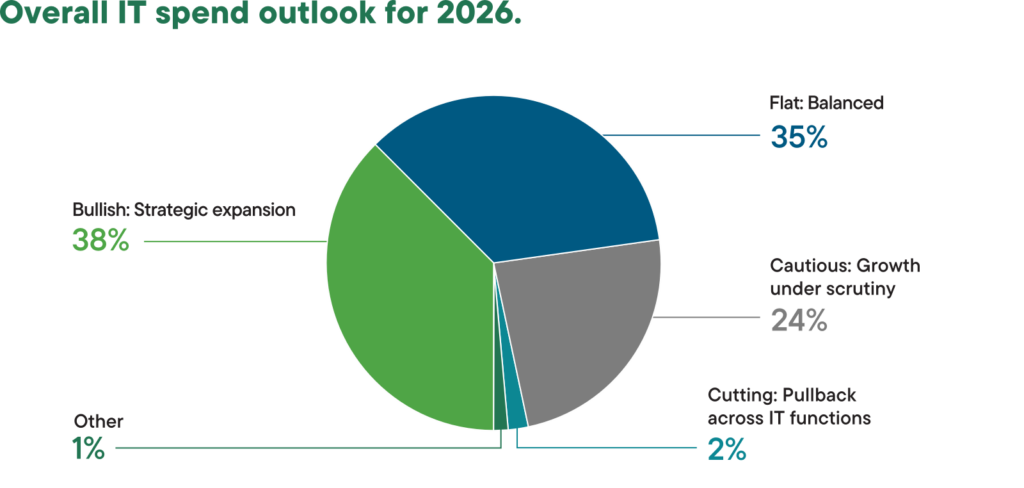
38% of CXOs are bullish on their overall IT spend with plans to strategically expand.
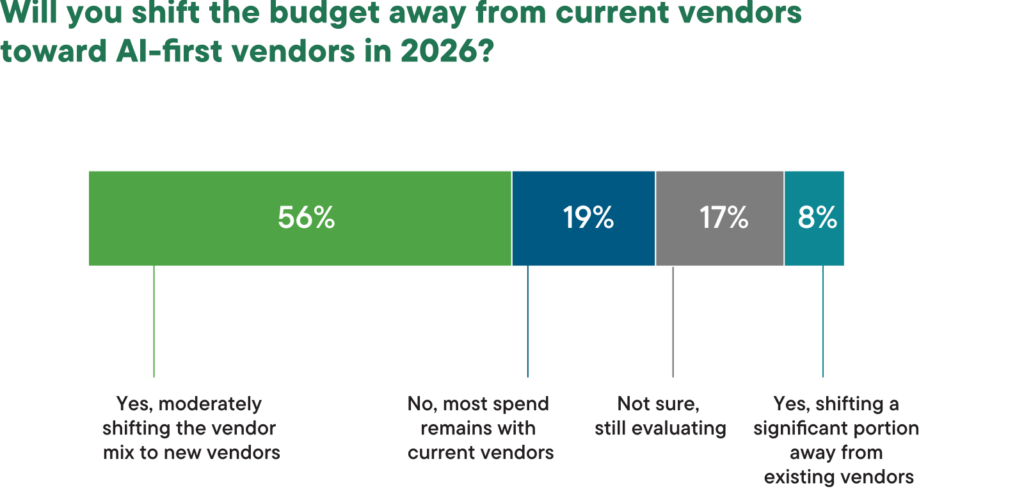


“Our strategy has shifted from building everything in-house to leveraging an ecosystem: hyperscalers, SaaS, and startups. We greenlight AI initiatives based on ROI in many forms—productivity, new ways of working, or new revenue. So far, efficiency has been the most immediately achievable outcome, especially for legacy environments, but innovation is a close second. AI is unleashing the ‘art of the possible’—if we can imagine it, we can often build it.”
– Geeta Pyne, Senior Managing Director & Chief Architect, TIAA
Founder actions:
46% of AI buying decisions come from business leaders, not just CIO/CTO teams.
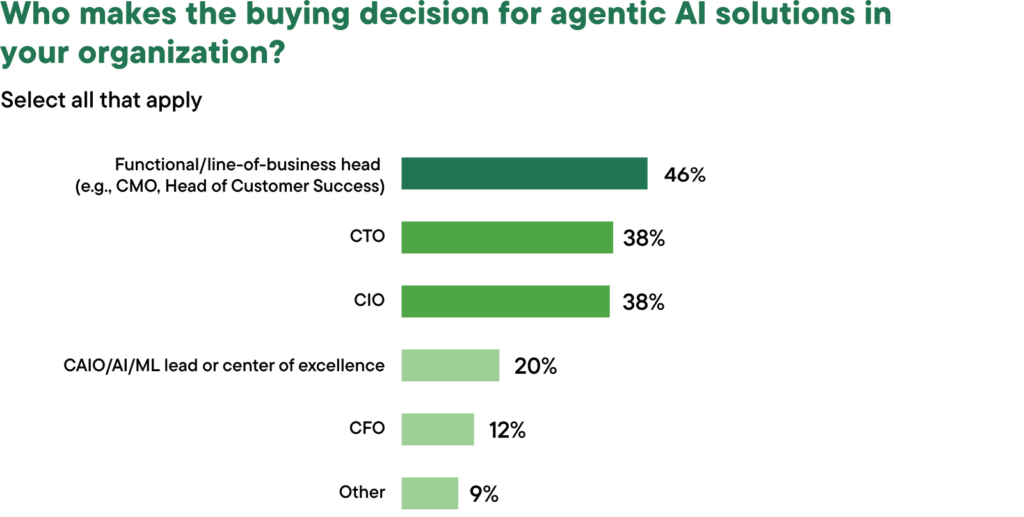
Each stakeholder evaluates agents through a different lens—business leaders assess workflow transformation while technical leaders examine architecture, integration, observability, and control.
Founder actions:
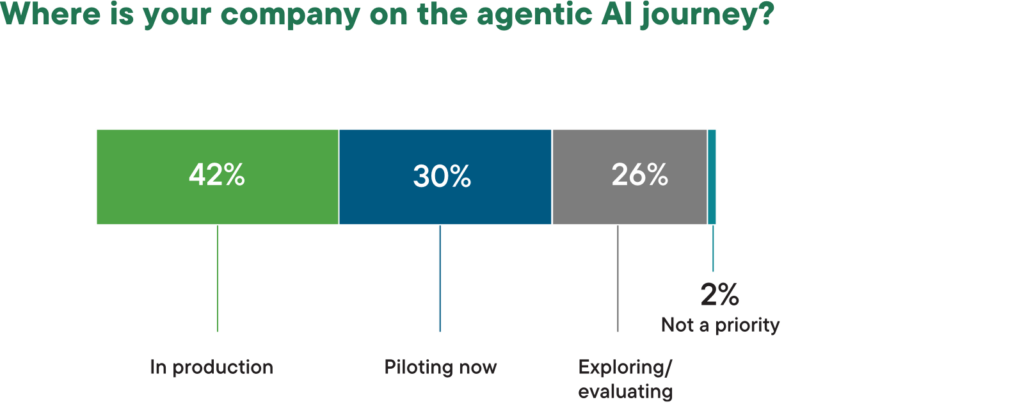
42% of enterprises already have agents in production via custom builds and third-party tools, with another 30% piloting first use cases. This means the market is ready—but buyers are at different stages.


“We’ve moved past the question of use cases. Our challenge now is scale. AI demand from clinical, research, and operational teams is growing faster than compute, data pipelines, or governance can keep up. The only way forward is platformization—shared compute, shared data, shared guardrails.
We don’t approve any AI initiative unless it delivers measurable ROI: cutting wait times from 42 minutes to under 1, reducing abandonment from 27% to nearly zero, or accelerating drug discovery by almost a decade. The biggest unlock is the compounding effect—once you remove friction in documentation, data access, and analysis, everything accelerates. AI becomes a flywheel, not a feature.”
– Tsvi Gal, CTO / Head of Enterprise Technology Services, Memorial Sloan Kettering Cancer Center
Founder actions:
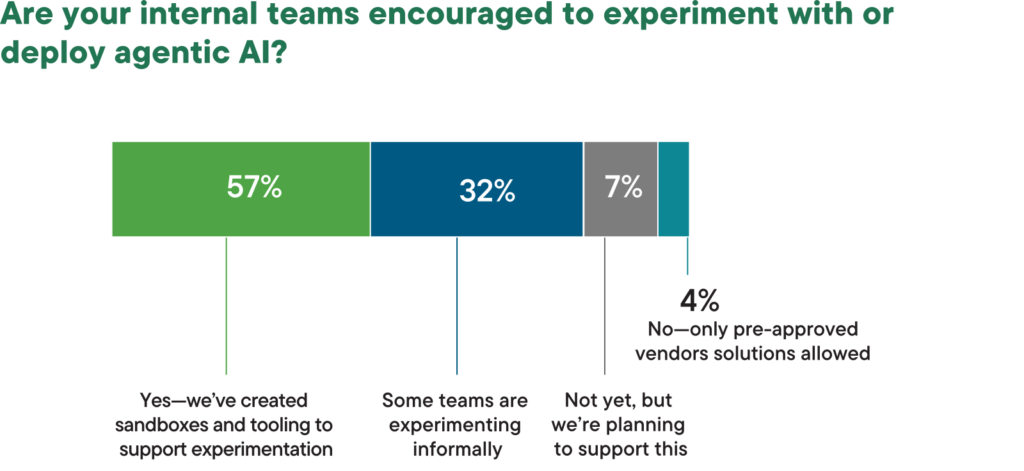
57% of CXOs encourage in-house AI experimentation. They want products that make this safe through sandboxed environments, controlled datasets, and transparent observability.


“In the agentic era, momentum is the new moat. We already have AI agents generating $15M in revenue, issuing 1.5M boarding passes, resolving 93% of customer inquiries, and autonomously selling bundles and upgrades. The next unlock is bold movement toward autonomous operations.”
– Neetan Chopra, Chief Digital and Information Officer of IndiGo Airlines
At the same time, 57% want to customize AI agents for their workflows. Modular architecture, role-based configurations, and API-first design signal maturity and accelerate integration.
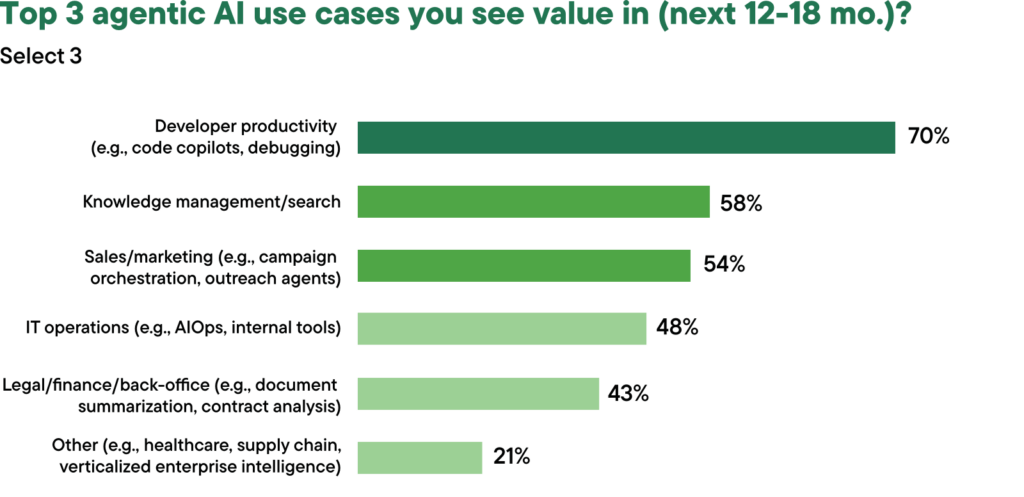
The top current use cases remain developer productivity (70%), knowledge management (58%), and sales & marketing (54%). Founders still have greenfield opportunities in cybersecurity, FinOps, and healthcare, where adoption is nascent but budgets are forming.


“At DigitalOcean, we’ve already begun reshaping engineering—using AI agents to automate system reliability—and we’re now extending that mindset across every function: customer support, sales, finance, legal, HR, and beyond. We already have multiple AI use cases in production, both internal and customer-facing, and we expect every major workflow to be touched by AI in the next 12 to 18 months.”
– Bratin Saha, Chief Product & Technology Officer, DigitalOcean
Founder actions:
Enterprise buyers have moved past demos. They require proof.
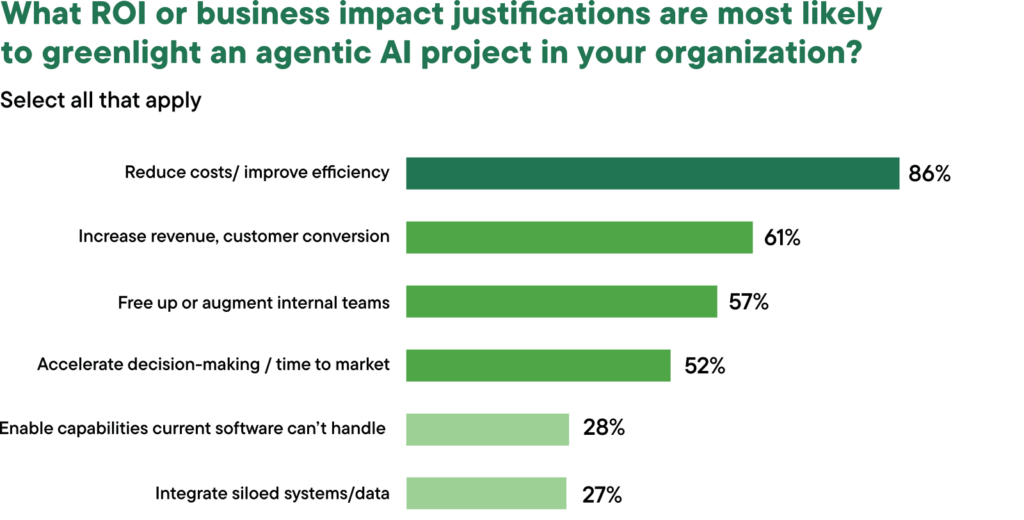
What buyers measure:
What buyers want from vendors:
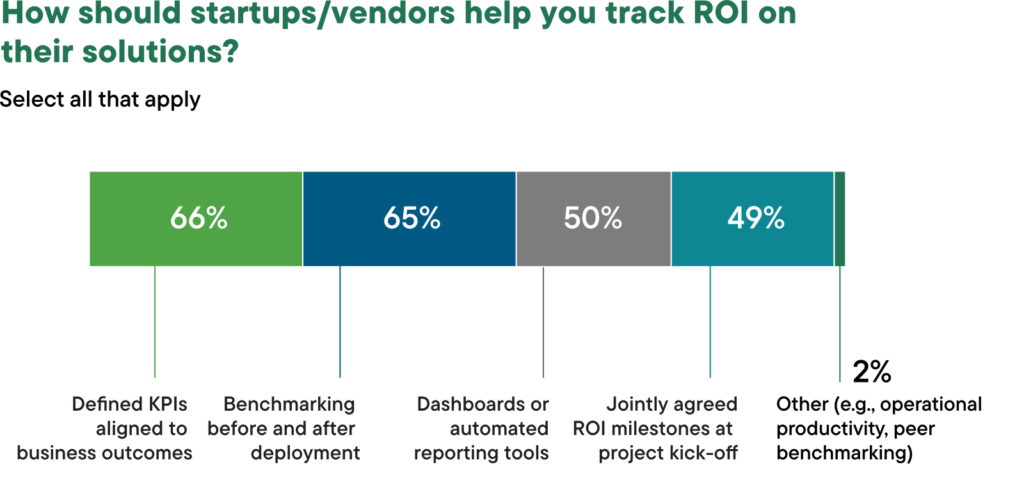
As Tsvi Gal, CTO at Memorial Sloan Kettering, articulates: “We don’t approve any AI initiative unless it delivers measurable ROI: cutting wait times from 42 minutes to under 1, reducing abandonment from 27% to nearly zero, or accelerating drug discovery by almost a decade.”
Madhu Reddy, EVP and CIO of Republic Bank of Chicago, adds: “Efficiency is the quickest win, but the most durable outcome is improved decision-making. The biggest ROI surprise so far? Reducing cognitive load.”


“When greenlighting AI initiatives, we look for a risk-adjusted return that matches the level of investment, timeline, and ambition. Small projects should move fast, generate learning, and earn the right for further investment. Large AI programs must show a credible path to the same financial and strategic return we expect from any capital project.”
– Art Hu, SVP & Global CIO; Chief Delivery & Technology Officer, SSG, Lenovo
Founder actions:
70% expect to trial AI tools in their own environments before signing, and they demand measurable evidence during that process.
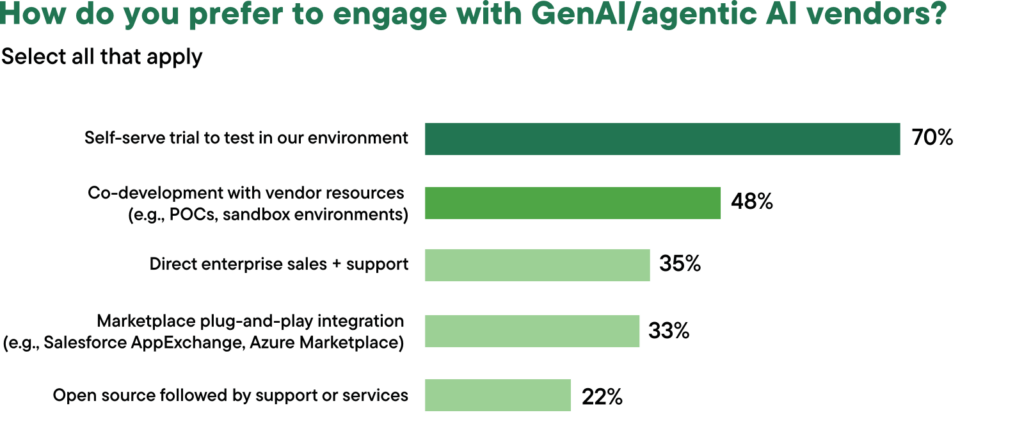


“Enterprise AI adoption isn’t just about features or benchmarks — it’s about giving leaders actionable insight into qualitative adoption metrics. We need frictionless ways to understand how AI is being used, what’s resonating with teams, and how to partner on accountability to increase usage.”
– Ben Davis, Cambria
Founder actions:
Data readiness slows deals more than any other factor. 58% of buyers cite data quality as their top blocker.
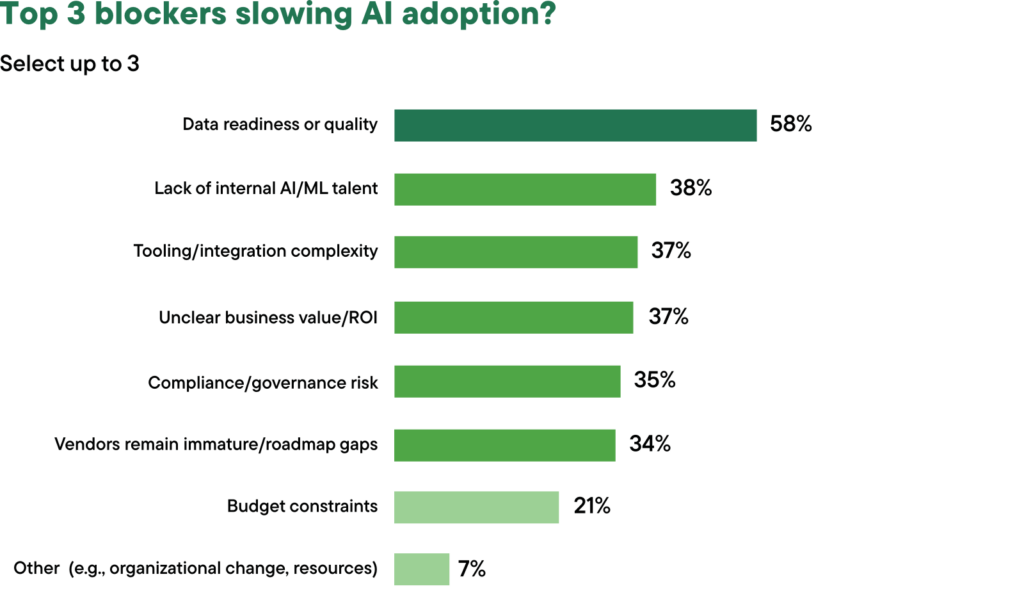


“The frontier is still structured data. Summarizing documents is easy; getting yesterday’s sales right is hard. And while agentic systems are powerful for tasks—summaries, code review, call-center automation—they’re not yet replacing jobs or end-to-end workflows.”
– Alfredo Colas, Proctor & Gamble
Founders mistakenly think data readiness means clean data. The primary problems are architectural – how systems connect, where credentials live, how data flows through the organization.
Our biggest challenge with AI adoption is the same one enterprises have faced for decades: interoperability.Chris Fallon, CIO of Wingstop
Founder actions:
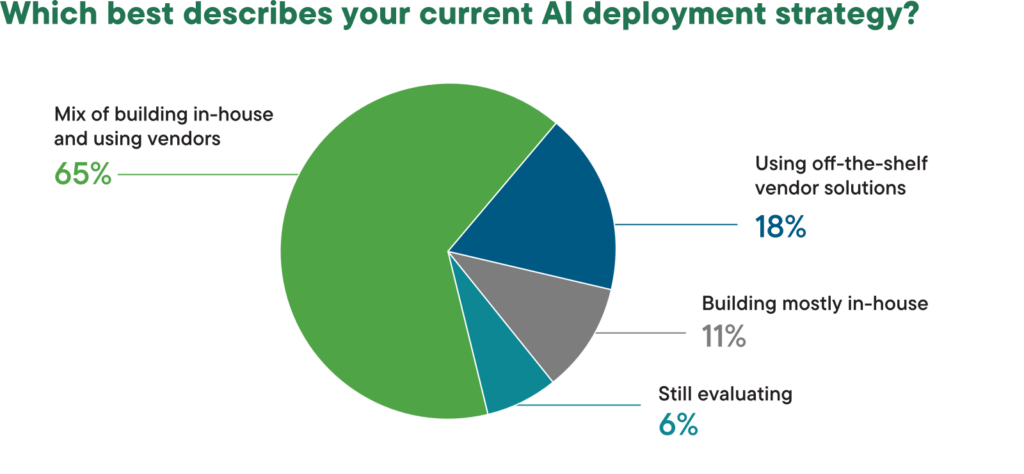
Enterprises combine vendor AI with in-house pipelines. 65% blend custom systems with AI-native tools.
Founder actions:


“The agentic shift is very real. A year ago this wasn’t the conversation; now we have multiple agents in pilot and production, and we expect many more. We buy some tools, but we build a lot ourselves because prebuilt solutions are too generic and our data is too sensitive. Building gives us better alignment to real requirements and protects data from external exposure.”
– Sachin Dangayach, Senior Director, AI, Applied Materials
Scaling requires moving from experimentation → production → enterprise rollout. The gating factor is trust.
84% of CXOs say integrated data security and compliance are mandatory for any AI deployment. Treat privacy, auditability, and observability as design features, not procurement hurdles.
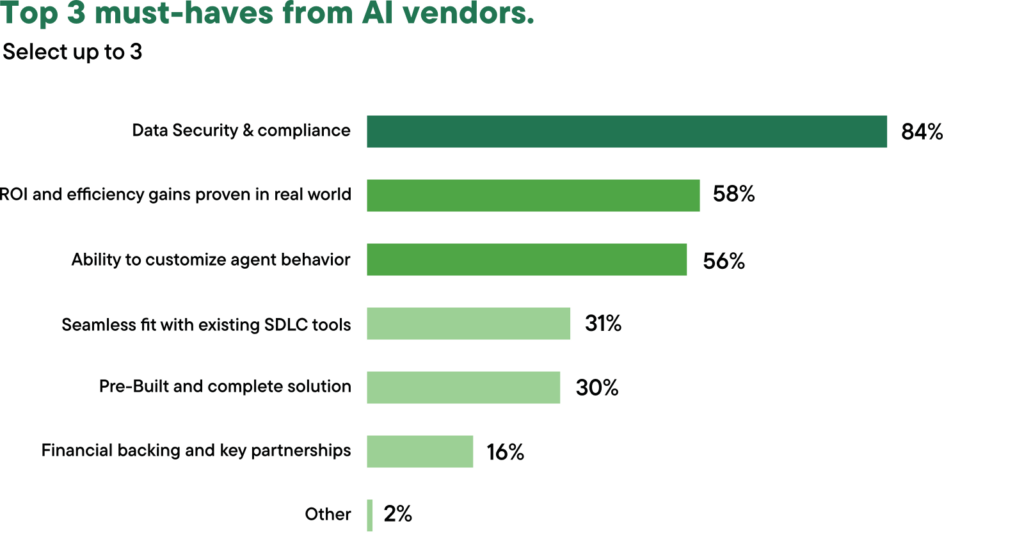


“In a highly regulated environment like banking, data governance is mission-critical. We have to build governance into every layer of the stack — models, data, applications, and user interfaces — and we must raise employee awareness so they understand the risks and how to use AI and agentic systems properly. At the same time, grassroots momentum is building. We want employees to have the latitude to create thousands of solutions. The people closest to the work should be able to deploy their own agents in a safe, self-serve environment.”
– Naren Chittar, Managing Director & GM of Machine Learning, JPMorgan Chase
Yet 60% of companies still lack formal AI frameworks. Startups that embed governance and compliance controls natively can become the default partner for cautious CIOs.
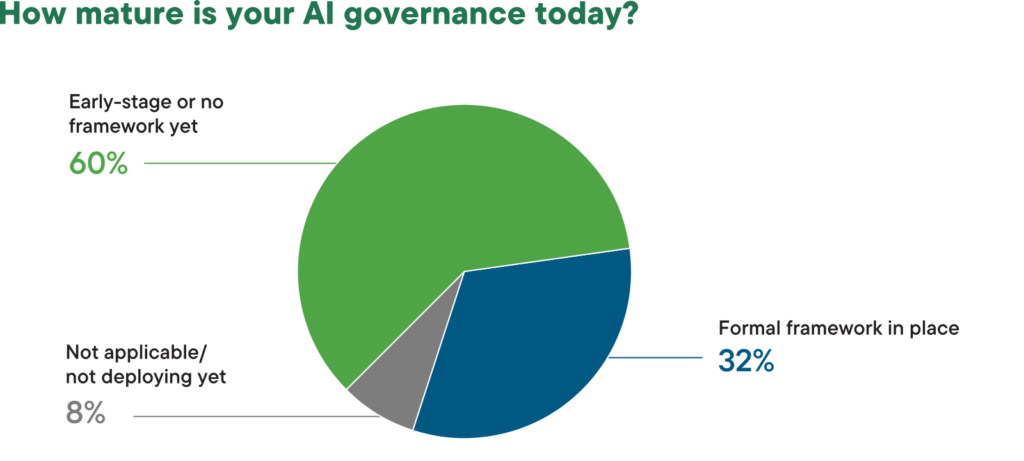

“Anchor every AI proposal in measurable outcomes, pair it with a simple risk framework, and show how governance, ethics, and compliance are being handled from day one.”
– Diane Tryneski, Former CTO/CDO, HBO; Senior Executive at Disney & Discovery
Founder actions:
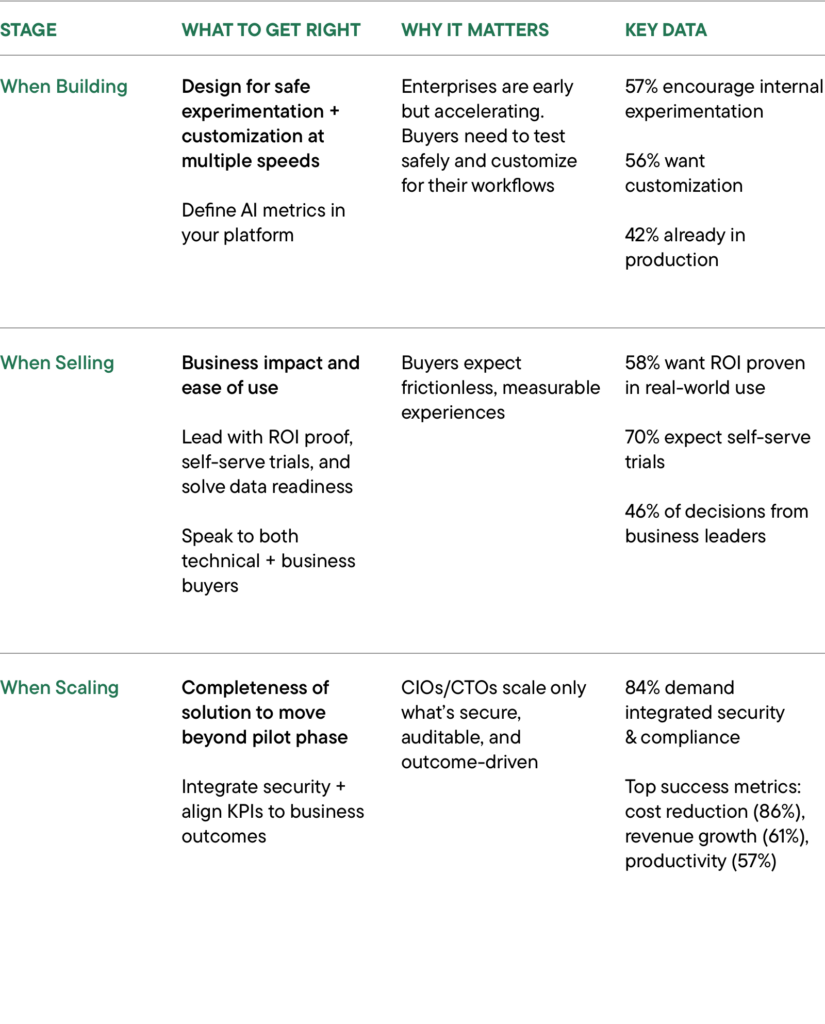
This table summarizes what to get right when building, selling, and scaling from the sections above.
Successful AI companies build sales capabilities in stages. Each stage removes friction and builds trust as buyers climb from trial to enterprise-wide transformation. For more, see our AI Sales Framework guide.
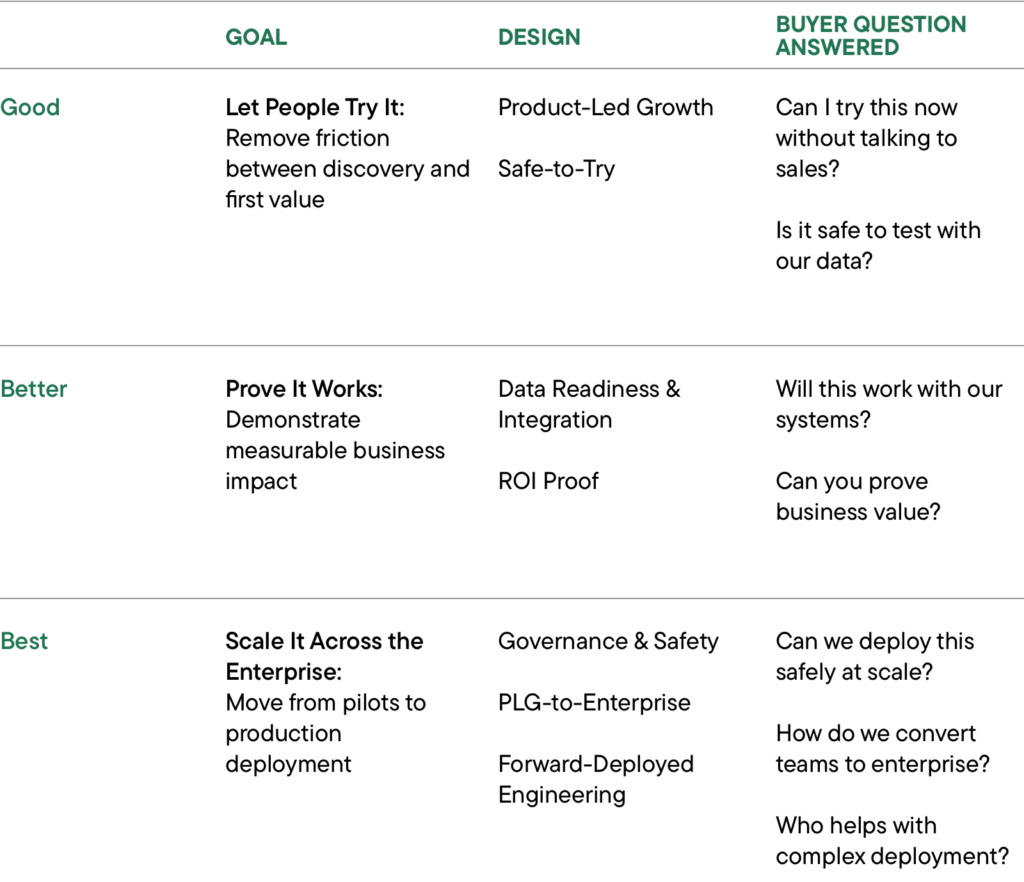
AI agents aren’t software – they’re autonomous workers that make decisions and take actions while keeping humans in the loop. This fundamental difference changes everything about how enterprises evaluate and purchase them.
The technology itself is still maturing. As Rao Surapaneni, vice president of Google’s CloudAI Business Application Platform, describes it: “We’re seeing a shift from task-oriented execution to goal-directed execution. Instead of asking AI agents to perform individual tasks, agents increasingly have the ability to figure out what tasks need to be performed to achieve a stated goal, then perform those tasks autonomously.”
Bottom line: SaaS buyers evaluate features. AI agent buyers evaluate trust, integration, and workflow transformation.
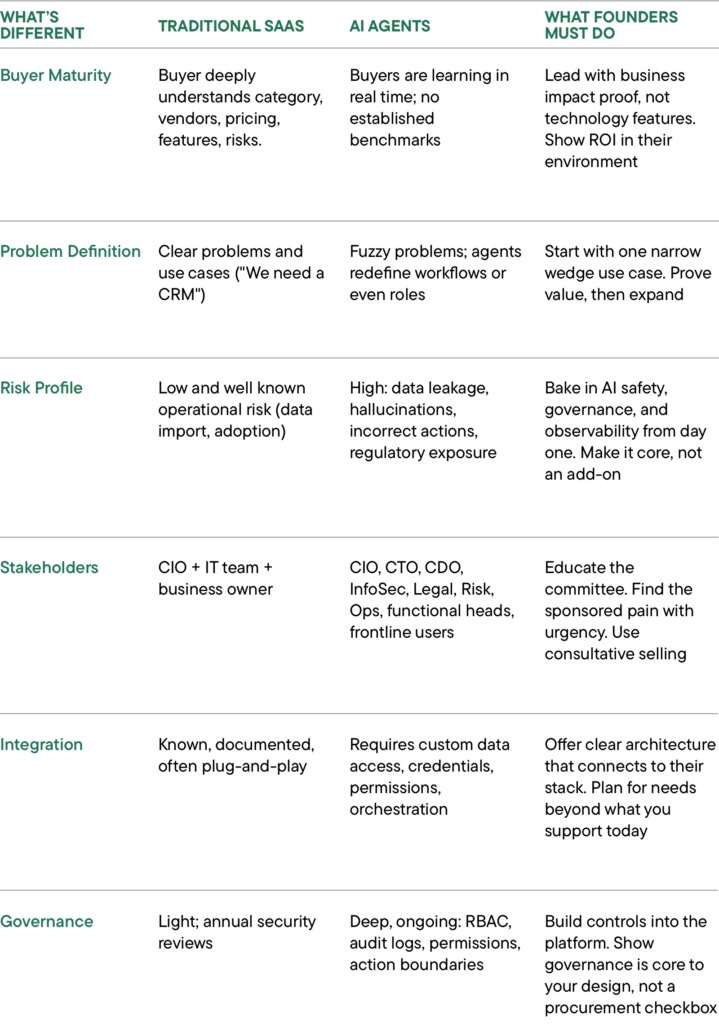
Enterprise buyers have moved past the hype. They’re not evaluating AI as a technology—they’re evaluating it as a business transformation. Enterprise buyers now prioritize three things: seamless integration, bulletproof security, and measurable business outcomes. When evaluating vendors, they’re asking: does this company have a “completeness of vision” to be our partner?
What “Completeness of Vision” Means to Buyers
Enterprise buyers aren’t looking for tools—they’re looking for long-term partners who can help them navigate a multi-year AI transformation. When they evaluate vendors, they assess whether the company has a complete vision across these dimensions:
Market Understanding: Can the vendor clearly articulate the buyer’s industry, workflows, constraints, and desired outcomes? Buyers want partners who understand their world well enough to shape a roadmap aligned with real business problems, not AI capabilities.
Innovation and Product Strategy: Does the vendor have a credible plan for future capabilities, model improvements, and platform evolution? Enterprises need confidence the product will stay competitive and relevant as AI, and their own needs, rapidly advance.
Integration with Existing Workflows: How seamlessly will the solution plug into the buyer’s existing stack, data sources, APIs, and processes? “Duct-taped integrations” destroy trust. Buyers expect a clear architecture that fits natively into their environment and scales cleanly.
Scalability and Future Requirements: Is the platform built to handle growth in users, data volumes, and emergent use cases—even those that aren’t known yet? Enterprises choose partners who design for longevity, not point solutions that will break under scale.
Business Model Viability: Will this vendor be around in three to five years? Buyers assess pricing logic, financial durability, and the sustainability of the vendor’s go-to-market strategy.
Vertical/Industry Strategy: Does the vendor understand the unique regulatory, compliance, and operational realities of the buyer’s sector? Vertical insight—especially in healthcare, finance, manufacturing, and public sector—is a powerful signal of maturity.
Beyond the Hype: Is the vendor focused on real outcomes rather than flashy demos? Buyers look for partners who measure success in tangible metrics: cost savings, faster decisions, improved productivity, and revenue impacts.
In essence, a complete vision reassures the buyer that the vendor is a strategic partner who understands their journey, not just a one-off transaction, and will help them achieve long-term success and competitive advantage
Founders who answer these questions at every stage—from first conversation through production deployment—will help enterprises escape pilot purgatory and define the next era of intelligent workflows.
The opportunity isn’t in building the most sophisticated AI models. It’s in building AI agents that enterprises can actually adopt, trust, and scale—and in becoming the strategic partner who guides them through that journey


“For 2026, we’re exploring agentic workflows that rebuild core processes end-to-end. A year from now, our business will make decisions faster, resolve issues proactively, and deliver experiences that feel far more personal. The biggest unlock ahead is decision intelligence — AI that blends data, context, and human judgment.”
– Madhu Reddy, EVP & Chief Information Officer, Republic of Chicago
This playbook draws from our 2026 survey of 266 CXOs from Fortune 50–Global 2000 companies and high-growth enterprises, conducted through the Mayfield IT Leadership Network.

1. Follow the Money in Enterprise AI
2. How to Build AI for the Enterprise
3. How to Sell AI into the Enterprise
4. How to Scale Adoption in the Enterprise
5. Founder Lifecycle Cheatsheet: How to Sell AI into the Enterprise
6. The AI Sales Framework: Good, Better, Best
7. Why Selling AI Agents Differs from SaaS
The Winning Formula for AI Founders
AI Sales Framework Guide
About This Research
This playbook draws from our 2026 survey of 266 CXOs from Fortune 50–Global 2000 companies and high-growth enterprises, conducted through the Mayfield IT Leadership Network.

