


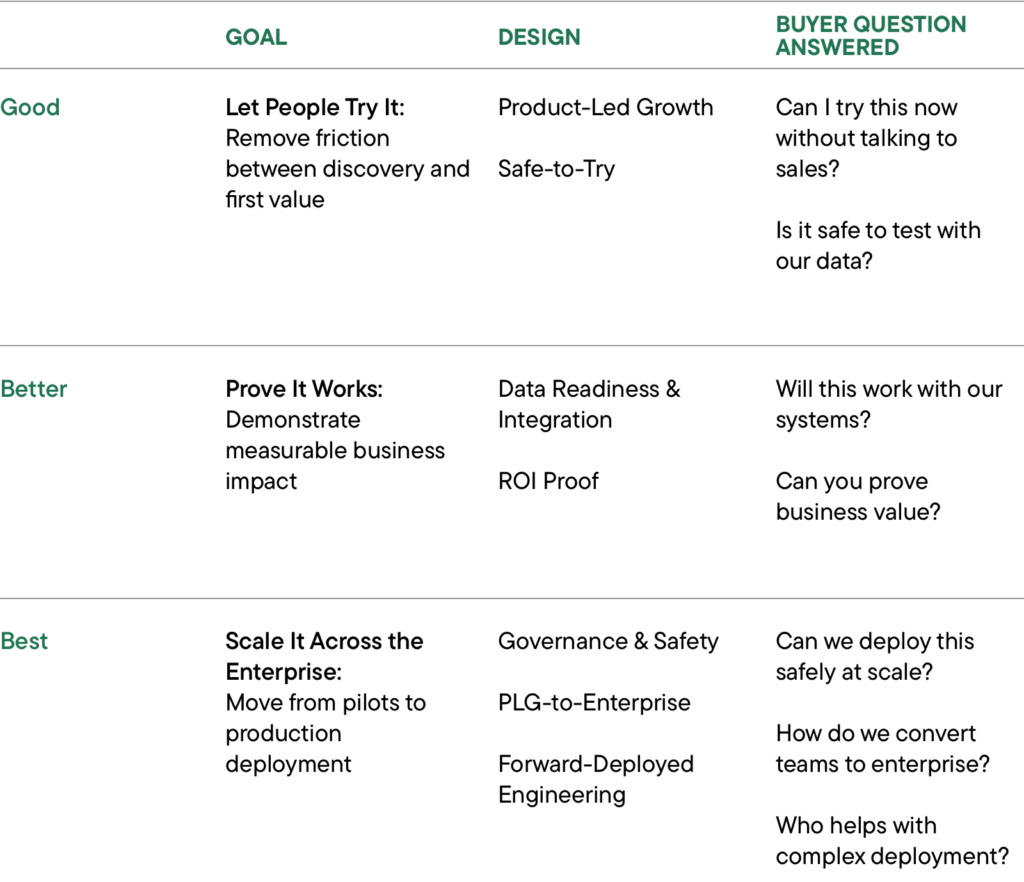
Get the product into users’ hands immediately. Remove all friction between discovery and first value.
AI adoption starts when individual users can try the product immediately: no demos, no procurement cycles, no friction. PLG lets users see value before they talk to sales, which dramatically accelerates trust and time-to-value.
What wins:
Why it matters:
70% of buyers expect self-serve trials. 56% want to customize agents for their workflows. AI agents that deliver meaningful results in minutes build internal champions organically.
Even with PLG, enterprises will not experiment unless the environment is safe, controlled, and observable. Build the trust infrastructure needed for initial hands-on trials.
What wins:
Why it matters:
84% require integrated security. Most enterprise buyers want to try AI, but only within a framework that protects their data, brand, and compliance posture.
Once prospects can use the product safely, they demand measurable business impact.
Without clean, connected data, AI agents can’t perform. This removes the largest adoption blocker.
What wins:
Why it matters:
58% cite data readiness as the top blocker. Solving it makes your product “real” instead of theoretical.
Once data and workflows are connected, buyers expect measurable business outcomes quickly. AI companies must prove impact and results.
What wins:
Why it matters:
86% measure cost reduction, 61% revenue growth, 57% productivity. ROI is what turns experimentation into committed adoption. When users see measurable value during the trial, they become internal champions.
Move from team pilots to production deployment and enterprise-wide transformation.
As adoption expands from assistive use cases to autonomous workflows, governance becomes non-negotiable.
What wins:
Why it matters:
60% lack internal governance frameworks and require vendors to provide them. Governance converts fear into confidence and makes procurement cycles smoother.
After users see value individually and within teams, usage reaches a tipping point: procurement engages. This converts organic adoption into structured enterprise agreements.
What wins:
Why it matters:
This is the moment when product-led adoption becomes predictable revenue. The sale is no longer hypothetical—the value has already been proven internally.
At enterprise scale, AI deployments require dedicated engineering partnership. FDEs accelerate rollouts, build custom workflows, solve integration edge cases, and drive transformation.
Companies like Palantir, Databricks, Stripe, Snowflake, and OpenAI rely on FDEs to unlock multi-million-dollar deals. This model works best in mid-to-late early stage through growth stage, where customers demand customization and the product evolves quickly.
What wins:
Why it matters:
AI value is contextual. FDEs turn general-purpose AI capabilities into embedded business transformation, unlocking multi-million-dollar deals and long-term expansion.


