


Insights from Mayfield’s 2026 CISO Survey
AI is becoming both a new attack surface and a defensive operating layer. The speed at which software is created, exploited, investigated, and remediated is compressing. For security leaders, the question is no longer whether AI will reshape the function; it is where autonomy can be trusted, how governance keeps pace, and which vendors can prove efficacy.
Security budgets are growing, and spend is already shifting.
72.8% expect security budgets to rise in 2027. AI remains a minority of total spend for most teams, but 70% report a moderate or significant shift from legacy vendors toward AI-native solutions.
AI-generated software is the leading emerging risk.
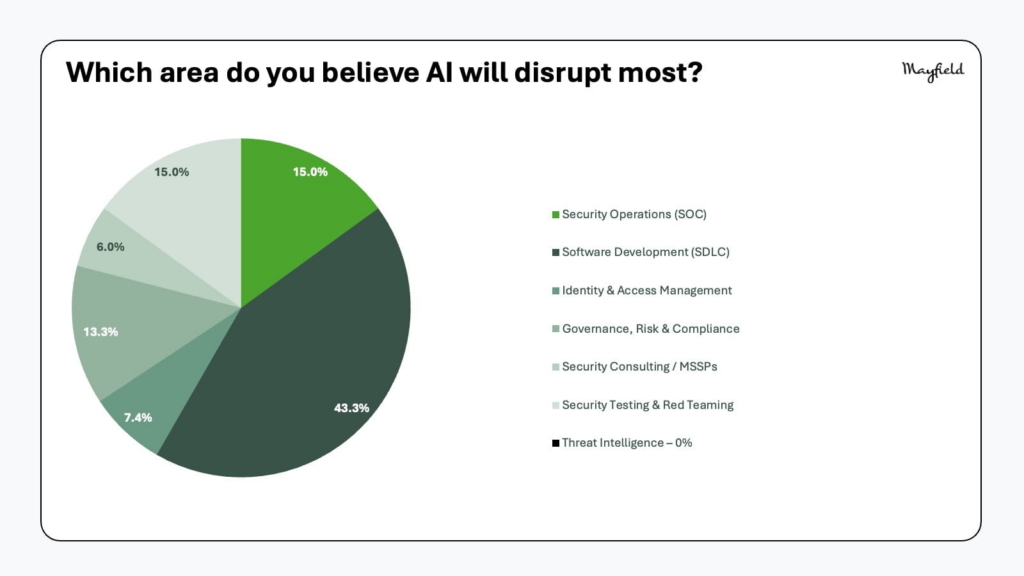
66.7% cite AI-generated software vulnerabilities as a top concern. SDLC is the function most likely to be disrupted, and only about 2% say their current stack is fully equipped for the resulting risk.
Vulnerability remediation is the clearest autonomy mandate.
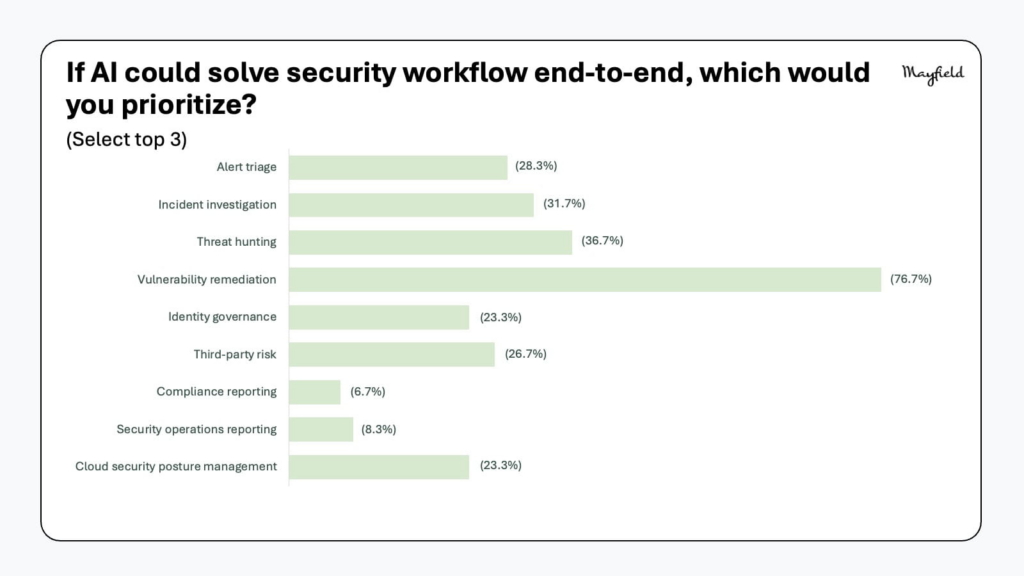
76.7% would prioritize end-to-end AI ownership of vulnerability remediation — more than twice the response for the next-highest workflow.
Trust — not budget — is the adoption gate.
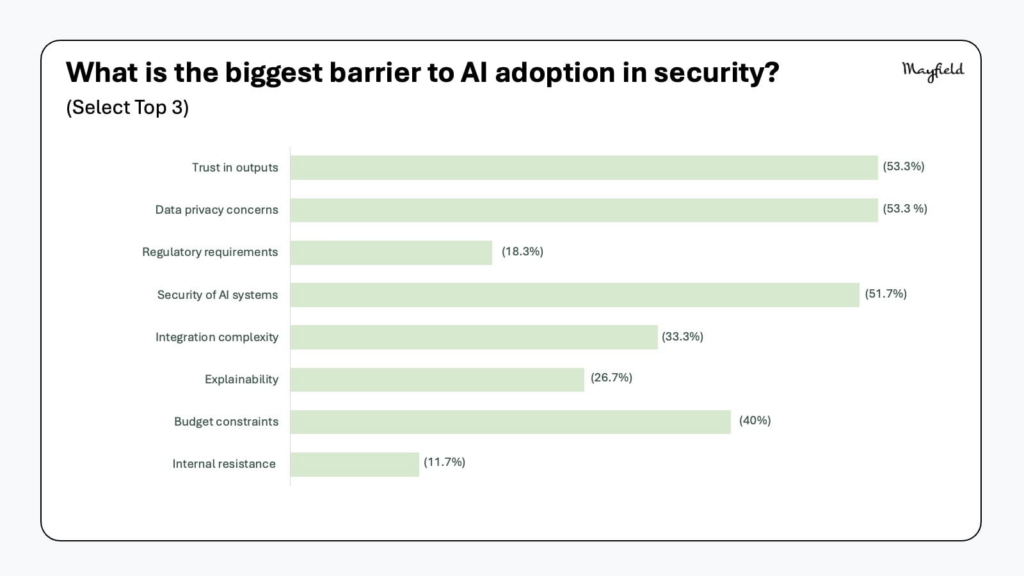
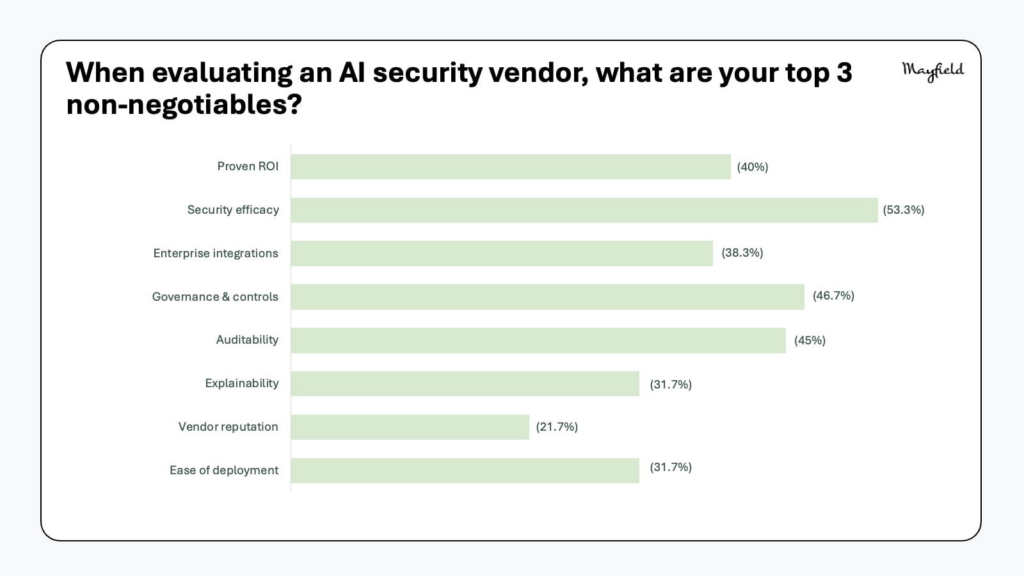
Trust in outputs and data privacy tie as the top barriers to AI adoption. Security efficacy, governance, and auditability lead the vendor evaluation criteria.
Operational adoption is outpacing governance visibility.
56.6% describe themselves as integrated across workflows, agentic, or AI-native — yet 83.3% still lack complete visibility into employee AI use.
CISOs expect more security spend in 2027, but the AI transition looks like steady reallocation rather than a single rip-and-replace event.
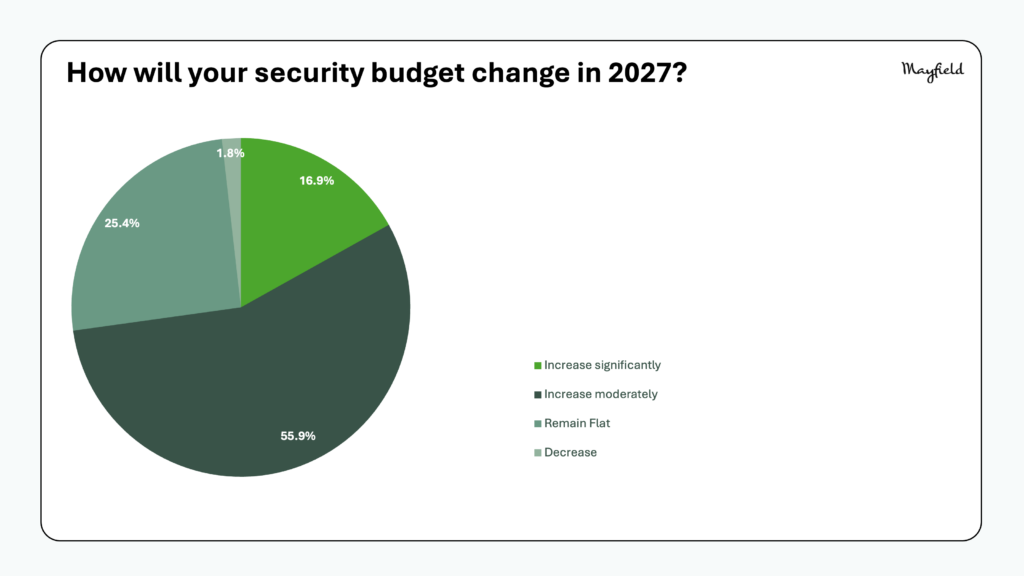
Nearly three-quarters expect budgets to rise, pointing to steady expansion rather than a dramatic spending surge.
AI remains a relatively small share of security budget spend, but budgets are already moving toward AI-native vendors.
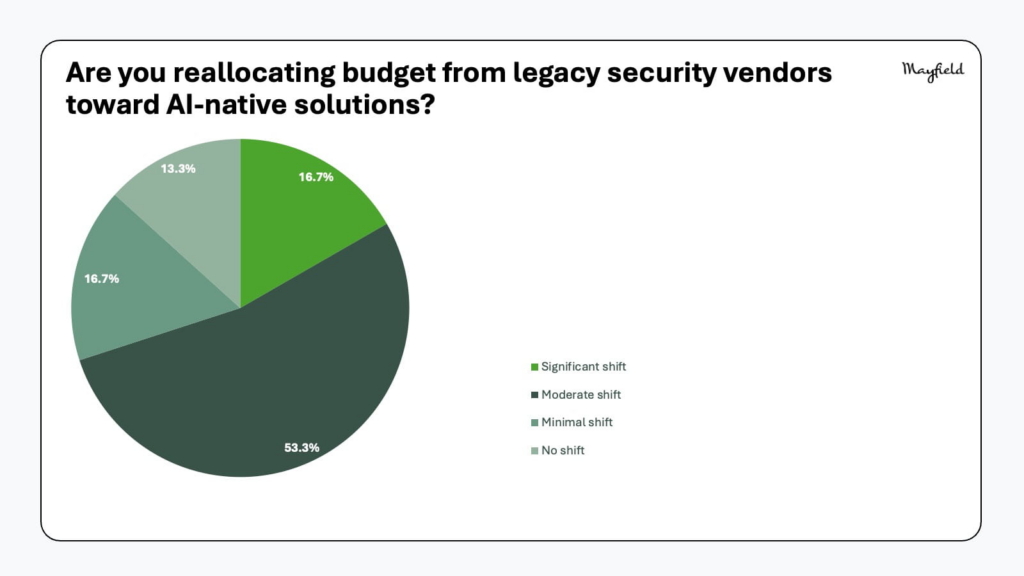
70% report a moderate or significant shift from legacy vendors toward AI-native solutions.
Mayfield Takeaway
Budget growth gives security leaders room to modernize, but the transition will be gradual. Prioritize AI investments tied to measurable risk reduction, and require new tools to prove value alongside—not merely replace—the existing stack.
The center of gravity has shifted from AI-powered attacks to AI-produced software — and the security stack has not caught up.
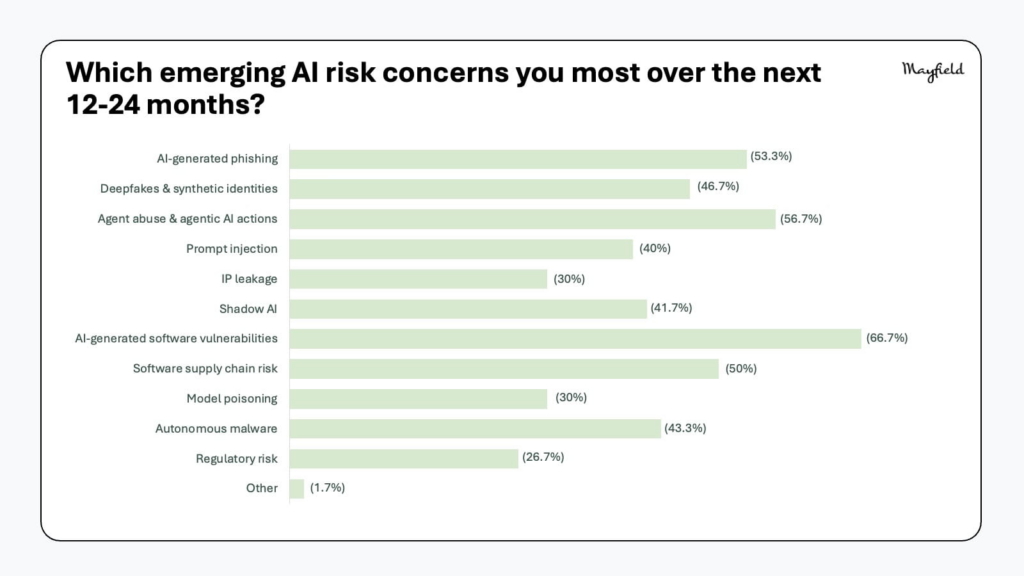
Yet only about 2% say their current stack is fully equipped for the resulting risk.
Software development stands well ahead of every other security function as the place CISOs expect AI to disrupt most.
Mayfield Takeaway
AI-generated software moves security upstream. CISOs should strengthen assurance inside developer workflows, require clear provenance, and preserve independent verification as software volume accelerates.
CISOs are not asking AI merely to create more findings. They want it to close the loop.
Mayfield Takeaway
Evaluate AI on its ability to close the loop safely—not simply produce more findings. Autonomous remediation requires clear approval boundaries, rollback mechanisms, and a complete record of every action.
The biggest blockers to AI adoption are confidence in outputs, privacy, and the security of the AI systems themselves.
AI security vendors are evaluated less like productivity tools and more like infrastructure that must stand up to scrutiny.
Mayfield Takeaway
Trust must be designed into the operating model. Before expanding autonomy, CISOs need measurable efficacy, explicit data controls, auditability, and a clear path for human review or override.
Most security teams are beyond experimentation — but visibility into enterprise AI use remains incomplete.
56.6% describe their organizations as integrated across workflows, operating agentic security, or already AI-native.
Another 26.7% are deploying point solutions, leaving only 16.7% still exploring.
As AI spreads through coding, browsers, SaaS, and business workflows, the security organization often sees only part of the picture.
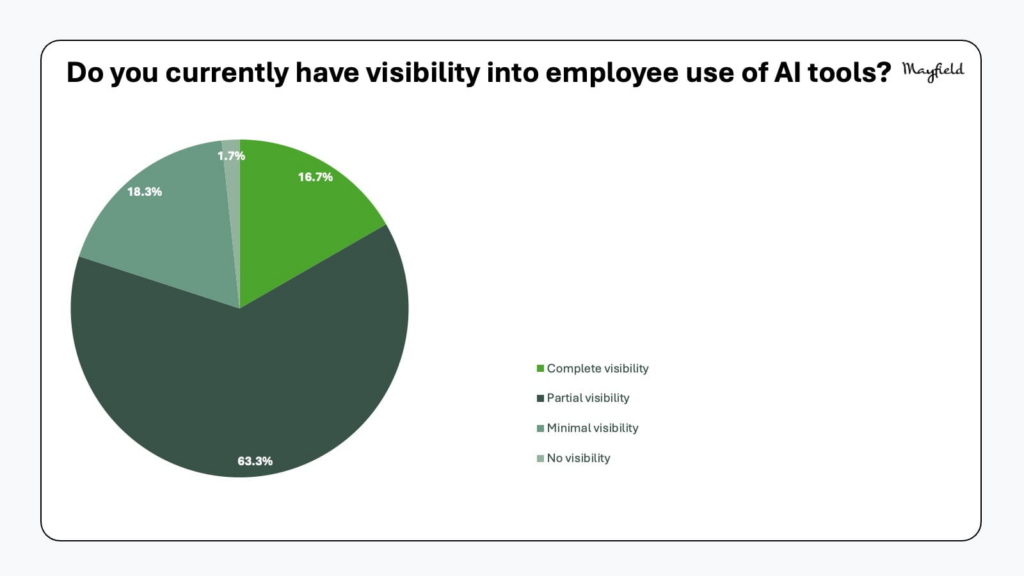
Only 16.7% have complete visibility into how employees are using AI.
Mayfield Takeaway
Complete visibility into enterprise AI use is foundational. CISOs cannot govern agents, tools, identities, and data access they cannot see.
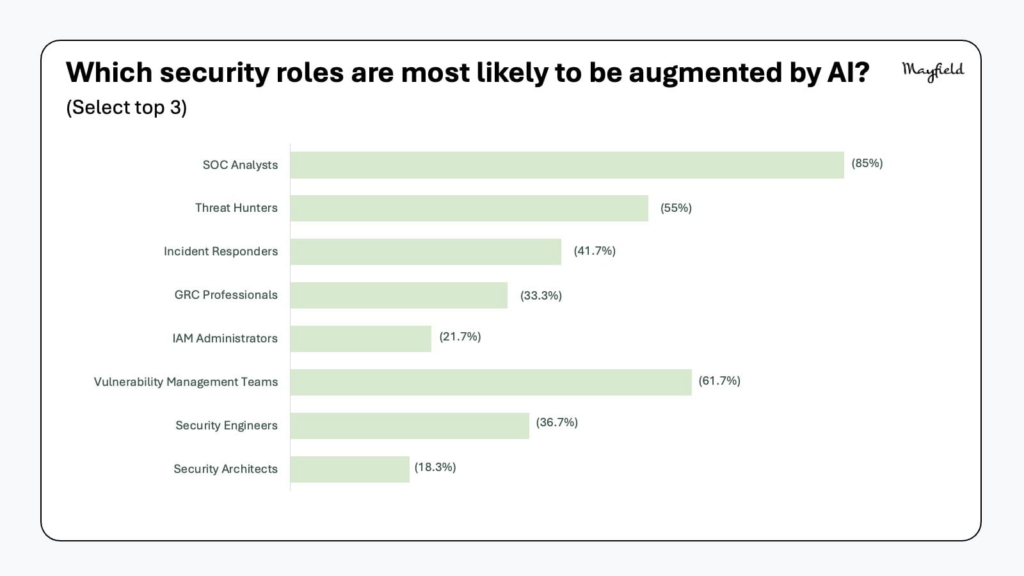
AI is most likely to augment high-volume operational roles first — especially SOC analysis and vulnerability management.
Mayfield Takeaway
The near-term workforce story is augmentation, not elimination. CISOs should redesign roles around judgment, orchestration, exception handling, and accountability as repetitive work shifts to AI.
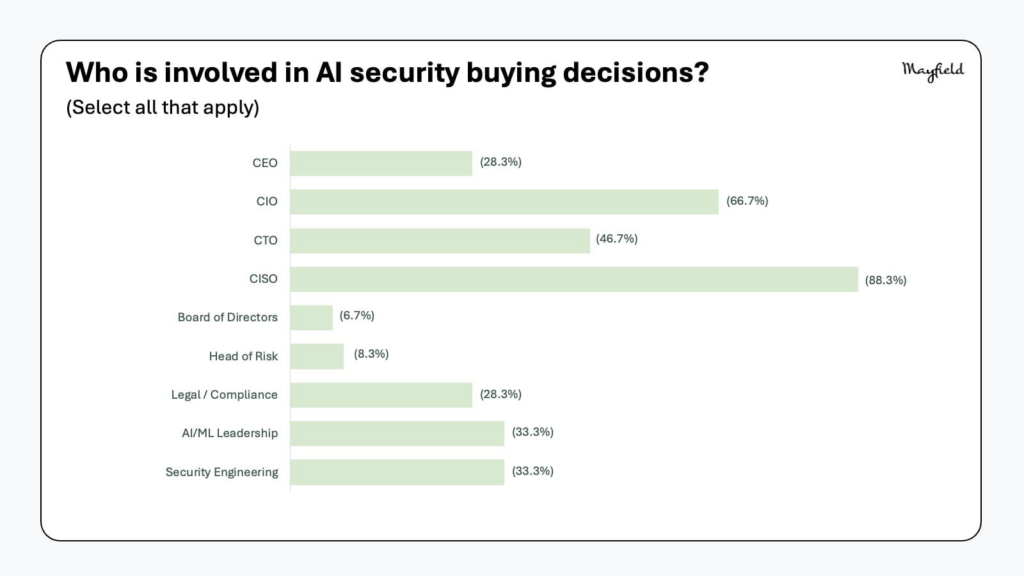
AI security remains a security-led decision, with the CIO and CTO as critical partners and the board largely outside the direct buying process.
Mayfield Takeaway
AI security buying should remain security-led but cross-functional. Establish clear decision rights across the CISO, CIO, CTO, AI and platform teams, and operational leaders before a pilot becomes a platform commitment.
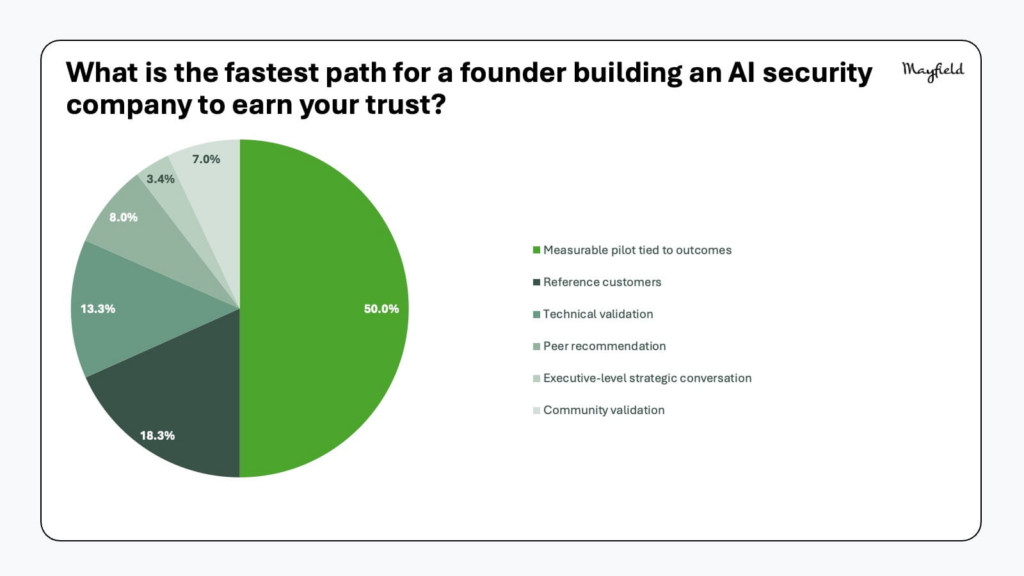
CISOs want to see an AI security product work in their environment, against their risk, with an outcome they can measure.
Mayfield Takeaway
Use measurable pilots to establish trust. Define the security outcome, success criteria, data boundaries, human controls, and evidence required for broader deployment before the evaluation begins.
CISOs agree on the vendors that matter strategically. They do not agree on which vendor is winning AI security.
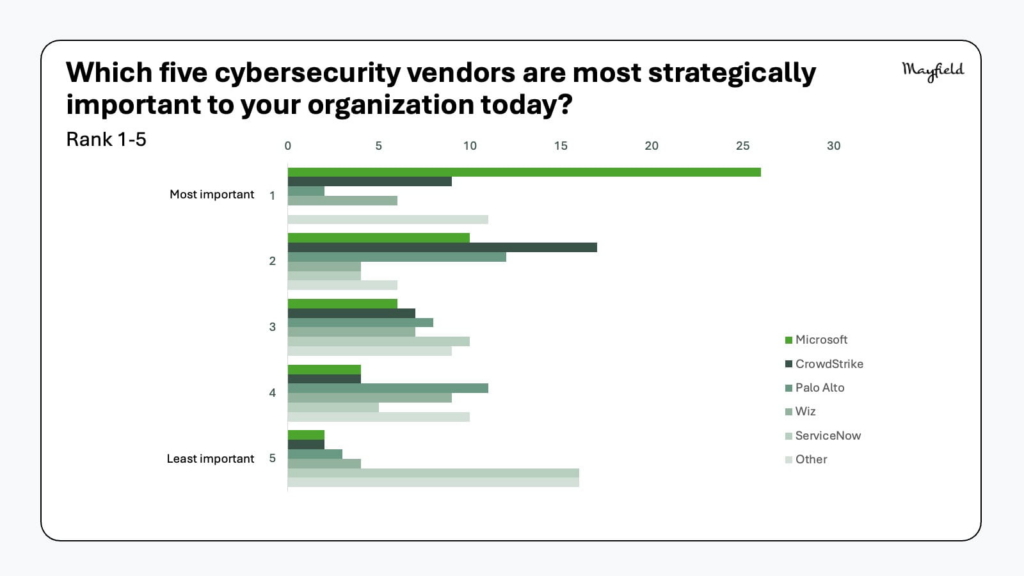
Microsoft, CrowdStrike, and Palo Alto Networks lead the strategic vendor rankings.
AI-capability responses scatter across more than a dozen names, with many respondents saying no clear leader has emerged.
Mayfield Takeaway
The AI leadership landscape remains unsettled. CISOs should reassess vendors based on demonstrated capability—not installed-base strength—and avoid assuming today’s strategic incumbent will become tomorrow’s AI leader.
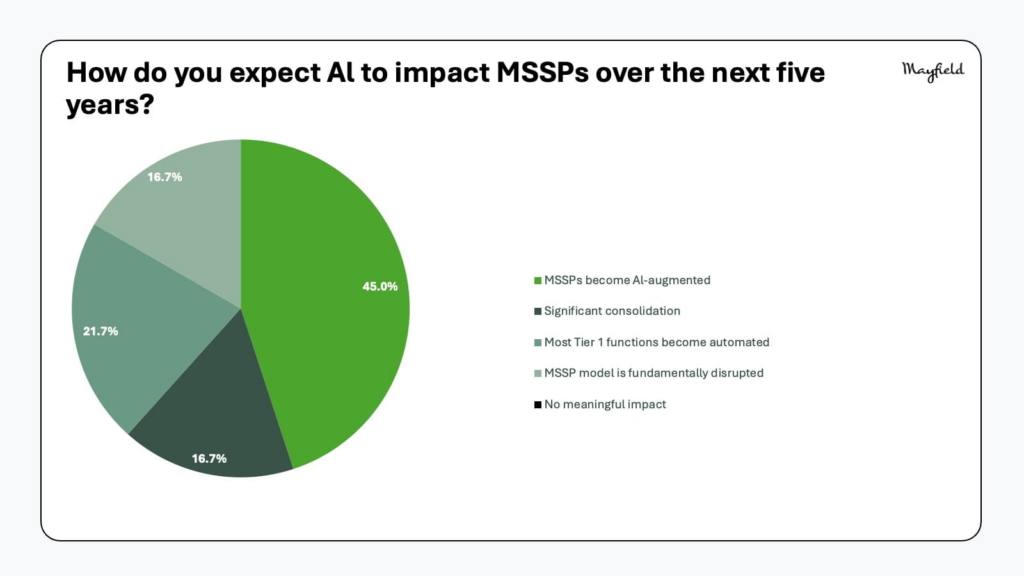
The dominant expectation is that managed security providers become AI-augmented — not that the model vanishes.
Mayfield Takeaway
Plan for MSSPs to become more AI-enabled, not obsolete. Evaluate how providers use AI to improve response, coverage, and analyst leverage while preserving transparency, accountability, and service quality.
CONCLUSION
The 2026 data points to a security landscape with budget, rising urgency, and no settled AI security leader. Yet adoption will move only as fast as vendors can prove efficacy, control, and accountability.
The CISO agenda
What These Findings Mean for Security Founders
ABOUT THE MAYFIELD SECURITY LEADERSHIP NETWORK
Mayfield’s Security Leadership Network brings together more than 1,300 CISOs, Chief Security Officers, and senior security leaders across virtually every major industry. The network is designed for candid peer exchange, early exposure to emerging technology, and direct engagement between experienced practitioners and the founders building the next generation of cybersecurity.
Mayfield surveyed more than 60 security leaders — CISOs, CSOs, deputy CISOs, and heads of security engineering and operations — on how AI is reshaping their organizations, where the risk is coming from, and where the opportunity is emerging. Respondents spanned financial services, cloud and infrastructure, healthcare, government and public sector, enterprise software, and other industries, with no single sector dominating the sample.

Thank you to the CISOs, CSOs, deputy CISOs, security engineering leaders, and operators who shared their perspective. We hope this report helps security leaders benchmark their own agenda — and helps founders understand where enterprise demand is becoming most urgent.
Gamiel Gran

Ten signals reshaping the CISO agenda.
1. Budgets are growing — and shifting
2. AI-generated software is the new attack surface
3. Remediation is the automation prize
4. Trust is the gate
5. Adoption is outrunning governance visibility
6. The security organization is being rewritten
7. The CISO owns the buying motion
8. Pilots beat pitches
9. AI security leadership is still unclaimed
10. MSSPs evolve, not disappear

