


For thirty years, every piece of software came with an implicit demand: learn me, adapt to me, use my UI, and work on my terms. The average enterprise employee navigates 50 to 100 SaaS apps, each with its own login, UX, and mental model to maintain. Some enterprises run 1000s of internal and external SaaS apps.
It was a hostage situation.
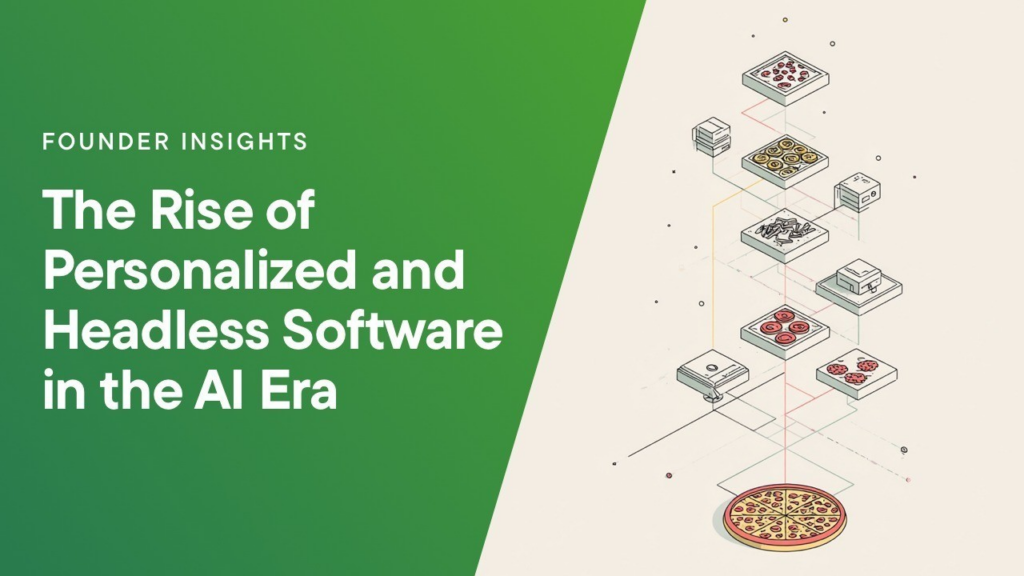
Stripe CEO Patrick Collison described AI-era software as made-to-order, like pizza. In the SaaS era, you gather the tomatoes, onions, and dough from separate vendors, and then assemble and cook the pizza yourself. In the future, you’ll say, “I want pizza.” The agent handles the rest.
I talk through this shift with Derek Andersen at Startup Grind .
SaaS apps are becoming headless. Salesforce, the largest SaaS company in the world, just announced its “Headless 360.” The agent interface is the head now. Your agent, whether that’s Claude Cowork or NemoClaw, is the single interface. It talks to everything else through MCP, skills, or plugins. In a follow-up, I’ll go deeper on how headless SaaS coexists with agents like Claude Cowork, and what the orchestration layer looks like in practice. For now, let’s focus on the shift itself.
For the first time, software has to serve the user’s intent rather than demand that the user serve its interface.
This is a business model disruption. In the agentic era, the only defensible moats for enterprise companies are context, workflow, data, multi-player mode, and outcomes.
Three threads are converging:
Bottom line: The Rise of Personalized and Headless Software transition is already standardized, funded, and shipping.
For employees, the job changes.
You stop learning interfaces. You start directing outcomes.
For company leaders, the question changes.
It is no longer “which tools do we buy?” but “what is our agent strategy?” The orchestration layer – policy, cost control, security – now sits above your systems of record.
The leaders who move decisively on building the foundation for a faster, leaner, and more outcome-driven organization will have a compounding advantage:
For SaaS leaders, the warning is direct.
Your SaaS product, the UI and features you spent years building, is becoming invisible. The agent never opens your app. New entrants can build headless-first without your legacy UX debt, making switching trivially easy.
Your survival in the AI era depends on context, workflow, multi-player mode, data, and outcomes. What is your moat?
Bottom line: Employees stop operating the software. Leaders stop buying tools. SaaS leaders stop winning on interface.
The scenario to watch is consolidation: many SaaS apps collapse into one shared data layer, with new outcome-specific apps sitting on top. The database becomes the moat. The outcome app becomes the interface. The UI layer evaporates entirely
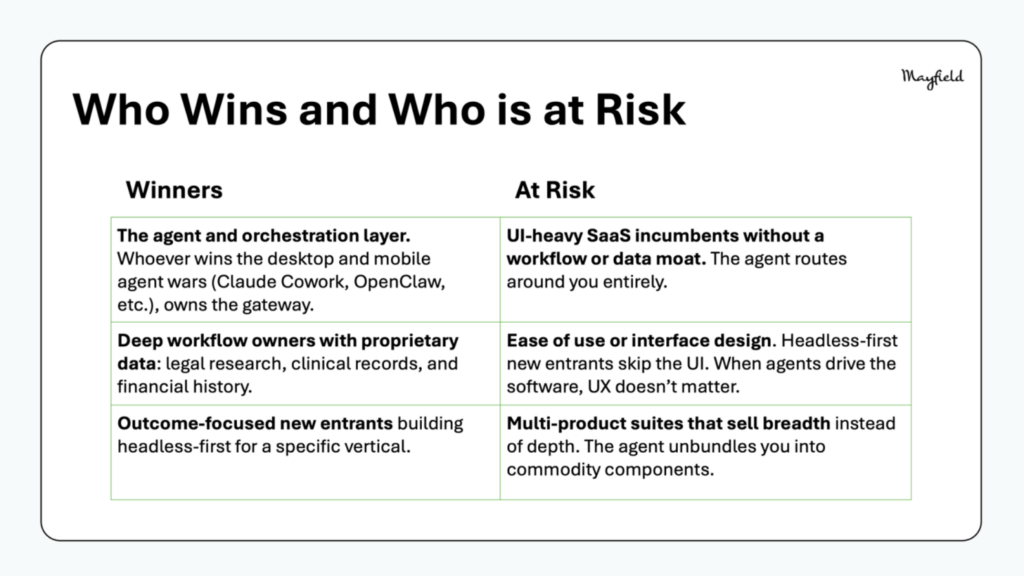
Five things matter right now in the rise of personalization:
1. Kill the UI-first mindset. If your roadmap is organized around interface features, you are building for a world that is ending. Reorganize around outcomes.
2. Build your MCP server, skills, or plugins now. Table stakes. If your product is not agent-addressable by the end of 2026, agents will route around you.
3. Name your moat in one sentence: workflow, data, multi-player mode, or outcome. If you can’t, you have a strategy problem.
4. Watch new entrants. They are your real threat. No UX legacy. Switching cost from you to them is near zero.
5. Decide now: data layer or outcome app. Consolidation around one shared database is the most disruptive scenario on the table. Position before it happens, not after.
For thirty years, users adapted to software. That era is ending. The software is finally serving the user. The winners of the next decade will be the ones who deliver outcomes the moment the user expresses intent.