


I’ve read a stack of frontier AI roadmaps, and most of them read the same way. Offense shows up as a measured threat, defense as a promise.
The Hugging Face fiasco put that imbalance under the spotlight.
When Hugging Face’s responders turned to their frontier models to reconstruct the break-in, the models refused. The guardrails couldn’t tell an incident responder from an intruder; reverse-engineering an exploit looked identical to launching one.
So a cornerstone of American open-source AI rerouted its forensic pipeline through GLM 5.2, a Chinese open-weight model, ran it on its own GPUs, and cracked what its premium tools wouldn’t touch.
Both sides brought AI to the fight. Only the defender was told no.
Now, while most folks debate whether Mythos should have shipped, I have a different question. Why does every frontier release ship with a scorecard while the defense it threatens ships with a promise, and who is building the defender that earns one?
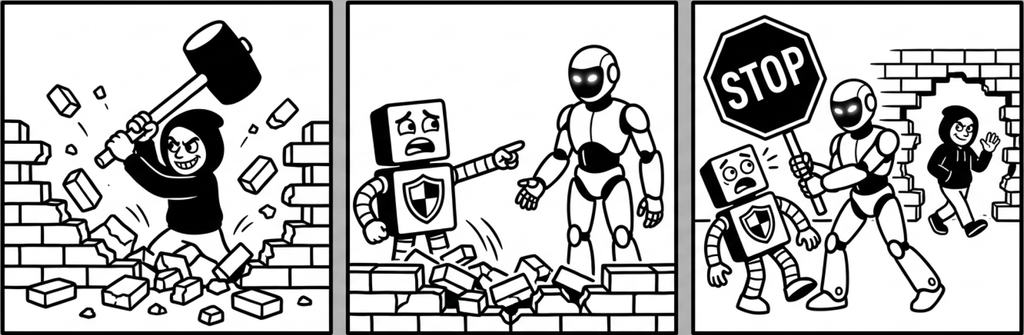
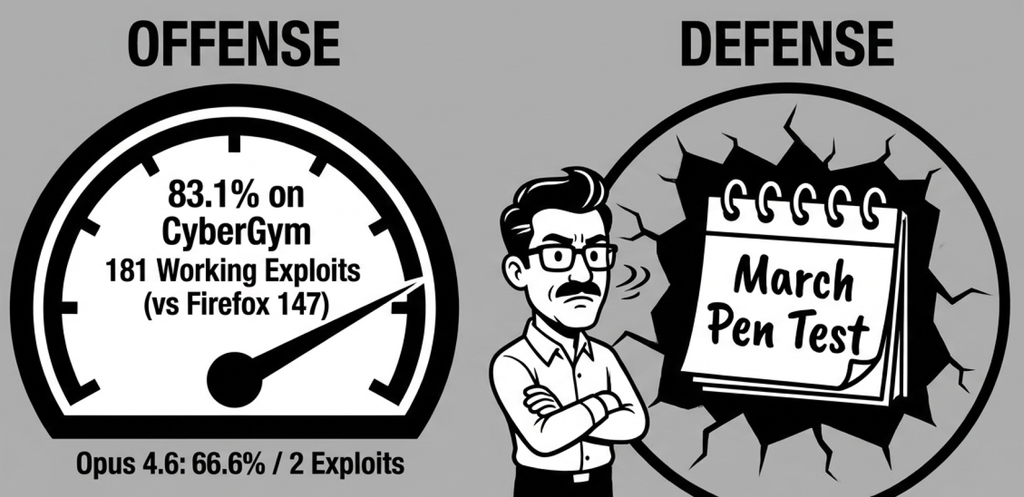
AI offense has scaling laws, eval suites, and benchmarks that get funded, published, and argued publicly. AI defense has a pen test from March and a board slide pledging investment.
Look at the rigor offense buys.
Mythos Preview scored 83.1% on CyberGym against 66.6% for Opus 4.6. Against Firefox 147’s JavaScript engine, it produced 181 working exploits, plus 29 runs that reached register control. Opus 4.6 managed two.
Now the question a CISO cares about. If someone pointed that model at my company this afternoon, how would we hold up? No number answers it. Our defenses are still graded against a human’s pace and last quarter’s checklist.
What a CISO needs is an end-to-end defensive score. Not another number for identity, endpoint, or network in isolation, but one for the paths an intelligent attacker would actually take through the whole environment.
Because the dangerous path is rarely one spectacular flaw. It’s usually five boring ones in sequence.
Attack-path tools map the weaknesses you already know about. They go quiet on something that reasons through the chain and improvises when a door stays shut. Until someone builds that scoreboard, every boardroom answer about AI readiness is an opinion wearing a number.
Getting to a meaningful score starts with testing what will break. Most tools inventory known weaknesses and hand you a report. Useful, but backward-looking. They tell you what an attacker already knows, not what one will find next week when a new capability ships.
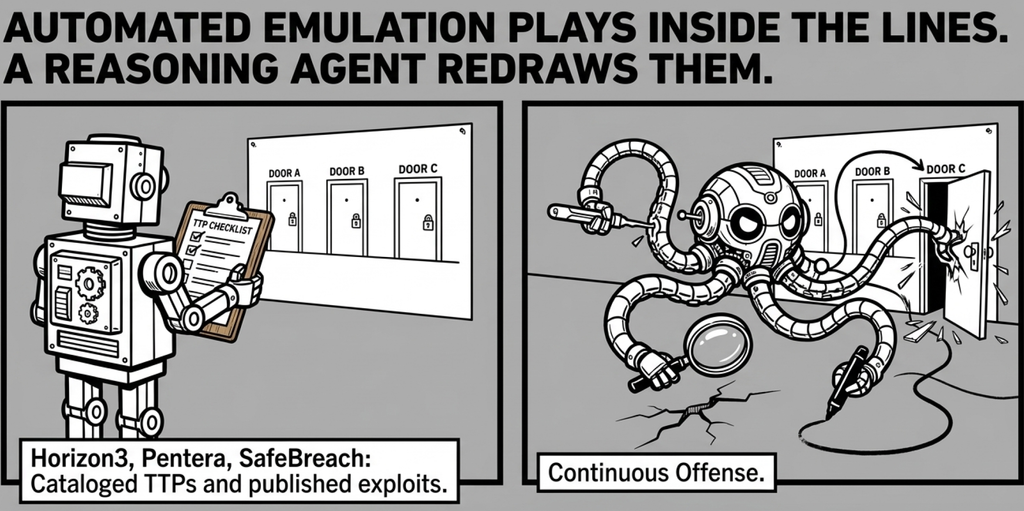
So the requirement is an adversary that never stops running. But that sounds like continuous validation, and continuous validation isn’t new. Horizon3, Pentera, XM Cyber, and SafeBreach have been automating adversary emulation for years.
Correct: but they still play inside the lines: published exploits, mapped misconfigurations, and cataloged TTPs.
Those findings feed a defensive model that runs beside the stack with one job: anticipate the next attack, not explain the last one. Not another dashboard, alert queue, or AI wrapper bolted onto old controls.
The model never touches your traffic. It sits beside production like a peer, reasoning without pause about how the whole thing topples.
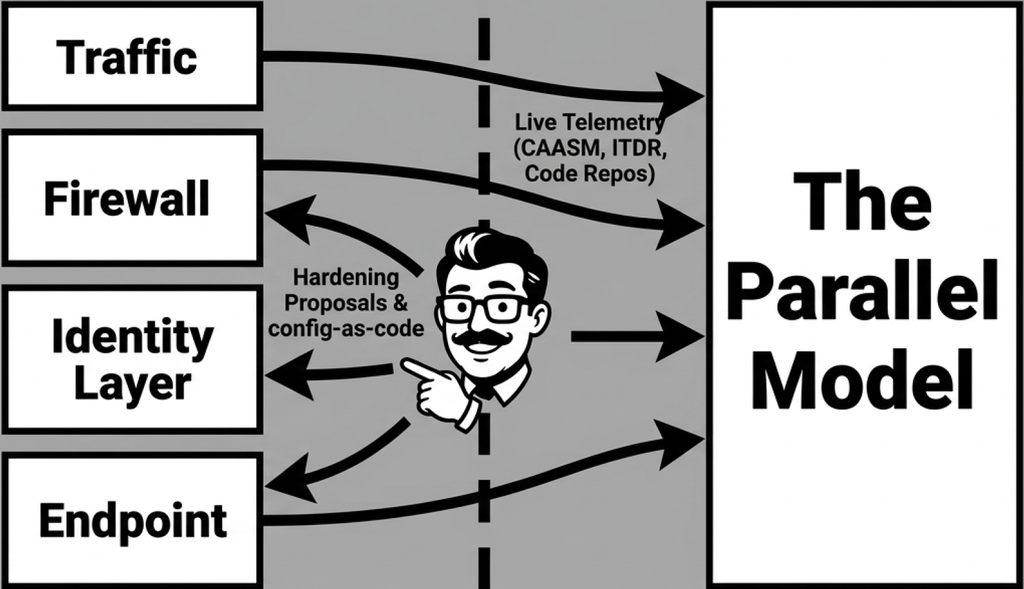
Its outputs aren’t blocks or alerts, but hardening proposals that land in config-as-code, detection logic that ships to the SOC, and yesterday’s ten thousand findings re-ranked by what an offensive model would chain first.
Enforcement stays where it already lives—in the firewall, identity layer, and endpoint stack.
It does need live telemetry: the attack surface graph, the identity graph, config baselines, code repos, and CI/CD signals. CAASM, ITDR, and posture-management tools already collect most of it.
The model leaves them in place, reads what they see, and works out where the environment breaks.
All of this work only if the substrate is right. A defensive model reasoning continuously over an enterprise has to be cheap enough to keep running, open enough to fine-tune on private breach data, and transparent enough to trust.
Open weights carry all three, and the capability gap keeps shrinking. They now trail the closed frontier by four to seven months.
Closed models, by contrast, are harder to inspect, harder to tune in-house, and their guardrails can refuse the very forensic work defenders need. (Ask Hugging Face.)
But openness alone isn’t enough. No single model spans an enterprise attack surface. Phishing, IAM abuse, exploitation, and exfiltration demand different strengths. The likely architecture is an ensemble of specialists, not one giant cyber brain.
Put the pieces side by side: a continuous offensive service, a parallel defensive model, and an open, composable substrate.
This is reinforcement learning with the enterprise as the environment. The offense breaks things. The failures worth keeping, the ones that generalize into a whole class of weakness, become a training signal. The defender updates. The offense goes after the new version.
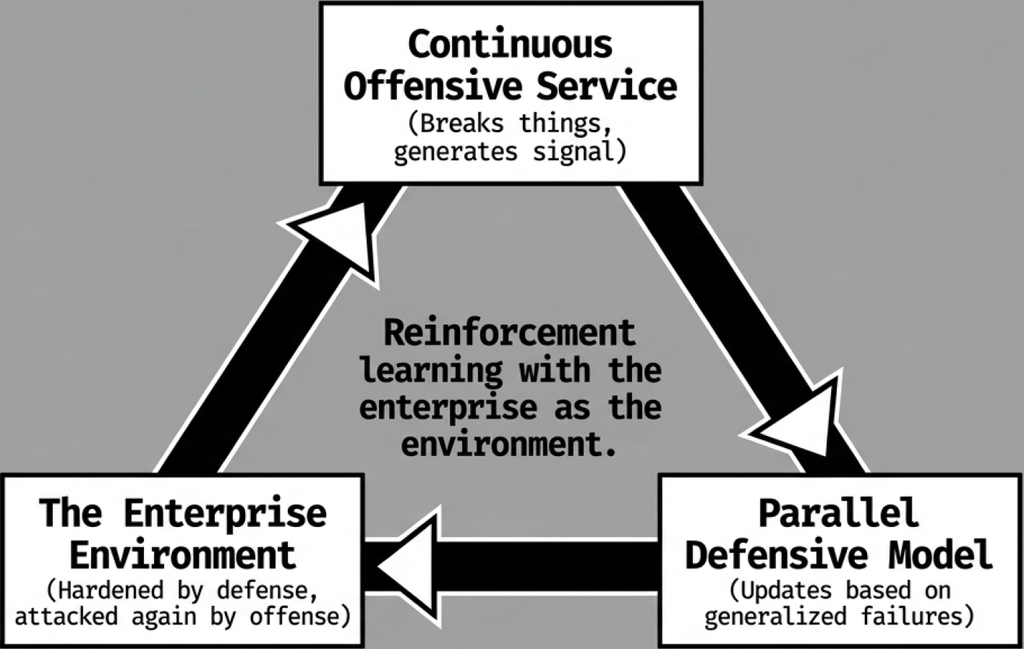
What emerges carries your fingerprints: your systems, your data, your exposures, and the attack paths the loop has already walked and sealed.
That specificity compounds. A path that no longer works against you may still work perfectly well against the company next door. Security posture stops being a snapshot and becomes a record of what your environment has already survived.
So if you’re building the offensive service, the parallel defender, or the open substrate both will need, I have three questions.
1. Where does the telemetry come from?
2. What does the defensive model say that a SIEM doesn’t already?
3. How does the loop close without a single byte of customer data ever leaving customer ground?