


Venture activity reached record levels in the first half of 2026. Investors deployed $412.7 billion across 9,646 deals, nearly 30% more than they deployed in all of 2025. But megadeals, defined as rounds of $100 million or more, took 87.5% of all venture dollars.
For founders who are just getting started, a different number matters more: 5,674. That is the estimated number of companies that raised their first venture round during the first six months of the year. At the current pace, more than 11,000 companies will raise their first financing in 2026, setting a record.
AI is lowering the cost of building companies, speeding up product development, and giving small teams capabilities that once required far more capital and headcount.
Investors remain selective, but they are still backing new ideas and new founders. If you have been waiting for the right moment to start, the PitchBook National Venture Capital Association (NVCA) Venture Monitor data says it is now.
AI companies raised $354.9 billion in the first half of 2026. That represented 86% of every venture dollar, up from 65.5% in 2025. This is not a cycle cresting. It is a structural shift that is speeding up.
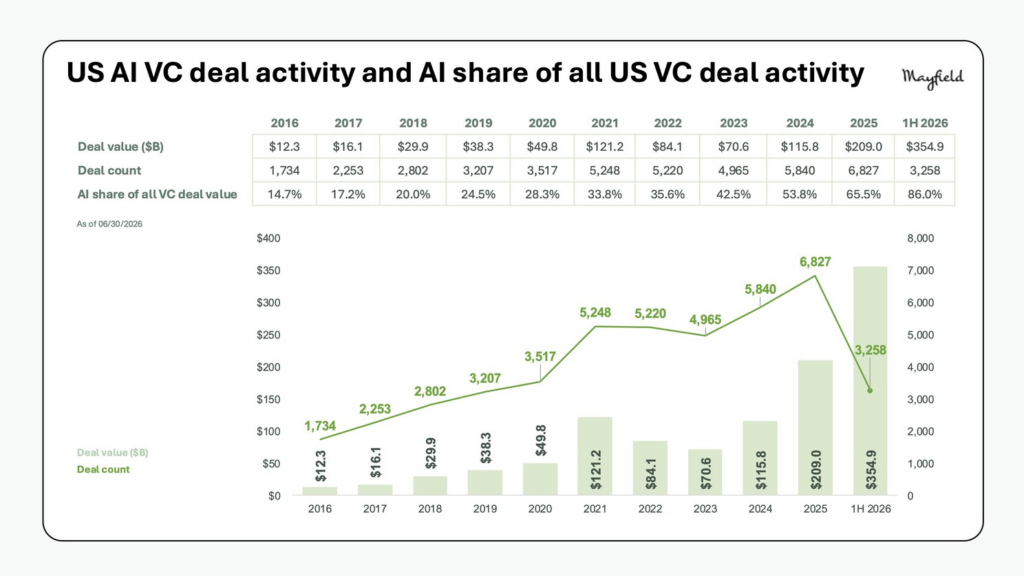
The mechanics matter more than the market share. AI is democratizing entrepreneurship with coding tools that help founders build and improve products faster. Existing foundation models let founders focus on the product and customer problem rather than building the underlying model themselves. As a result, a small team can test an idea with less time, money, and technical support than ever before.
This change can expand the founder pool. Domain experts, operators, designers, researchers, and industry insiders can now turn their knowledge into working products more directly. A large engineering team no longer has to come first.
At the Series D and later stages, the median pre-money valuation for an AI company reached $4.25 billion. For a non-AI company, the median was $644 million. That is a 6.6x premium.
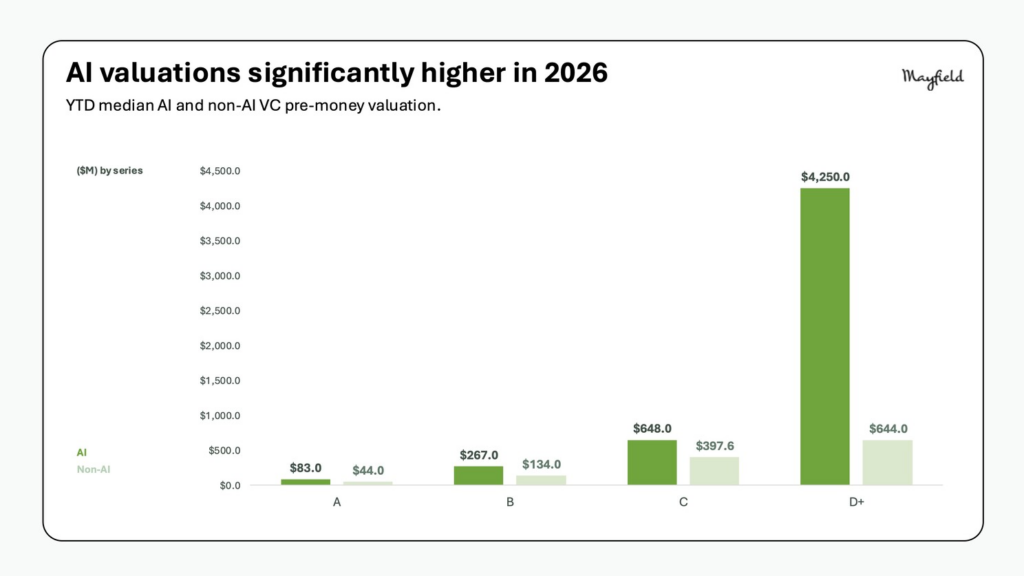
The largest rounds and valuations show how much capital has moved toward AI.
Bottom line for founders: Use AI to move quickly from insight to working product. Get the product in front of customers early. Learn what they will use and pay for before building a large team.
An estimated 5,674 companies raised a first venture round in the first half of 2026. At the current pace, the annual total could exceed 11,000 for the first time.
First-financing deal value reached $22.1 billion in six months, slightly ahead of the pace set by the $40.9 billion invested during all of 2025.
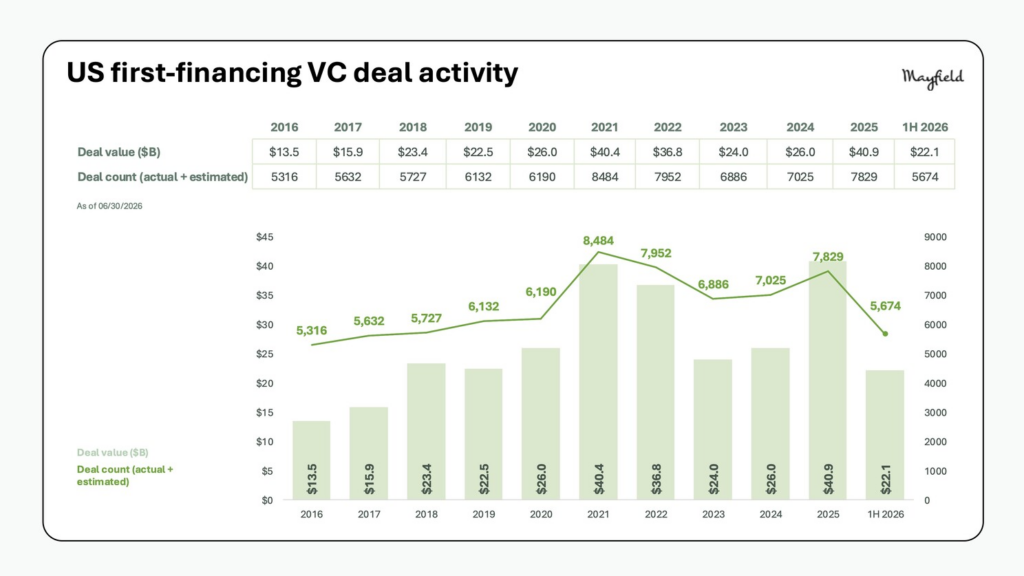
This creates a strong opening for founders with a clear AI thesis and a credible team. Early-stage investors are backing AI-native companies, and some are working with founders from the idea stage.
Bottom line for founders: More companies are getting a first venture check today than at any point in the past decade, but the venture market becomes more selective as companies grow – so plan for that shift from the beginning.
Venture firms raised $72.4 billion across 405 funds during the first half of 2026, nearly matching the $74.9 billion raised in all of 2025, but across far fewer funds. Aggregate capital held up. The number of firms able to raise funds is shrinking.
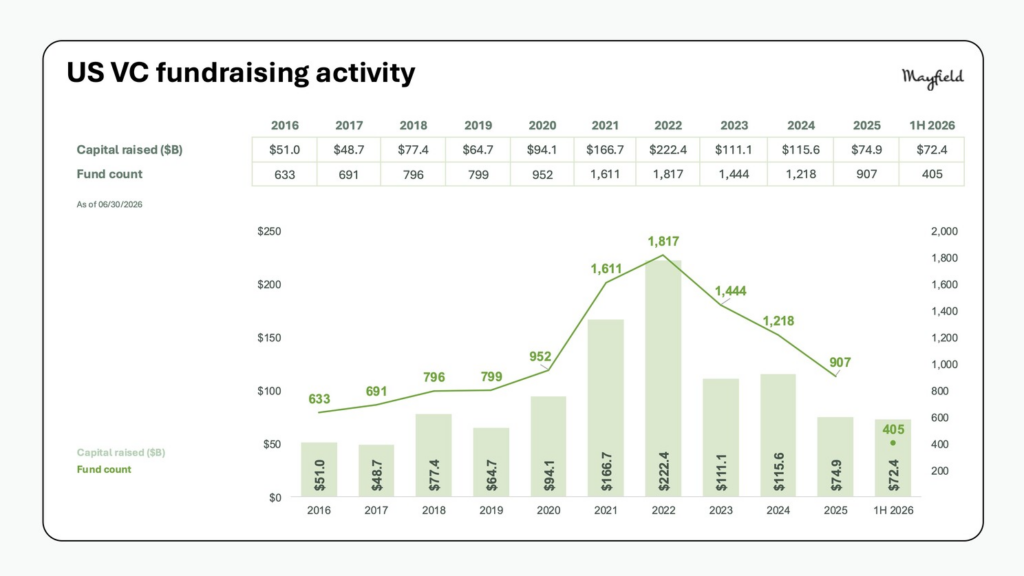
The root cause is the distribution drought. LPs have received little cash back from existing commitments, so they are concentrating their re-ups on proven managers. LP dollars are still flowing, but to fewer and fewer managers.
Established firms raised $64.5B while emerging firms raised just $7.9B — giving experienced managers 89% of all capital, the highest share in a decade.
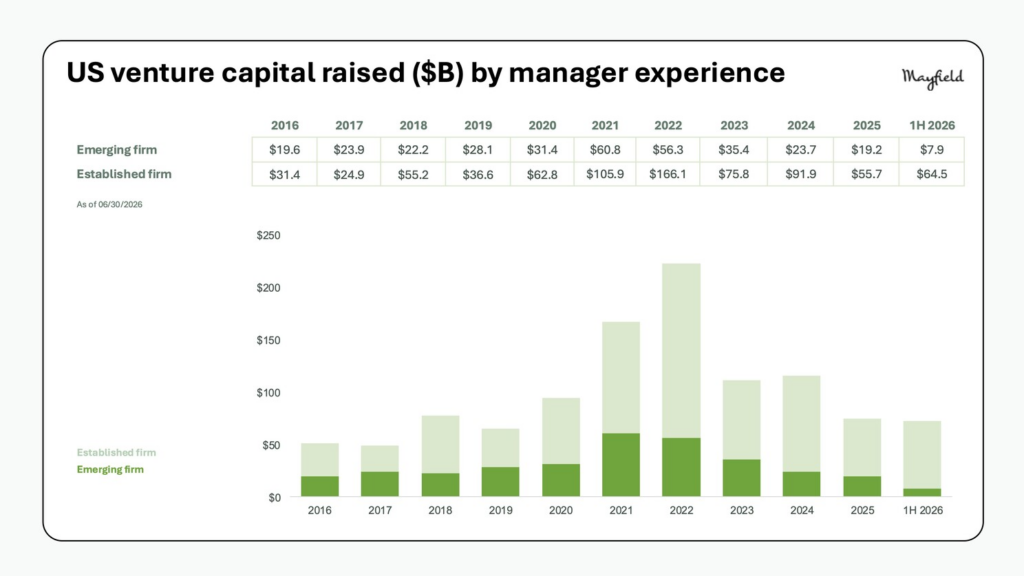
A venture firm’s ability to write the first check matters. Its ability to support a company through later rounds matters just as much. Founders should understand the firm’s fund size, reserves, remaining capital, investment pace, and ability to raise its next fund.
Bottom line for founders: Fund fit is now a diligence item, not a formality. Choose a venture firm with standing power and the right fund model for your company.
AI tools will help more people build companies. They will also create more competition.
Access to the same foundation models will not give a company a lasting advantage. Competitors can use the same tools, build similar features, and move just as quickly.
A durable advantage may come from proprietary data, a unique workflow, strong technical architecture, trusted distribution, innovative business model, deep domain knowledge, or the ability to learn faster from customers.
The market will reward founders who use capital with discipline. Build efficiently. Prove customer demand. Raise money when the company has reached a clear milestone that increases its value.
Founders should also choose investors whose fund models fit the company’s needs. A firm’s ability to finance later rounds and reserves can shape the relationship long after the first investment.
Bottom line for founders: Capital remains available, but it becomes more selective after the first financing. Show early demand and a credible path to category leadership.
In the first half of 2026, the San Francisco Bay Area captured $319.4 billion in deal value, roughly 77% of all US venture dollars. Since the start of 2025, investors have put $492 billion into San Francisco Bay Area companies alone. New York took 6% while Los Angeles and Boston each captured 3%.
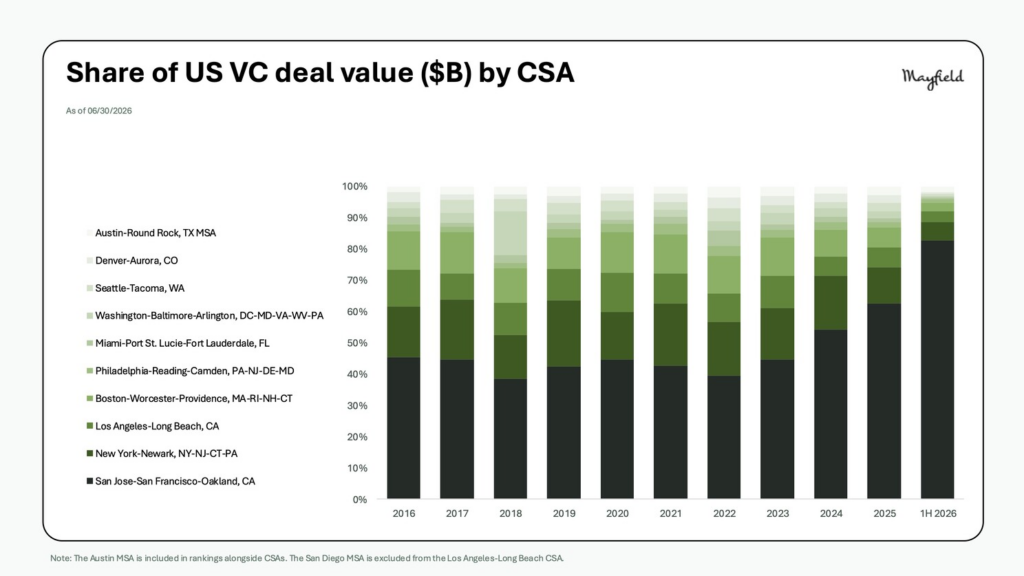
AI talent remains scarce and concentrated on the West Coast. The Bay Area’s dense network makes it easier for founders to meet co-founders, employees, customers, technical peers, and investors. Those relationships help teams hire, learn, and move faster.
Bottom line for founders: You can build anywhere, but you cannot build in isolation. Treat network density as a competitive advantage.
Venture-backed exit value reached $2.18 trillion across 874 exits in the first half of 2026. In all of 2025, exit value totaled $284.1 billion across 1,578 exits.
In June 2026, SpaceX went public at a $1.7 trillion valuation and raised roughly $75 billion, becoming the largest IPO of all time and the largest US VC-backed tech IPO by 17x. Its $250 billion acquisition of xAI in February 2026 was the largest acquisition ever of a VC-backed private company.
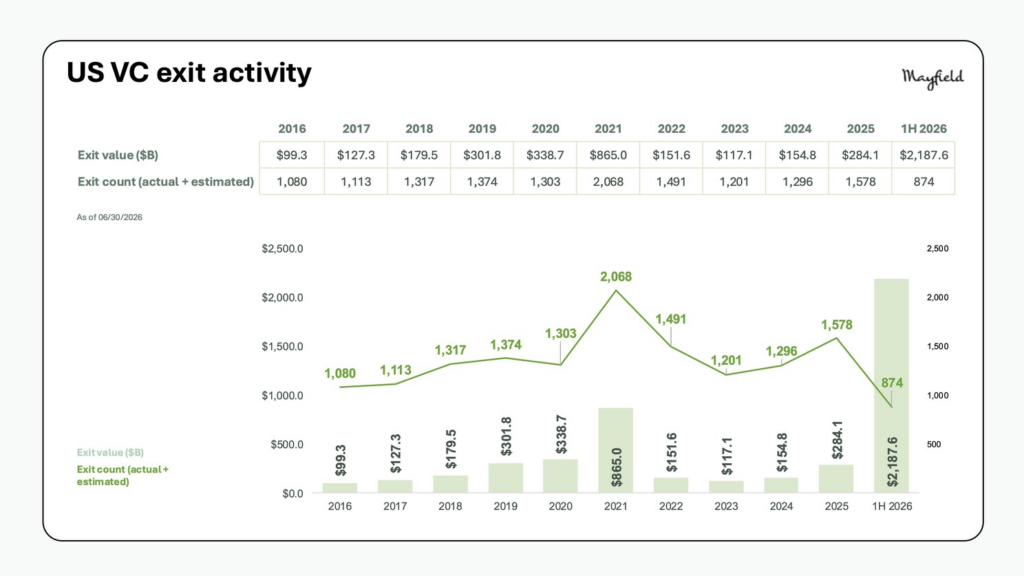
Even without the SpaceX IPO and xAI transaction, first-half exit value would have reached about $237.6 billion. That is already 84% of the $284.1 billion recorded during all of 2025. If that pace continues, the adjusted 2026 exit value would reach roughly $475 billion.
SpaceX also announced a $60 billion acquisition of Cursor. If it closes in Q3 2026, it would become the second-largest acquisition of a venture-backed company.
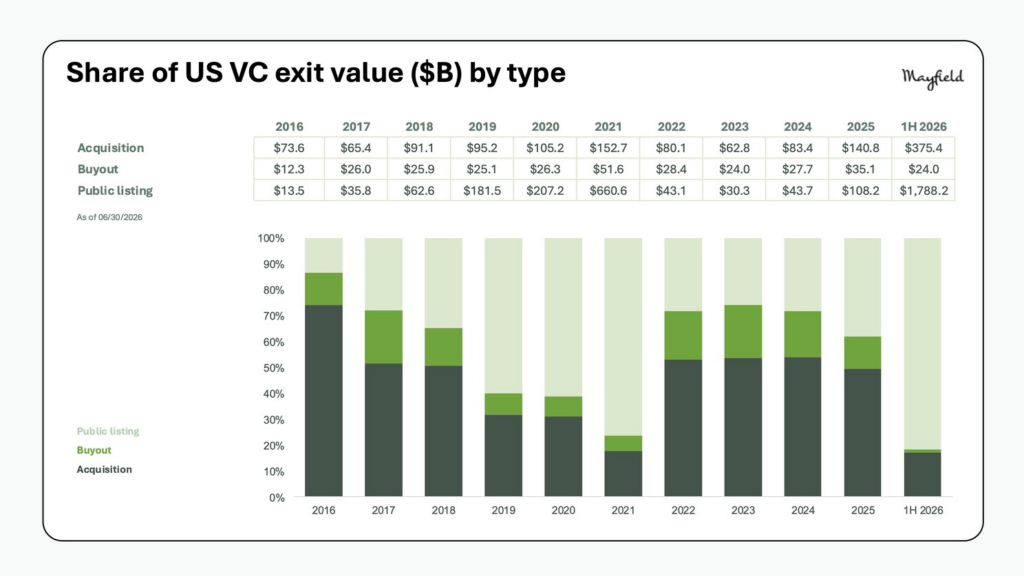
The IPO window has started to open, but only for a small number of companies.
There are still positive signs. Large exits return capital to investors and bring experienced operators and serial founders back into the startup market. They can help finance and build the next generation of companies.
Bottom line for founders: Build a durable company with several possible outcomes: independence, acquisition, or a public listing. Treat the improving exit market as a positive signal, but stay focused on the long-term plan.
Record venture investment, AI funding, San Francisco Bay Area deal concentration, and exit value all point to the same conclusion: capital is plentiful but highly concentrated.
That concentration has not slowed the wave of new startups in the ecosystem. Thousands of companies are raising their first venture rounds. AI is cutting the cost of turning an insight into a product. It is also expanding the range of people who can become founders.
AI has lowered the cost of starting a company and raised the standard for winning.
The companies that break through will solve problems customers cannot ignore. They will build advantages competitors cannot copy, attract exceptional people, and choose investors who can support them from inception through scale.
If you have a clear insight and the drive to move fast, this is one of the best moments in the AI era. It’s still early in the AI supercycle. The companies that will lead the next decade are being founded now.