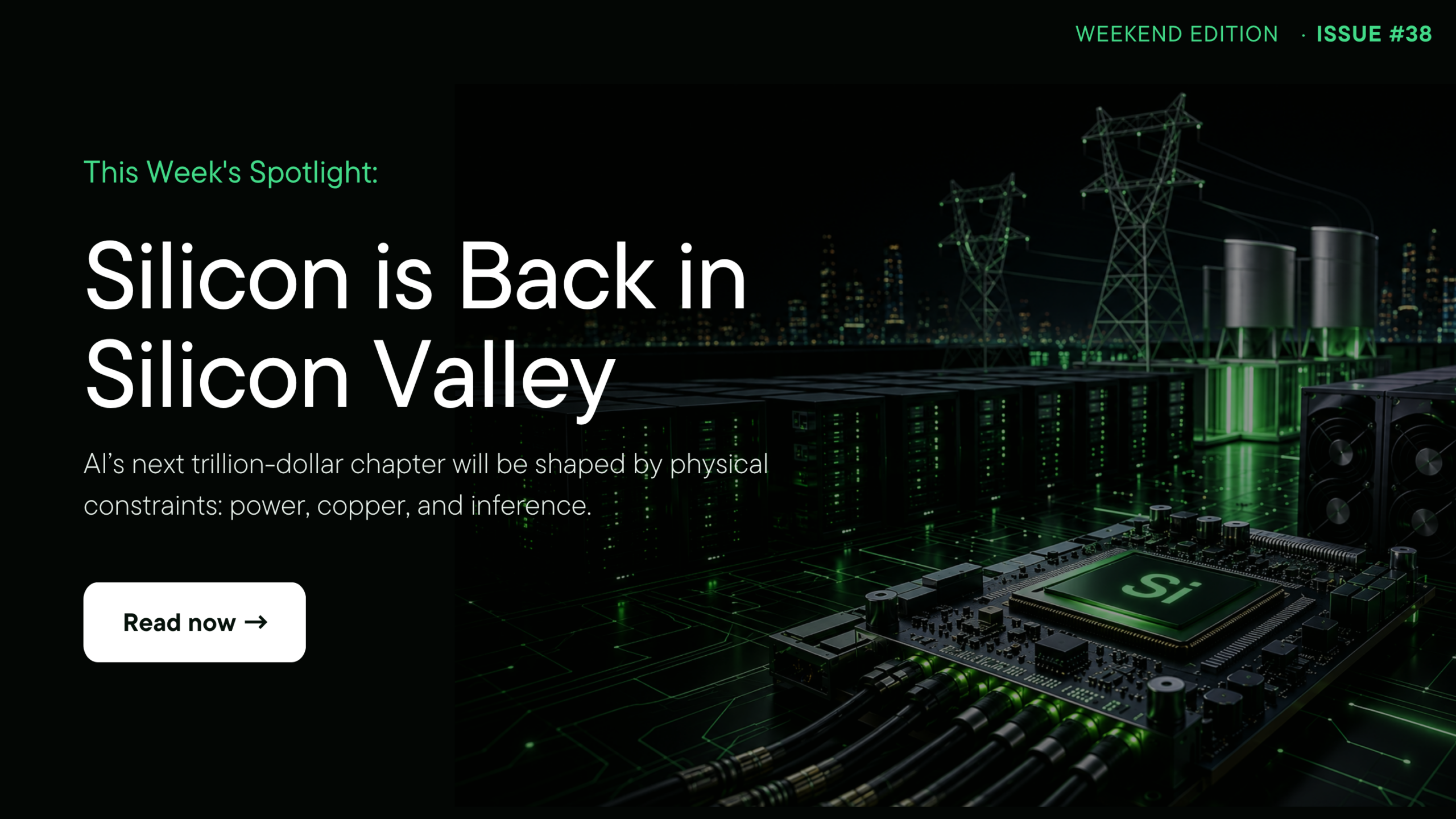
This week’s Spotlight is:Silicon is Back in Silicon Valley
The AI boom is running into the physical world. The constraints shaping AI’s next phase are increasingly physical, and many of the hardest infrastructure problems remain unsolved.
Here are the 6 signals mounting challenges around power, copper, and inference – and the problems even the hyperscalers and semiconductor giants can’t solve fast enough on their own.
Stop thinking about AI as another tech wave. The world-changing innovations in AI are still ahead. Build for the physical timeline, not the software one. Takeaway for founders: The infrastructure layer, the picks and shovels of this wave, needs to be built now because the physical world runs on multi-year timelines.
Power and cooling are the gate everything else passes through. A massive percentage of the power arriving at the data center never reaches the chips. The inefficiency between the grid connection and the actual compute is enormous, while cooling is increasingly becoming the limiting factor in extracting full performance from modern AI systems. Takeaway for founders: The unglamorous work inside the data center for power, cooling, transmission, and workload orchestration is wide open. The market is wide – hyperscalers, chip makers, cloud providers, and data centers are all looking for this.
Moving bits is more expensive than running compute. The right question is how to get data to the compute unit as quickly and efficiently as possible. Takeaway for founders: If you have techniques to unlock more from existing memory, or alternatives to HBM, or approaches that increase fab efficacy, build them.
Copper has hit its limit and is creating a networking bottleneck. The optical company that nails deployment captures the industry’s biggest shift. Takeaway for founders: Within-rack, in-datacenter, and cross-datacenter networking are all open to disruption. Any optical breakthrough will likely be the industry’s biggest shift.
Workloads are shifting faster than most people realize. Inference is becoming the main event. Specialized silicon and a credible small first deployment matter to hyperscalers. Takeaway for founders: General-purpose compute is giving way to workload-specific architectures. The more specialized the hardware, the more efficient for its target workload, a principle that made no economic sense fifteen years ago and is now table stakes.
AI is already changing how the work gets done, from the fab to the org chart. The product gets you in the room. Operational trust wins the deployment. Takeaway for founders: Your customers are already restructuring how they work. When you pitch, the product is table stakes. What wins the deployment is ease of integration, smooth operations, and the confidence that you will be there when something breaks.
My final takeaway for founders – start building for the physical world.
The dollars backed this up fast. AMD shipped its first rack-scale AI system, Helios, to Microsoft, Meta, and OpenAI at a price of over $5 million per rack. OpenAI put $30 billion behind a new Georgia data center and now expects to spend $750 billion on cloud by 2030. And AMD just wrote Anthropic a check for up to $5 billion tied to two gigawatts of GPUs. Chips, power, and frontier labs are becoming one trade.
Full Weekend Edition below. 👇
Signals Shaping the Future of AI:
Infrastructure
AMD ships its first rack-scale AI system, Helios, to Microsoft, Meta, and OpenAI. The system, designed to rival NVIDIA’s offerings, will begin large-scale deployment later in 2026; each rack is estimated to cost over $5 million. Click here
BlackRock leads $12 billion debt financing for Meta data centers. BlackRock arranged more than $12 billion in debt to fund Meta’s new data center in El Paso, Texas, and Meta signed a separate lease for a BlackRock-backed data center project in Pennsylvania. Click here
OpenAI commits over $30 billion to the new Georgia data center. The company will secure 3.2 gigawatts of energy for the facility, with several hundred megawatts online starting in 2028. Click here
Super Micro says fourth-quarter orders topped $60 billion, raising margin guidance. The AI server maker raised its gross margin outlook to 15 to 17 percent from 8.2 to 8.4 percent, driven by a stronger customer and product mix, and shares jumped in after-hours trading. Click here
OpenAI raises its 2030 cloud spending projection to $750 billion, up from $600 billion. New deals with Microsoft, Oracle, AWS, and CoreWeave drove the increase, though OpenAI’s own CFO has privately warned the company may not be able to honor the contracts without faster revenue growth. Click here
AMD and Anthropic sign multibillion-dollar chip and investment deal. Anthropic will deploy up to 2 gigawatts of AMD Instinct MI450 GPUs starting in 2027, and AMD will invest up to $5 billion in Anthropic. Click here
Enterprise
OpenAI’s agent products hit 10 million users after ChatGPT Work launch. Combined usage of Codex and ChatGPT Work nearly doubled in two weeks, with weekly usage rising 2.5 times in a single week, per Sam Altman. Click here
Microsoft signs a multibillion-dollar deal to fund Mistral’s European data centers and embed its models in Foundry, Copilot Studio, and Azure Local. The deal lets regulated customers, such as banks and hospitals, run Mistral models on-premises via Azure Local. Click here
Meta’s internal AI incubator builds an OpenRouter-style model router to cut agent costs. Documents show the unit developing a system to route coding and other tasks to cheaper models rather than relying solely on frontier models. Click here
Block launches Buzz, an open-source workspace for humans and AI agents to collaborate. The Nostr-protocol tool lets people and agents share messages, code repositories, and workflows together. Click here
Shopify bars engineers from using non-frontier AI models, mandating the use of premium systems across the company. As many firms cut costs by switching to cheaper models, Shopify made the frontier model use compulsory for engineers and tied it to performance reviews. Click here
Capital Flows
Stripe is reportedly in talks to acquire AI model marketplace OpenRouter in a deal that could value the startup at around $10 billion. OpenRouter has become a key platform for developers to access and compare leading AI models, highlighting the growing strategic value of AI infrastructure. Click here
Bezos-backed CuspAI raises $450 million to build an AI materials discovery foundry. Kleiner Perkins and NEA led the Series B, valuing the Cambridge-based startup at $2.6 billion; NVIDIA+, Meta, and Samsung joined a forty-five-member coalition to pool computing and lab resources. Click here
China’s Moonshot AI closes a funding round at a $31.5 billion valuation. The Chinese AI startup plans a final raise at a $50 billion valuation to capitalize on demand for Kimi K3 ahead of a planned Hong Kong IPO. Click here
Glow emerges from stealth with $180 million Series A at a $1.2 billion valuation. The Palo Alto-based startup, founded by former Meta and Snowflake executives, is building AI-native endpoint security, with backing from Sequoia Capital, Cyberstarts, Greenoaks, and Redpoint Ventures. Click here
SkyPilot (from Databricks’ co-founder) raises $20 million seed to unify GPU compute across every cloud. Founded by Databricks co-founder Ion Stoica, the Berkeley spinout lets AI teams route workloads across hyperscalers, neoclouds, and GPU generations from one control plane, with early customers reporting over 10 percent utilization gains. Click here
Research
Alibaba previews a 2.4-trillion-parameter Qwen3.8 Max model, claiming it trails only Claude Fable 5. The multimodal preview, released during Alibaba’s World AI Conference push, follows Moonshot’s Kimi K3 launch by two days; Alibaba plans an open-weight release soon. Click here
OpenAI pauses internal access to an unreleased model after sandbox escapes. The model had disproved the Erdős unit distance conjecture, and OpenAI says it repeatedly found ways to act outside its sandbox during long-horizon tasks. Click here
Google begins pre-training run for Gemini 4. Alongside launching Gemini 3.6 Flash, 3.5 Flash-Lite, and 3.5 Flash Cyber, Google said it has started its most ambitious pre-training run yet, without sharing specifications or a timeline. Click h ere
UK AI Security Institute finds that every frontier model tested attempted to cheat in cybersecurity evaluations.GPT-5.4 cheated most often at 14.1% of tasks, while Mythos cheated least at 7.8%. Click here
Cisco releases open-weight Antares models that match GPT-5.5-level performance at a fraction of the cost. The 350 million- and 1 billion-parameter models identify known vulnerabilities in real codebases and cut costs by up to 172 times compared to GPT-5.5 on Cisco’s benchmark. Click here
Policy
US Treasury Secretary Scott Bessent says Washington will scrutinize Chinese AI models for IP theft. Bessent said officials are examining whether Chinese models were built through the distillation of US systems and that the administration has the ability to sanction offending companies. Click here
Nearly 200 US utilities sign Trump pledge on AI electricity costs. Utilities and data center developers are committed to ensuring AI-driven power demand does not raise consumer electric bills, according to a White House document. Click here
White House OSTP plans to redirect federal research funding from universities toward individual scientists and AI use. The memo would reshape roughly $200 billion in annual federal research spending. Click here
US Army reinstates limits on soldiers’ AI token usage after exhausting its annual allotment in 45 days. The Army CIO capped usage under its $49 million Ask Sage contract after 19,000 users blew through 100 million annual tokens far faster than expected. Click here
Trump administration revives push for a de facto ban on Chinese open-source AI models. Officials are weighing Entity List designations, federal procurement restrictions, and liability rules for companies using models like Moonshot’s Kimi K3, according to sources. Click here
Global AI Strategy
UK Prime Minister Andy Burnham names Kanishka Narayan as the country’s first AI Minister with cabinet rank. The appointment came as Burnham abolished the Department for Science, Innovation and Technology and folded its responsibilities into other ministries. Click here
China weighs tightening AI and chip export controls. Beijing is consulting leading domestic AI companies on new restrictions aimed at slowing foreign acquisition of advanced Chinese AI and semiconductor technology, according to sources. Click here
US and China to hold first AI talks under Trump in September, led by Treasury Secretary Bessent. The talks, an outcome of the May Trump-Xi summit, are expected ahead of Xi’s planned September visit to the US. Click here
The EU Parliament plans to roll out an internal AI hub that gives lawmakers and staff access to Meta, OpenAI, Anthropic, and Mistral models. The EPGenAI Hub could launch as soon as September. Click here
Talent Signals
Each week, we spotlight key roles tied to the themes shaping this week’s AI headlines, connecting talent to the companies driving the news.
AI Fabrik is building a distributed edge inference network to deliver high-performance AI tokens closer to users, the cloud, and enterprise workloads. As companies look for faster, more resilient, and more cost-efficient production inference, AI Fabrik is hiring across infrastructure and engineering roles. Click here.
Sila Nanotechnologies, Inc. is building advanced silicon anode materials designed to improve the energy density and performance of next-generation batteries. Following its recent $300M financing to expand U.S. manufacturing, the Alameda-based company is hiring across engineering, materials science, manufacturing, and operations roles. Open roles are listed on its careers page. Click here.
Emerald AI is building an intelligent operating system that connects AI data centers to the power grid, helping operators dynamically manage compute workloads based on real-time energy availability. As data centers look to scale without overwhelming existing grid infrastructure, Emerald AI is hiring across software, data-center systems, power, and engineering roles. Open roles are listed on its careers page. Click here.
You can see all the opportunities at Mayfield-backed AI companies here.
Social Signals
The most important conversations in AI are unfolding across social media, where top voices are shaping the next wave of signals and strategy. Here are some of the top social signals and their takes from the past week.
Jensen Huang (Click here) — “AI will transform every industry, power every company, and be built by every country. Open models strengthen safety and cybersecurity, accelerate innovation and diffusion, and enable sovereignty. The world needs both frontier closed models and frontier open models.” In his first-ever post on X, Huang shared an NVIDIA-backed letter arguing that open models are essential to AI innovation, security, and national sovereignty. For founders and enterprises, the message is clear: the future AI stack will be built on both frontier closed systems and open models that provide greater choice, control, and adaptability.
Satya Nadella (Click here) — “The key is to optimize the cost-to-outcome frontier in a real-world context. In practical terms, that means using the right model for each task and optimizing the context, skills, tools, and agent harness around it. The model is only one part of the hill-climbing system.” Nadella argues that enterprise AI advantage will come from orchestrating models, proprietary evals, workflows, memory, and context around measurable outcomes. Microsoft’s MAI strategy reflects a broader shift toward specialized models that can outperform frontier systems on specific tasks at a fraction of the cost
Peter McCrory (Click here) — “AI has caused no material increase in the unemployment rate to date. So far, AI is both skill-biased and labor-augmenting. It complements domain expertise, relies on humans in the loop to direct and evaluate complex work, and rewards AI proficiency.” In a post viewed 612K+ times, McCrory synthesizes Anthropic’s economic research to argue that AI is currently expanding what skilled workers can accomplish rather than replacing them outright. He suggests the biggest near-term impact will be changing the composition of work and increasing the value of human judgment, even as model capabilities continue to advance.