

Linux didn’t create the Internet, but it created the foundation on which everything else ran. OpenClaw is doing the same thing for agents, and doing it faster than anyone expected.
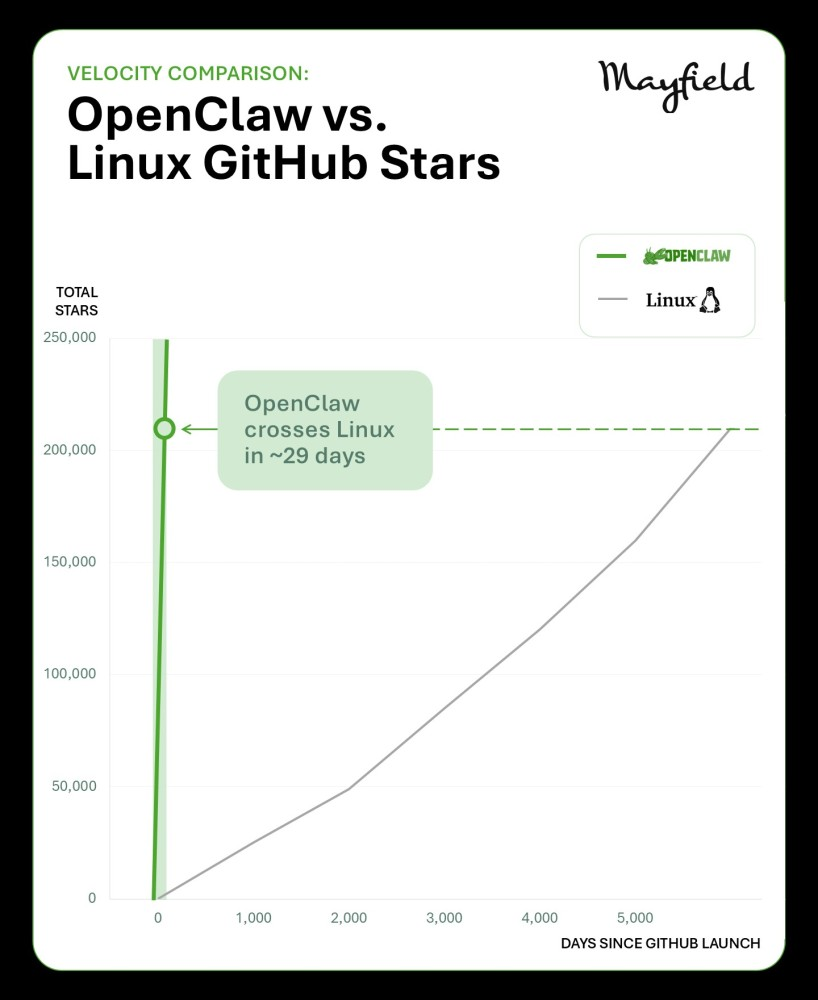
Last week, I covered why OpenClaw is Linux for agents. Created by 🦄 Peter Steinberger, OpenClaw is an open-source agentic OS in which AI agents can perform real work by calling tools and running workflows. It’s like Linux for agents, with a compressed adoption timeline. OpenClaw surpassed Linux in GitHub stars in 29 days, making it the fastest-growing open-source project in history. NVIDIA’s Jensen Huang called it a “vertical adoption curve.”
Now let’s go deeper into OpenClaw and its ecosystem, why the security risks are existential, and where the real company-building opportunities live.
OpenClaw is best understood as an execution layer. At its core, it connects language models directly to tools, data sources, and real-world systems so that agents respond and execute.
Traditional software follows a simple logic: input → process → output.
OpenClaw changes that to: intent → reasoning → action.
In that sense, OpenClaw is emerging as the default OS for agents, much like Linux became for software.
The key primitive is skills: packaged capabilities that turn a generic agent into a specialist. Skills are the building blocks of OpenClaw agents. Skills are APIs, connectors, scripts, and workflows bundled into deployable modules covering everything from sending an email to querying a database to scraping and summarizing a webpage.
If OpenClaw is the OS for agents, skills are the apps.
Within weeks of launch, OpenClaw had tens of thousands of deployed instances, hundreds of thousands of developers engaged, and millions of agents created across the ecosystem, with viral growth spreading across geographies, particularly in the US and China. This happened because it unlocked action, not just intelligence, the skill abstraction made it composable, and open source accelerated distribution.
The speed matters for two reasons. This powerful but currently unregulated ecosystem is forming now, meaning foundational infrastructure layers are being established in real time. At the same time, adoption is outpacing safety, governance, and enterprise readiness. That gap is where the most durable companies in the OpenClaw ecosystem will be built initially.
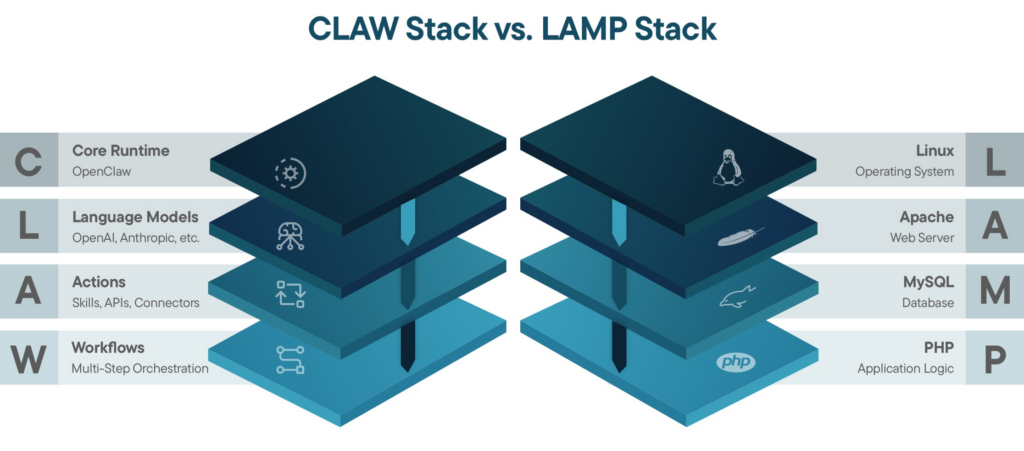
If the Linux analogy plays out, we know what comes next. An OpenClaw stack (what I am calling “CLAW Stack”) will emerge similar to the LAMP Stack that powered the web era (Linux, Apache, MySQL, PHP).
W → Workflows (Multi-Step Orchestration)
C → Core Runtime (OpenClaw)
L → Language Models (OpenAI, Anthropic, etc.)
A → Actions (Skills, APIs, Connectors)
The Security Gap Is the Biggest Barrier to Enterprise Adoption
OpenClaw agents today are essentially always-on scripts with API keys and decision-making ability, which introduces a new class of security risks:
Enterprises will not deploy agents they cannot audit, govern, or stop. The security gap is the primary reason OpenClaw’s viral developer adoption hasn’t yet translated into enterprise adoption.
Bottom line: For OpenClaw to cross the enterprise threshold, it needs a control plane. Security is the control plane for the OpenClaw ecosystem.
Each structural risk creates a company-building opportunity:
Every major platform transition produced a security and governance layer that became mandatory infrastructure. It was firewalls, Single Sign-On (SSO), Web Application Firewalls (WAF), Cloud Security Posture Management (CSPM), Security Information and Event Management (SIEM), and Identity and Access Management (IAM). The agent era demands all of the above, plus a new class of controls that didn’t exist before.
Incumbents and startups are already offering the equivalent of Red Hat and AWS for OpenClaw for sandboxing. NVIDIA’s NemoClaw is an early example, offering secure, enterprise-grade agent distributions and managed infrastructure to run agents at scale. I believe there will be many opportunities for companies, both big and small, in the OpenClaw ecosystem, including:
Bottom line: The OpenClaw ecosystem is the scaffolding for the agent economy.
Once the infra layers for OpenClaw are in place, numerous vertical and domain-specific agent companies will thrive.
The verticals with the strongest early signal share five traits:
The best vertical agents will be AI workers that are tied to a specific function, with clear inputs, defined systems, and measurable outputs.
Here are some examples:

Marketing, recruiting, research, and supply chain are some other verticals that share the same underlying logic. Each involves high volumes of repetitive, multi-step workflows that span multiple tools, incur measurable labor costs, and produce outputs that are sufficiently clear to evaluate and improve over time. The best opportunities are where the workflow is already well-understood, the cost of doing it manually is high, and the ROI of automating it is obvious to a business buyer.
Bottom line: Vertical depth is the defensibility strategy. Startups win by going narrow, owning domain expertise, and building agents that work like coworkers.
The OpenClaw ecosystem is forming fast. Here’s the advice I’m sharing with founders building in the OpenClaw ecosystem:
Don’t build generic agents. The runtime layer will commoditize quickly. Foundation model providers will absorb generic use cases.
Build control layers. Security, governance, and observability are mandatory infrastructure that unlock enterprise deployment. These categories will be large, defensible, and durable.
Verticalize early. Building an AI agent for a vertical will drive faster adoption, clearer ROI, and stronger defensibility. Horizontal platforms will handle the “AI agent for everything.” Startups will win on domain expertise and workflows.
Design for determinism and trust. Enterprises buy systems they can audit, reproduce, and explain to a regulator. Build in guardrails, approvals, audit trails, and human-in-the-loop controls from day one.
Own a control point. The winners in the OpenClaw ecosystem will control the control plane: identity, connectors, policy, observability, or billing.
OpenClaw unlocked what agents can do. The generation of companies being built right now will define what agents are allowed to do, how they’re governed, and how they create economic value.
The trillions in value creation didn’t come from Linux. They came from every company in the ecosystem built around it. The same dynamic will play out in the OpenClaw era, but only faster, and at a scale we’ve never experienced before.
We are early. Adoption is ahead of infrastructure. Capability is ahead of control. The builders who close that gap will define the agent economy.