



For the last three years, the AI industry has been asking one question: which model will win?
The next era of AI will be defined by many models – open and closed, large and small, general and specialized, and increasingly sovereign. Enterprises and founders will choose the right intelligence for each task. The most capable organizations will be able to switch as performance, cost, and control change.
NVIDIA’s $12.9B acquisition of Hugging Face is a bet that open models, and the distribution layer around them, will become strategic infrastructure. Stripe paid a reported $7.5B for OpenRouter, which routes each request across 400+ models by task, price, and speed – pricing the switching layer above any single model.
The value is moving to open models and the layers that host and route them. Open-weight models are accelerating that shift, pushing the industry toward a world where intelligence is abundant, and the model becomes a programmable ingredient you build with.
First, a distinction. Open-weight is not the same as open-source. With an open-weight model, you get the finished, trained model — you can download the weights, run them on your own GPUs, fine-tune on proprietary data, distill, and deploy inside a bank or a government.
The full training data and recipe remain proprietary. Enterprises do not need complete openness to gain many of their economic and strategic benefits.
Open weights commoditize access to intelligence, even when the process for creating that intelligence stays proprietary. Open weights will change the economics, architecture, and competitive structure of AI.
Here are four developments I expect to unfold:
The gap between frontier and open-weight models continues to narrow – unevenly, but unmistakably. On coding and a growing set of enterprise benchmarks, the best open-weight models now follow closely behind the proprietary frontier models.
That doesn’t mean frontier models go away. Frontier labs will keep advancing with the best intelligence to solve the hardest problems.
But most enterprise tasks do not require the world’s smartest model. They require a model that is reliable, fast, secure, and economically appropriate for the job.
The market will start to bifurcate:
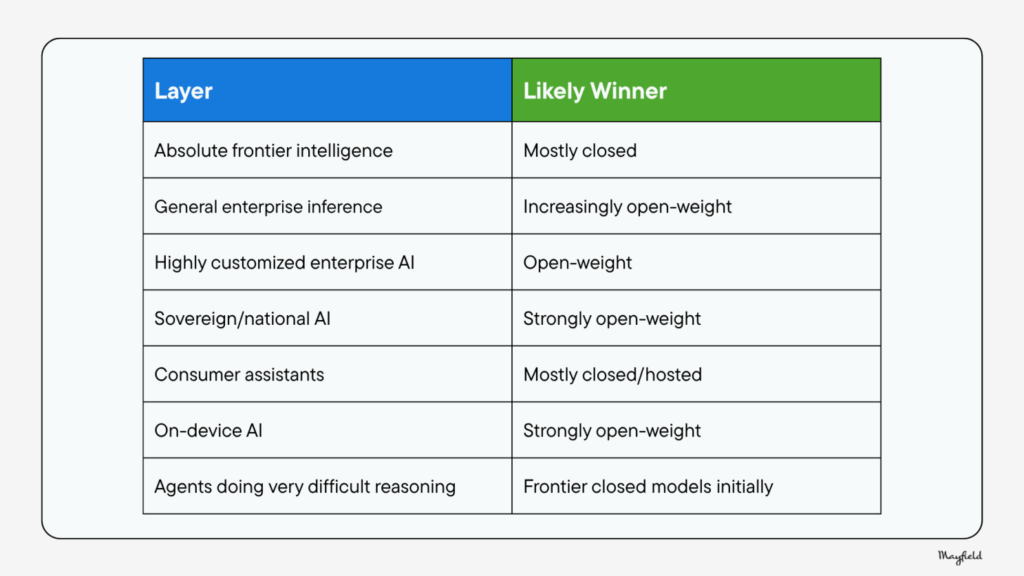
Imagine an enterprise workload distribution eventually looking something like:
Those percentages are illustrative, but the architecture is what matters.
As capable model intelligence becomes more available and less expensive, it will find its way into more products, workflows, devices, and decisions.
Enterprises should not be asking whether to standardize on OpenAI, Anthropic, Gemini, Llama, Qwen, Mistral, DeepSeek, or another model. They should be building the capability to use all of them.
Different models will be optimized for different kinds of work: reasoning, coding, customer service, document processing, scientific research, and edge applications. Some will be proprietary. Others will be open-weight, fine-tuned, or run privately.
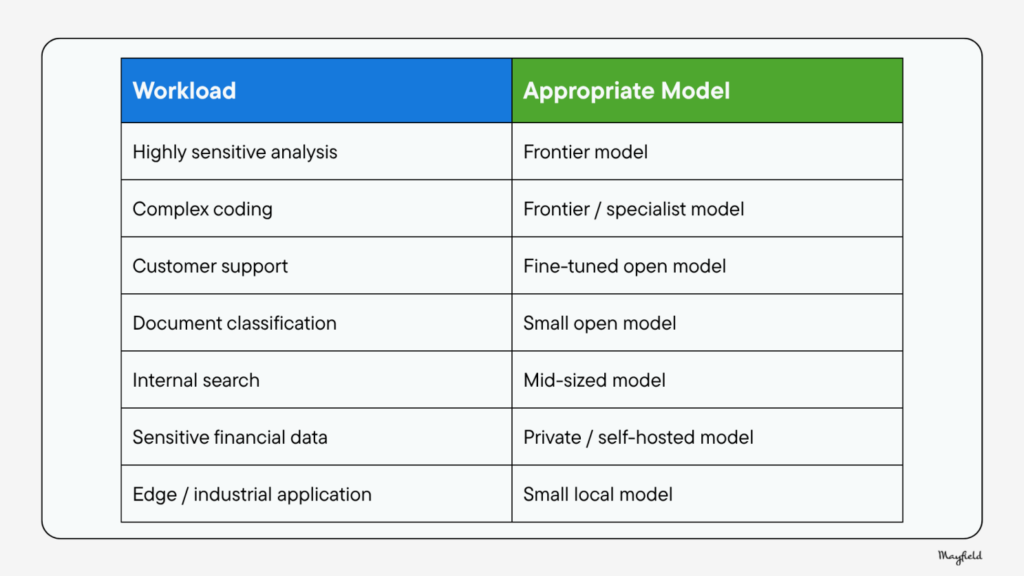
This is the architecture Microsoft’s CEO Satya Nadella has been pointing to – applications using multiple models (proprietary and open, fine-tuned and distilled), with the harness and the context layer decoupled from any single model.
The winning enterprise architecture will optimize across capability, cost, latency, security, and control.
Over time, model routing will start to look like query optimization in a database. Developers don’t decide which CPU instruction runs a SQL query, and eventually, they shouldn’t have to decide which model runs every task either.
When enterprises can run, customize, fine-tune, and eventually distill models themselves, they become less dependent on a single API provider.
NVIDIA’s CEO Jensen Huang has been clear that the future is not proprietary versus open. It’s proprietary and open. Closed models will continue to push the frontier. Open-weight models will spread that intelligence across industries, enterprises, devices, and countries.
Open weights give organizations greater control over data residency, deployment, customization, latency, and cost. For governments, regulated industries, and sovereign AI programs, that control is becoming a requirement, which is why this is a geopolitical and commercial shift. (See my Newsweek byline on AI sovereignty.)
But owning access to a model does not mean every enterprise should operate it. Self-hosting introduces real costs: infrastructure, security, optimization, monitoring, updates, reliability, and specialized talent. At a modest scale, an API may remain the better economic choice.
The strategic value is optionality. Even an enterprise that primarily uses proprietary models benefits from maintaining a credible open-weight alternative.
For the past few years, much of the perceived value in AI has sat in foundation models. As models become more capable and substitutable, that value begins to migrate.
Below the model, value accrues to compute, networking, inference infrastructure, and optimization.
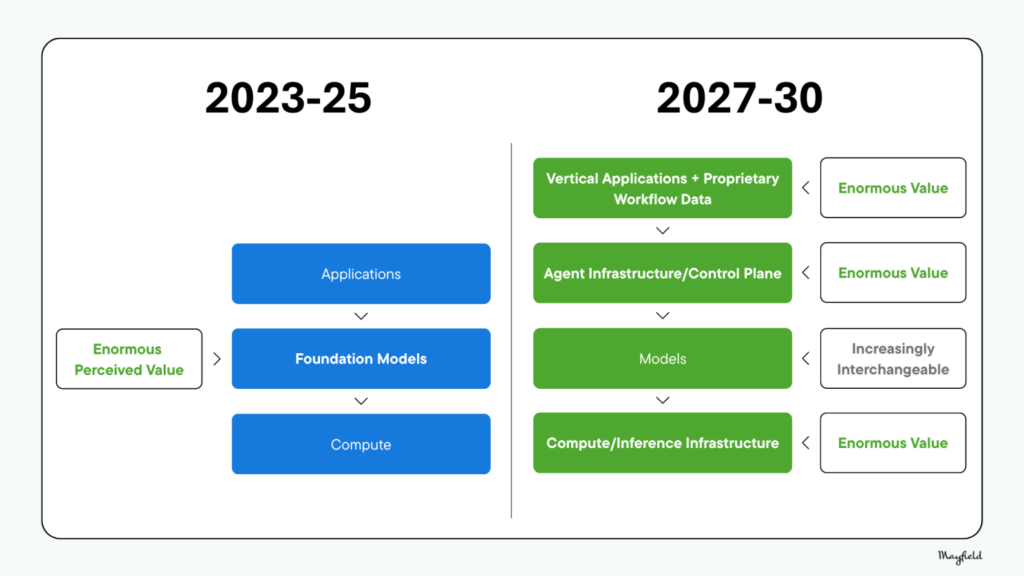
As models become interchangeable, durable value shifts to the layers above them:
Context and memory deserve special attention. Models provide general intelligence. Context and memory make that intelligence useful to a specific company, customer, and moment.
Context includes the customer’s history, the organization’s policies, the current workflow, the actions already taken, the outcomes observed, and the permissions governing what the system may do.
Memory allows an agent to retain relevant context across tasks and improve over time.
A prompt can be copied. A model can be replaced. A deeply integrated context and memory layer, built from proprietary interactions and outcomes, is much harder to reproduce.
The old stack was roughly: Model → Application → Customer
The durable stack inverts it into a loop that feeds itself: Models → Proprietary Context + Evals → Agent / Reasoning System → Workflow → Actions + Outcomes → Proprietary data → Back into the System
Consider an underwriting agent. It owns the workflow, understands the customer’s context, integrates with core systems, learns from every completed decision, and feeds those outcomes back as proprietary data that sharpens the next one.
The model is an input. The loop is the company.
Vertical models, where you own specialized intelligence, get far more interesting (see my prior newsletter about Vertical AI: https://www.linkedin.com/pulse/how-ai-transforming-vertical-saas-navin-chaddha-nuawc/). For example, a healthcare company might start with Nemotron, Mistral, or Qwen, then add proprietary clinical data, reinforcement learning, domain-specific evals, and workflow integration. The resulting asset can be enormously valuable even though the underlying foundation model is commoditized.
My advice to founders: assume models will become dramatically better, cheaper, and more interchangeable – and build a company that becomes more valuable when that happens. Focus on owning three things: your workflow, your proprietary data, and your distribution.
That leads to 10 principles:
For enterprises buying and deploying AI, my advice is to build the capability to continuously choose models rather than lock into one. That comes down to owning three things: your context, your evaluations, and your optionality.
Here are some things to keep in mind:
A frontier model might be right for complex reasoning today. A specialized open model may do the same task at a fraction of the cost tomorrow. Enterprises and founders who can make that switch quickly will have an enormous advantage — which is why the winners will own their data, context, evaluations, and workflows, and then rent or run the intelligence underneath.
The foundation model is moving from being the product to becoming a programmable ingredient of the product.
That has implications across the ecosystem:
The first chapter of generative AI was about building the smartest models. The next chapter will be about what we build with abundant intelligence.
Originally published on LinkedIn.


