


Earlier this week, Mayfield hosted our CXO Insight Call: “The Internet of AI Agents” with Professor Ramesh Raskar and Gunjan Sinha. Below is a consolidated summary of the discussion, why this moment matters for enterprise leaders, and how you can participate as a design partner with Nasiko, the intelligent registry and control plane for AI agents.
1. Agents will become the new digital workforce.
Agents will operate as autonomous “digital employees,” each with identity, permissions, and accountability. They will: Perform complex workflows, Interact across enterprise boundaries, Make decisions, transact, and collaborate. And Billions of agents will emerge in the next decade.
2. The missing layer: Agent infrastructure.
The industry is focused on building agent tools, but the real gap is the infrastructure layer, including DNS for agents (identity + routing) Agent passports (credentials + permissions), Interoperability standards, Trust, safety, and attestation, Global registries and control planes. This foundational layer will define the next 10–20 years of enterprise AI.
3. Closed ecosystems are the biggest threat.
Left alone, the agent economy may turn into a set of walled gardens (like mobile app stores), with: Opaque algorithms, Restricted innovation, Vendor lock-in, Centralized control over agent interaction, An open approach unlocks trillions of dollars in enterprise value.
4. Trust, governance, and security are non-negotiable.
Enterprises need a governance model for machine actors just as robust as for humans: Identity, access, and role definitions, Data sovereignty and privacy protections, Cross-agent observability, Explainability and auditability (even years later). Cost controls and operational guardrails. Without trust, global agent adoption will stall.
5. The enterprise stack must evolve.
Today’s SaaS/ERP/CRM architectures were built pre-agents. Expect: A 5–10 year coexistence period, New interoperability standards, Agent-native workflows, A shift from siloed systems to multi-agent ecosystems. This transition mirrors the shift from mainframes → PCs → web → cloud — but will happen much faster.

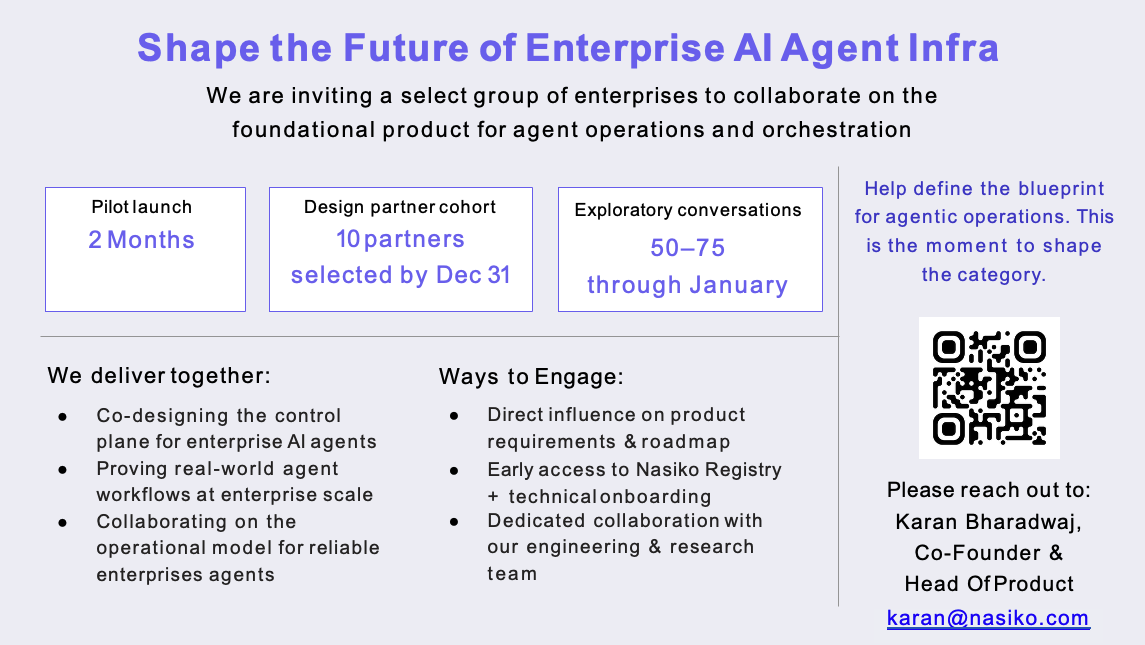
Consider joining the design partnership with Nanda/Nasiko to shape the foundations of enterprise agent infrastructure. As shared during the event, we’re building Nasiko — the Intelligent Registry and Control Plane for AI agents. Nasiko provides enterprises with a unified way to discover, govern, route, and monitor agents across frameworks, clouds, and organizational silos. As companies adopt more agents, Nasiko becomes the foundational layer that brings visibility, reliability, and control to this emerging agentic landscape.
Two Ways to Engage
1. Active Design Partner – structured pilots, co-design sessions, roadmap influence.
2. Strategic Observer – updates + participation in curated workshop. If you’re interested or want to schedule a follow-up conversation.
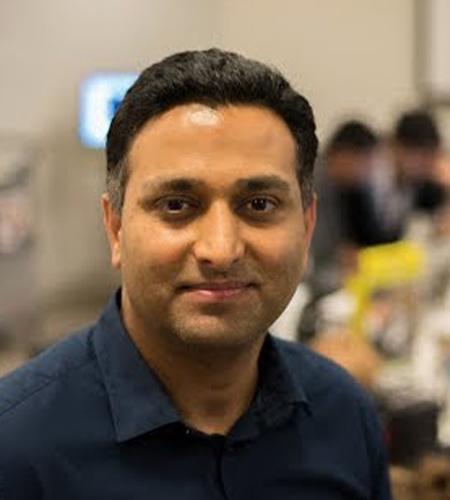
Ramesh Raskar is an Associate Professor at MIT, leading pioneering research at the intersection of distributed AI agent architectures, health technology, and computational imaging. As a founding architect of NANDA, he focuses on agentic web infrastructure that empowers decentralized decision-making in complex systems. He received the National Academy of Inventors award (2024), Lemelson Award (2016) and ACM SIGGRAPH Achievement Award (2017). He has worked on special research projects at Google [X], Apple and Facebook and co-founded/advised several companies. He holds 100+ US patents.

Gunjan Sinha is a co-founding partner of Project Nanda, a Non-profit initiative supported by OpenGrowth.org. Gunjan is a serial entrepreneur and early internet innovator who co-founded WhoWhere?, one of the world’s first search engines. Since then, he has built, invested in, and scaled dozens of companies—including eGain (EGAN), MetricStream, MarketStar, AISquare, Nasiko and OpenGrowth.Ventures. His ventures span AI, compliance, knowledge platforms, and enterprise innovation. Gunjan is equally committed to social impact, supporting global health, youth empowerment, and digital inclusion through initiatives like CFHI.org, Horasis.org, and the National Competitiveness Council (Compete.org). Across all his work, he has championed the power of technology to uplift people and create a more resilient, intelligent future.


