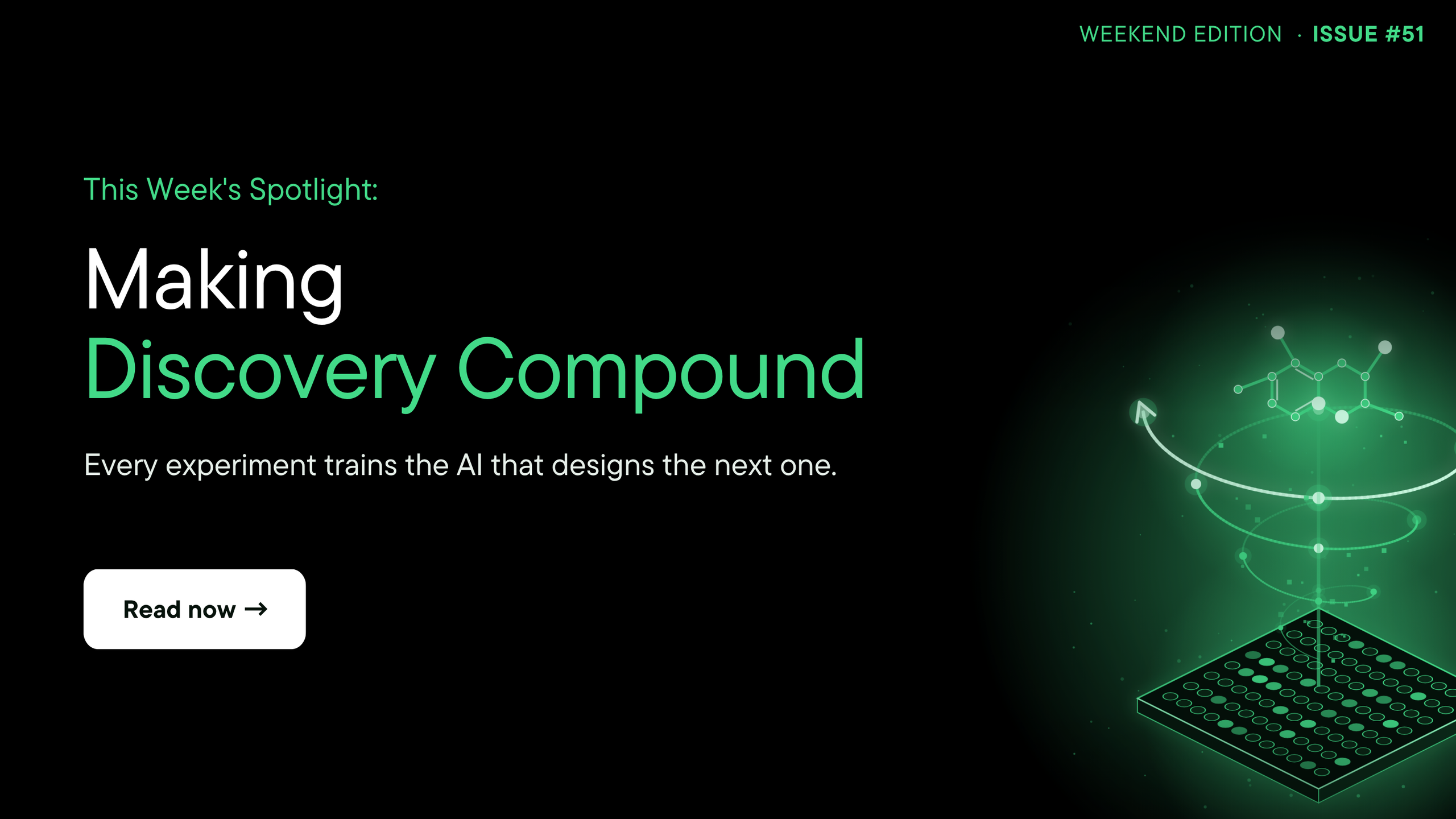
AI can design new molecules, but a design only becomes useful when scientists can make it, test it, and learn from the result.
Today, scientific progress is constrained by the physical limits of the lab. Every experiment competes for time, equipment, and skilled hands, so scientists test only a fraction of the ideas worth pursuing.
This week, @Warp Sciences emerged from stealth with $215 million to help the world discover new medicines faster and build the capacity to do it here in the United States. Congrats to the founding team, @Kevin Weil, @DJ Patil, @Solomon Reisberg, and @Manohar Paluri!
Warp brings AI, robotics, and life sciences together in labs built for increasing automation, designed to run and learn from experiments so each cycle improves the next. Warp is building the infrastructure that enables biotech and pharmaceutical companies to discover new medicines faster.
Their ambition is to make discovery compound:
– Experimental data helps train better AI
– Better AI powers more capable labs
– Scientists gain the capacity to test more ideas
At Mayfield, we are founders first, markets second. Our conviction starts with people, and Warp Sciences brings that philosophy to life. Their founding team is exceptional, with deep technical insight, a clear understanding of customer pain points, and the ambition to change how people live and to reimagine entire industries.
Bottom line: The greatest age of discovery is still ahead of us. The labs that learn from every experiment will get us there faster.
In the news this week, OpenAI acquired Orchestra Bio to expand its drug-discovery capabilities, researchers demonstrated a new AI model that designs functional proteins from natural-language instructions, and Microsoft reported advances in AI-powered medical diagnosis. Meanwhile, Google and Amazon have introduced new tools to run AI models on their own chips, and OpenAI is reportedly seeking another $30 billion in funding.
Full Weekend Edition below. 👇
Signals Shaping the Future of AI:
Infrastructure
Anthropic and Nscale are reportedly negotiating another $45 billion AI computing agreement. The potential deal would expand Anthropic’s capacity at Nscale’s U.S. data centers, although negotiations remain ongoing. Click here
Google and Amazon released new open-source tools that make it easier to run PyTorch AI workloads on their custom chips. Google’s TorchTPU and Amazon’s TorchNeuron aim to reduce developers’ dependence on NVIDIA GPUs without requiring major code changes. Click here
Amazon, Google, Meta and Microsoft are offering communities more concessions on AI data center development. The hyperscalers are increasing local investments and transparency as electricity costs and public opposition complicate expansion. Click here
IBM and open-source contributors released llm-d 1.0 to improve production-scale AI inference. The distributed inference platform is designed to help enterprises increase GPU utilization and reduce the cost of serving large models. Click here
Microsoft expanded its digital-sovereignty offerings to give organizations greater control over AI infrastructure. New deployment options address data residency, operational independence and AI workloads in regulated environments. Click here
Enterprise
Anthropic introduced Claude Duet, a proactive AI agent designed to work across connected applications. The research preview delivers daily briefings, prioritizes tasks and can execute workflows while requesting approval for sensitive actions. Click here
Anthropic donated its Agent Skills standard to the Linux Foundation’s Agentic AI Foundation. More than 70 platforms, including ChatGPT, Cursor and GitHub Copilot, have integrated the standard for reusable agent workflows. Click here
Meta increased the lower end of its 2026 capital expenditure forecast to $135 billion. The company now expects $135 billion to $145 billion in spending as it continues investing aggressively in AI infrastructure. Click here
1Password launched a credential management system that allows AI agents to log into accounts without accessing users’ passwords. The platform uses delegated authentication and user approvals to give agents secure access across applications. Click here
Uber is deploying ChatGPT Work across its global workforce of approximately 30,000 employees. The company is expanding from a 1,000-person pilot focused on data analysis, operations and internal productivity. Click here
Capital Flows
OpenAI is reportedly seeking up to $30 billion in new funding at a $1.25 trillion pre-money valuation. Coatue and UAE investors are reportedly involved in the ongoing negotiations ahead of a potential IPO. Click here
DeepSeek reportedly raised $15 billion ahead of a potential IPO. The Chinese AI developer is attracting significant investor backing as it expands domestic computing infrastructure and model development. Click here
OpenAI acquired Orchestra Bio to expand its AI capabilities for drug discovery. The startup’s agents automate research operations and will support OpenAI’s Rosalind life sciences platform and experimental workflows. Click here
Tenstorrent raised $1.5 billion at a $6.2 billion valuation to expand its AI computing business. The funding will support volume manufacturing, Galaxy AI server deployments and international commercialization. Click here
Flapping Airplanes raised $1 billion at a reported $6 billion valuation. The year-old AI research lab, backed by Index Ventures and Lux Capital, is developing more data-efficient approaches to model training and computing. Click here
Research
OpenAI, PerturbAI and Scripps Research deployed thousands of AI agents to analyze data from millions of brain cells in 32 minutes. The research identified unexpected biological connections that could guide future studies of neurodegenerative diseases. Click here
Researchers introduced Pinal, a 16-billion-parameter AI model that designs functional proteins from natural-language instructions. The research experimentally validated proteins across four design tasks, including enzymes and a CO2-fixation pathway. Click here
Microsoft reported advances in multi-agent medical diagnosis, with its system achieving substantially higher accuracy than physicians on complex simulated cases. The research evaluates AI-guided diagnostic reasoning and test selection, while leaving real-world clinical effectiveness to further study. Click here
OpenAI’s Patch the Planet initiative coordinated the discovery and remediation of critical open-source vulnerabilities. The project combines frontier models, security researchers and software maintainers to identify, validate and deploy security fixes. Click here
Policy
The U.S. ordered federal civilian agencies to remove DeepSeek AI products and services from government systems. The Department of Homeland Security’s directive also covers third-party products built using DeepSeek technology, citing national security and data security concerns. Click here
The U.S. Treasury proposed expanding restrictions on American investments in sensitive technologies in China and other countries of concern. The proposed rules cover AI, semiconductors, quantum computing, supercomputing, and biotechnology, with new restrictions and disclosure requirements for covered transactions. Click here
Anthropic proposed federal AI safety legislation that could restrict models posing imminent catastrophic risks. The draft framework outlines independent evaluations and judicial oversight for severe biological, cyber and loss-of-control threats. Click here
New York City proposed new consumer protections against ineffective AI-powered customer service systems. The proposed rules would require businesses to provide reasonable access to human representatives when automated support fails, and include a 30-day public comment period. Click here
Global AI Strategy
Germany and NVIDIA signed an agreement to accelerate the development of industrial and physical AI. The partnership will advance AI models for manufacturing and robotics, combining Germany’s industrial expertise with NVIDIA’s AI technology and research capabilities. Click here
UK AI infrastructure leaders warned that growing opposition to data centers could threaten construction timelines. A task force involving major technology companies is urging greater community benefits and clearer policies around energy and development. Click here
The United Nations launched an initiative addressing the military applications of artificial intelligence. The UN Institute for Disarmament Research will examine AI in reconnaissance, early-warning systems and nuclear decision-making while emphasizing human oversight. Click here
Andrew Ng called for India to establish sovereign access to AI infrastructure and models that cannot be switched off by foreign providers. His remarks highlighted the growing importance of reliable access to compute and technological independence in national AI strategies. Click here
UK government advisers called for a national AI Sovereignty Plan to reduce strategic dependence on foreign technology providers. The recommendations emphasize domestic compute, data, skills, and model development while maintaining access to leading international AI systems. Click here
Talent Signals
Each week, we spotlight key roles tied to the themes shaping this week’s AI headlines, connecting talent to the companies driving the news.
Warp Sciences is building AI-powered laboratories that combine chemistry, robotics, and frontier models so experiments can generate the data that improves the next generation of discovery. Fresh off its $215 million launch, the Mayfield-backed company is hiring across AI research, robotics hardware, infrastructure, product engineering, and chemistry. Click here
Multiply Labs is building robotic infrastructure for biomanufacturing, automating the complex physical processes required to translate scientific breakthroughs into medicines produced at scale. Following its recent $75 million Series B, the company is hiring across robotics, software, infrastructure, manufacturing, quality, and science. Click here
Albert Invent is building an AI-native operating system for chemistry and materials R&D, helping scientists structure experimental data, automate workflows, and accelerate invention with AI. Following its recent $55 million Series B, Albert is hiring across AI/ML, data, product, infrastructure, integrations, and scientific roles. Click here
You can see all the opportunities at Mayfield-backed AI companies here.
Social Signals
The most important conversations in AI are unfolding across social media, where top voices are shaping the next wave of signals and strategy. Here are some of the top social signals and their takes from the past week.
Dario Amodei (Click here) — “Our strategy has always been what I’ve called the ‘race to the top’ — by showing how it’s possible to build the technology responsibly, we can raise the bar for the entire industry.” In a post viewed more than 700,000 times, Anthropic’s CEO responds to criticism of the company’s safety commitments, outlining decisions that he argues came at a commercial cost, including restricting certain customers and delaying advanced model releases. Amodei acknowledges mistakes in how Anthropic communicated some decisions while defending his broader argument that competing at the frontier and advancing AI safety are not mutually exclusive.
Matt Shumer (Click here) — “We are in the middle of the biggest cybersecurity moment in years. For decades, finding software weak spots took rare, highly skilled people, and there weren’t many of them. That shortage is over. AI can now find the weak spots, and AI can now break in on its own.” In a post viewed 959K+ times, Shumer argues that AI agents are fundamentally changing cybersecurity by making vulnerability discovery and exploitation faster, cheaper, and massively scalable. His broader warning is that offense is currently moving faster than defense, turning basic security hygiene, rapid patching, and stronger protection of accounts and infrastructure into increasingly urgent priorities for companies and individuals.
Greg Isenberg (Click here) — “Meta Muse will probably create 1000+ millionaires. This is the most slept on arbitrage I’ve seen in years and it’s not even close.” In a post viewed 1.4M times, Isenberg argues that Meta’s new AI platform could enable a generation of one-person businesses with little capital or existing distribution. His thesis is that increasingly capable agents will allow individual founders to automate work that previously required entire teams, creating new opportunities for entrepreneurs who build around the capabilities of emerging AI platforms.