


This article is part of our Future of AI series from Imagination in Action 2025 Silicon Valley Summit — where founders, leaders, and investors explored what’s next for AI. Explore the magazine.
In the world of technology startups, the brass ring every founder yearns for is “unicorn” status—reaching a billion-dollar valuation. That’s long been the benchmark of success, even as founders recognized that achieving such status could take many years and many employees.
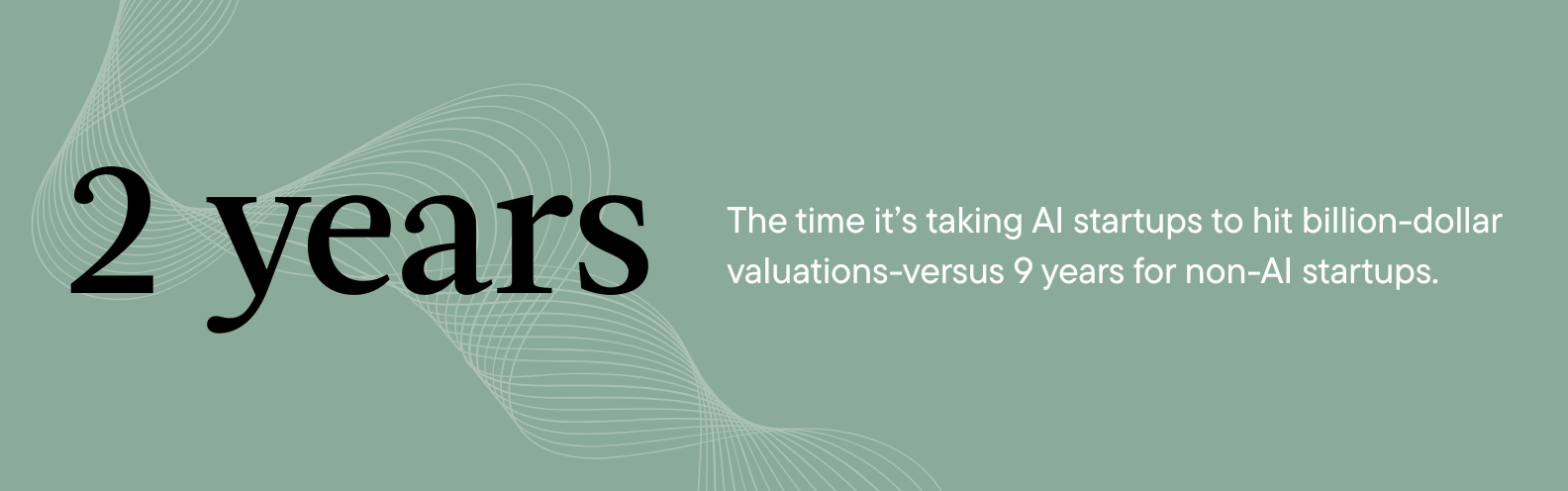
According to a recent comment from Manlio Carrelli, the CEO of CB Insights, non-AI startups typically have a median of about 400 employees and take 9 years before they become unicorns. But startups in the AI field are hitting billion-dollar valuations with just over 200 employees—and in just 2 years.
That data point demonstrates that the AI economy is already driving impressive progress, but several speakers at Imagination in Action predicted an even more startling future. It won’t be long, they said, before advanced AI capabilities offer companies the ability to rapidly develop and improve products and services with streamlined internal operations and, by extension, fewer people.
While one of the biggest societal fears about the impact of AI is that people losing their jobs, these speakers envisioned a different dynamic within the startup ecosystem: the rise of billion-dollar companies with an order of magnitude fewer workers.
“You could have a billion-dollar company with just a few people because they’re able to scale that much faster.”
Tarun Raisoni, Gruve
Jeremiah Owyang, General Partner at Blitzscaling Ventures, said AI-native companies are redefining what “scale” looks like. AI startups are being structured to stay small. The average startup has 20 employees making over $5 million in revenue, with revenue per employee of $1-3 million versus the industry average of $200K.
“It’s because they’re agentic first,” Owyang said. “A 19-year-old founder doesn’t need to manage 200 people. With 170 AI agents, they can still achieve the same operational leverage.”
One of the biggest factors driving this is the underlying power of next-gen AI systems to automate internal business functions—IT, HR, sales, and the like—that used to require bulky teams.

As Replit CEO Amjad Masad explained, non-technical domain experts can use AI to quickly build those in-house functions without hiring people, creating AI-driven businesses.
“If an [AI] agent can go hire a human or can go hire another agent,” Masad said, “then we’re going to see companies shrink. We’re going to see a lot more entrepreneurship, and the market is going to be more dynamic. I think more people will get rich.”
This democratization of startup building represents a fundamental shift. Previously, launching a tech company required either technical expertise or the capital to hire engineering teams. AI is eliminating that barrier, allowing domain experts to focus on solving problems in their fields while AI handles the technical implementation.
“We’re going to see companies shrink… and a lot more entrepreneurship.”
Amjad Masad, Replit
A 100x multiplier
The Internet spurred massive growth across the business world. By connecting everyone online, making information instantly accessible, and seamlessly bringing together companies with their customers, business got faster and more efficient—and the number of unicorns blossomed.
AI is changing the game yet again, especially for startups working hard to scale their operations.
“Back when I was a founder, six or seven years ago, sales development representatives (SDRs) were everything—we had a team of 100,” said Patrick Salyer, a partner at Mayfield. “That would be an absolute waste of money now. The rules are being rewritten, and founders need to adapt their go-to-market playbooks just as fast as their products.”
“The world’s moving much faster now,” Salyer said. That’s because AI is helping startups construct fluid systems in nearly every aspect, from how they build their products, how they sell them, how their supply chains collaborate, and how they engage with customers.
For startup founders looking to get their companies off the ground in a fiercely competitive landscape, AI is essential, helping them to establish market share and scale up faster than ever.
A revolution in science
The technology is also a huge boon for those whose companies are built to productize and monetize science. That’s because AI is increasingly being used to advance scientific research, sometimes even resurfacing discarded discoveries for altogether new purposes.
UC Berkeley assistant professor of chemistry and biomedical engineering Aditi Krishnapriyan pointed out that through the transfer of data from large to small models, AI can vastly speed up advances in science such as the materials design of batteries.
Progress like this is fertile ground for startup founders aiming to become unicorns. Scientific discoveries that once took years or decades can now be accelerated dramatically, opening new markets and opportunities at unprecedented speeds.
Embracing AI
For founders, the message is clear: Building successful businesses in the future won’t require armies of employees. Instead, founders can scale with smaller teams by leveraging AI in any number of domains.
This may force society to rethink how to ensure economic opportunity, but for founders with new ideas, there has never been a better time to start a company.
The days are gone when founders would have to raise millions of dollars to go to market. Instead, it’ll be a race to see who can leverage AI and get the best ideas in front of customers first.
Founder Takeaways
Explore The Future of AI | This article is part of our Future of AI series from Imagination in Action 2025 Silicon Valley Summit — where founders, leaders, and investors explored the next revolution of AI. We explored how AI is changing scientific research, creating new startup economics, straining power grids, and challenging us to rethink everything from enterprise software to regulatory frameworks. Dive into the Future of AI magazine to see the full picture.

