


This article is part of our Future of AI series from Imagination in Action 2025 Silicon Valley Summit — where founders, leaders, and investors explored what’s next for AI. Explore the magazine.
The rise of AI reinvigorated the robotics industry. Robots were once simply pre-programmed machines that were effective only within highly controlled environments.
But neural networks and LLMs have breathed new life into robotics, enabling companies to take the first steps towards building machines that perceive their surroundings and make real-time decisions about how to interact with the physical world.
“I’m excited about the possibility of taking robots out of constrained environments into real human environments.”
Steve Cousins, Stanford
The term “physical AI,” also known as embodied AI, describes systems that understand and adapt to the physical world with the help of software and sensors and the continuous processing of sensory data. In a very brief time, physical AI has begun transforming key sectors beyond robotics: self-driving vehicles, healthcare, military weapons, manufacturing, and security.
“I’m excited about the possibility of taking robots out of constrained environments into real human environments.”
“I’m excited about the capabilities that we’re going to have in manufacturing, and really take that to a new level,” said Steve Cousins, executive director at the Stanford Robotics Center. “I’m also excited about the possibility of taking robots out of constrained environments into real human environments, and being able to operate there successfully.”
But if the industry is to one day develop machines with the agency and utility of C3PO and R2-D2, it must first overcome many technological challenges. For ambitious technologists, the sector offers the chance to solve some intriguing and daunting problems.
Imperfect humanoid robots
Not everyone agrees on the best direction forward. Rodney Brooks, the pioneering roboticist who co-founded Roomba maker iRobot and developed foundational robotic architecture, offered a less-than-dazzling view of the near-term potential for humanoid robotics, suggesting that robots would continue “doing real work” primarily in warehouses, plants, and factories—sectors where they’re already deployed.
His most pointed critique? “We have zero grasping capability,” he said, highlighting how humanoid robots still struggle with taking basic actions.
For Ashish Kumar, a Tesla researcher who worked on that company’s Optimus AI and Robotics program, perfection isn’t a prerequisite for commercialization or revenue generation. He pointed to AI chatbots, AI video production, and self-driving cars as examples of imperfect technologies already generating substantial value.
The issue with humanoid robots, he argued, is simply scale: Once production volumes increase, costs will plummet, like they do with other technologies.
Engineering challenges remain
Those seeking to build better robots face an array of technical hurdles. Some of the challenges include building smaller and more perceptive sensors, more stability in two-legged robots, smaller sensors that enable robots to better perceive diverse environments and improved capabilities for robot actuators—the components that drive robotic limbs.
AI has enhanced robots’ real-time decision-making, but providing them with absolute autonomy in any environment is still a ways off. The problem is that there are too many variables in the physical world, which requires robots to process too much data.
These aren’t abstract problems. Samir Menon, CEO of Dexterity, an AI-powered robotics provider, shared a story about a robotic arm his company built that excelled at moving mail packages—until it malfunctioned one day. His staff discovered the arm clutching a perforated box leaking liquid that damaged its components. The culprit? The box was designed to let earthworms inside breathe.
No amount of pre-deployment testing had anticipated earthworms by mail.
When robots meet the real world
Along the same lines, Stanford’s Cousins shared an anecdote about putting a robot into a hotel.
“When you’re in factories, you’re behind safety cages or you’re very careful to control the environment,” Cousins said. “You can make everybody wear steel toe boots, and you can keep people behind yellow lines.
“But when we put our robot into a hotel for the first time, the very first time we looked at what the robot’s cameras were seeing and we saw a three-year-old’s bare toes. A child had obviously hugged the robot. We’re like, whoa! We weren’t thinking about this when we designed the safety system.”
That incident prompted a complete redesign of the safety system, Cousins said.
Building on progress
The many challenges notwithstanding, newcomers to physical AI will find a host of innovative tools and pioneering technology to build on. Embodied intelligence has made massive strides in touch and feel perception. Robot locomotion has matured, resulting in improved motors. Quadrupeds, the robots that get around on four articulated limbs, are more agile.
The manufacturing and warehouse sectors are seeing real commercial traction. These environments, while less constrained than traditional factory settings, still offer enough structure to make current physical AI capabilities viable.
For all the legitimate technical concerns, many in the field remain bullish on physical AI’s trajectory.
That tension—between measured caution and audacious ambition—will likely define physical AI’s evolution over the coming decade. The winners won’t be those who choose one approach over the other, but rather those who know when each is appropriate.
The robots are learning to touch our world. Now we need to figure out if we’re ready to touch back.
Developing the World’s Most Trusted Driver
Autonomy is a major challenge for physical AI, but Waymo already employs AI to ensure its cars are safe on the road, even in the face of the most unexpected external actions.
“We have to assume the worst in many situations, and the long tail of difficult scenarios dominates the technology.”
Vincent Vanhoucke, Waymo
“Modern AI enabled us to bring together all the components that you need to build an autonomous agent that operates in the real world,” Waymo distinguished engineer Vincent Vanhoucke said. “You can interpret images and sensor inputs, you can reason, you can plan—and all of that is in a common framework.”
As Vanhoucke put it, following the rules of the road is the easy part. The much harder problem to solve is how to engineer the company’s vehicles to respond properly when people, animals, and other vehicles “do crazy stuff.”
The Alphabet-owned company’s cars feature more than 20 high-resolution cameras, meaning that at any given moment, they’re ingesting a huge amount of data about what’s going on around them. “We have to assume the worst in many situations,” he said, and “at scale, operating the long tail of difficult scenarios dominates the technology.”
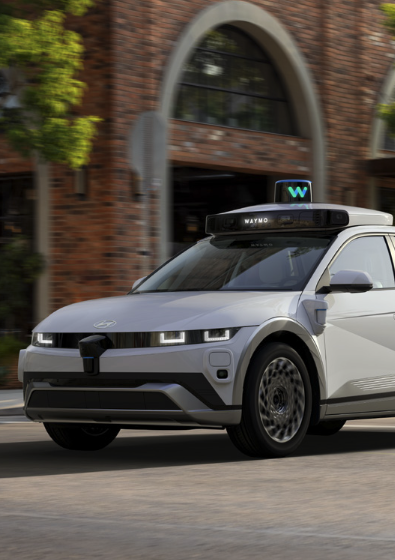
Previously, Waymo leaned on the data it derived from millions of miles of autonomous driving. Now it’s able to leverage vision language models that can understand and parse the world outside the vehicles at a deep level, in real time.
While the company’s cars have already been on the streets of San Francisco, Los Angeles, Phoenix, Atlanta, and Austin, it plans to grow to many other cities over time, so it needs an AI that’s capable of adapting quickly to new locations.
To that end, Waymo built its own model based on the types of driving data its cars collect—images, context, maneuvers, and so on—that it uses to predict how its vehicles should navigate city streets, even streets that are new to it.
The resulting performance was on par with the previous on-board-only systems yet is far more scalable and simple. And now, it’s working to refine the models even further.
In that effort, the conversational nature of modern AI is a plus.
“The nice thing about driving is that it’s like a conversation,” Vanhoucke said. “You’re stopping at a stop sign and there’s another car there, and you’re going to nudge forward, nudge forward, maybe they go and then you stop. It’s a visual conversation, and that’s not just a cute metaphor. It’s literally the problem that we have to solve.”
Founder Takeaways
Explore The Future of AI | This article is part of our Future of AI series from Imagination in Action 2025 Silicon Valley Summit — where founders, leaders, and investors explored the next revolution of AI. We explored how AI is changing scientific research, creating new startup economics, straining power grids, and challenging us to rethink everything from enterprise software to regulatory frameworks. Dive into the Future of AI magazine to see the full picture.

