


AI is giving the CIO a bigger mandate than ever before.
The IT organization doesn’t disappear in the AI era, but it will stop being a ticket-taking, infrastructure-managing cost center and become the platform and the guardrails for how the whole company uses AI.
For decades, IT meant keeping the lights on: uptime, networks, devices, enterprise apps, and SLA compliance. The asset was infrastructure, and the function was judged on cost and ticket volume. In the AI era, the assets become data, models, and workflows, and the job moves from “we manage systems” to “we enable intelligence across the enterprise.”
As agents take over ticket resolution, troubleshooting, patching, monitoring, and routine QA, the surviving function does different work. It designs automation-first systems, oversees agents rather than doing manual ops, and focuses on exception handling and reliability. The job moves from doing the ops to supervising the system that does the ops. What remains is the work agents can’t do: ambiguity, tradeoffs, and knowing when to trust the system and when to step in.
The future CIO runs that system. They sit alongside the CTO, the CDO, and the CFO as a business co-creator and transformation leader, and the defining question changes from “are systems stable and secure?” to “is the company becoming AI-native, safely and fast enough?”
The new job splits into five roles.
The CIO orchestrates a network of agents that surface insights, run tasks, and flag risks, and steps in where judgment is needed.
Standup with AI and human leads. AI summarizes what every team shipped yesterday and flags the delays, risks, and dependencies across orgs, then suggests reallocations of people, compute, and budget. The CIO validates the calls, resolves the cross-functional conflicts, and overrides where human judgment is needed.
Product and business partnership block. Time with the heads of Sales, Marketing, and Product. Each function runs its own copilots; the CIO’s team provides the platform and the governance. In the room, agents simulate ROI in real time, pull internal data on the spot, and suggest architectures and vendors. The CIO works as the filter and prioritization engine.
AI portfolio review. In place of 50 IT projects, the CIO reviews the top AI use cases, adoption metrics (who uses what in practice), and model performance metrics (accuracy, drift, and cost). Agents bring usage heatmaps, ROI attribution, and blunt recommendations: shut this down, or double down here.
Vendor and model strategy. Managing the ecosystem is constant work: comparing model performance across OpenAI, Anthropic, and open-source models; negotiating enterprise contracts; and deciding between build, buy, or hybrid, with agent-driven risk scoring for lock-in, compliance, and data exposure.
Exception handling. Most operations run themselves; what reaches the CIO are the edge cases. A critical AI system produces a flawed output that reaches customers. A possible data-leakage incident. A business unit bypassing governance with shadow AI. Agents deliver root-cause analysis and simulate remediation outcomes, and the CIO makes judgment calls when the trade-offs are ambiguous.
Governance and risk council. With legal, compliance, and security: review the AI risks, update the policies on data usage, model access, and audit trails, and keep the company aligned with regulations. Agents watch for policy violations in real time, generate audit-ready reports, and flag emerging regulations around the world.
The pattern holds all day: agents do the work and surface the signal, and the CIO sets direction and owns the calls that can’t be delegated. There are fewer dashboards and more decisions because the CIO responds to synthesized insight. The CIO’s span of control widens dramatically, since agents carry out the monitoring, analysis, and execution that used to take whole teams. The work itself shifts toward the edge cases and the strategy. Speed becomes the defining factor: decisions that used to take weeks now happen in hours.
The new IT org runs as a layered system, with governance across the entire stack: build once on the platform, reuse the agents everywhere, and apply them in the business.
The principle is to centralize platforms and governance and decentralize use cases and adoption.
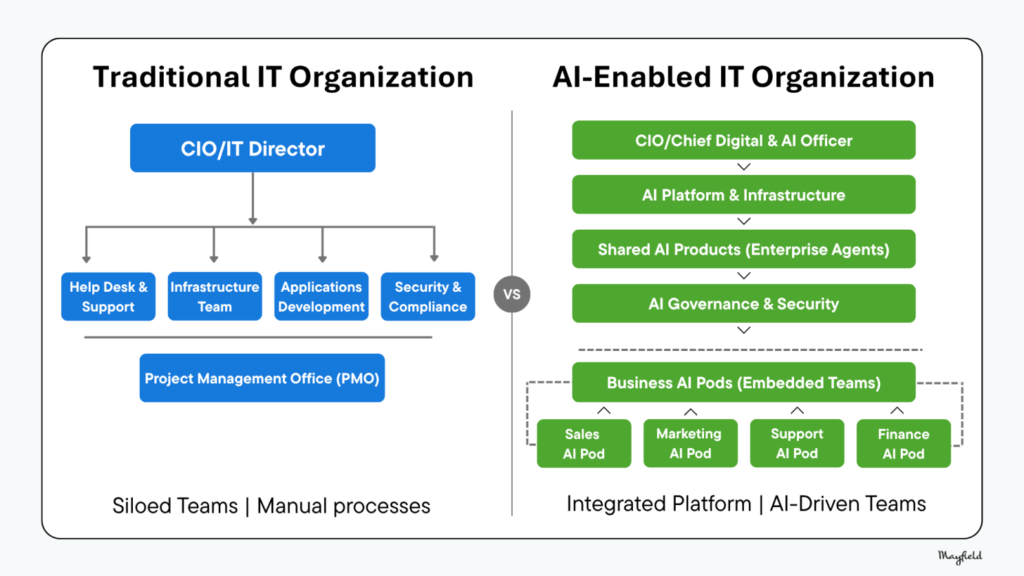
As agents absorb the work beneath them, roles get reimagined. IT Support becomes an Experience and Automation Manager. The SysAdmin becomes a Reliability and Automation Engineer. The Security Engineer becomes an AI Security and Risk Specialist. The Data Engineer becomes a Real-Time Data Platform Owner. The IT Project Manager becomes an AI Product Manager, moving from timelines to outcomes and from projects to products.
Other roles appear for the first time:
The result is a flatter, more modular org than the old hierarchy of infrastructure, support, help desk, and a security silo. Headcount drops and the talent profile rises because every role left in IT is closer to designing the system than to running manual tasks. The move is from executor to designer, operator to orchestrator, specialist to systems thinker.
Most CIOs will adopt agents. A smaller number will rebuild their organizations around them. The difference shows up in five shifts.
The bar is higher now. The role has grown from execution into design, supervision, and judgment.
Agents take over execution, but the advantage still belongs to the leader who sets direction, defines standards, and governs trust, security, and risk across all models and agents.
The CIOs who come out of this strongest will build the fastest, safest way for their company to use AI: a platform company inside the company, where a small, high-caliber team lets everyone else build safely. Their orgs will be flatter and carry more leverage, their governance will be strong without being slow, and the function will move from managing systems to enabling intelligence across the enterprise.
The question for every CIO: Are you becoming the fastest, safest way for your company to use AI, or the gatekeeper it routes around?
This is part 4 of a series on the Future of CXOs in the AI Era – Part 1 covered the Architect CMO, Part 2 covered the The Orchestrator CRO, and Part 3 covered the CFO – Capital and Resource Orchestrator.