



The CFO role is being rebuilt. Not optimized, not augmented, but rebuilt around what matters most: where and how every dollar is allocated, and how fast that can change.
While the job of the CFO for decades has always been to look forward and be an efficient allocator of capital, finance leadership has come to mean: closing the books, explaining variances after the fact, and managing reporting cycles. The CFO sits at the end of the value chain as the company’s scorekeeper, looking backward and explaining what had already happened – not as the financial GPS for the business.
AI agents change that entirely. As agents take over the close, the reconciliations, the variance analysis, and the data cleanup, what’s left is what CFOs are truly meant to do – judgment work:
The future CFO does this from a higher altitude.
The new job is split into five roles.
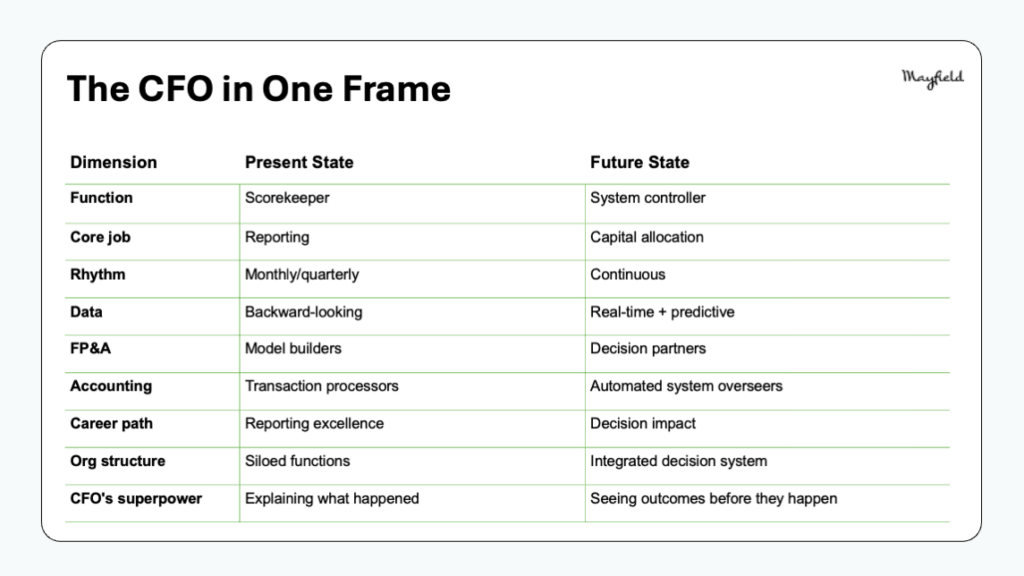
A large share of finance’s time goes into work that never reaches a board meeting. Processing, reconciliations, data gathering, variance hunts, spreadsheet consolidation, close support, audit prep, and payment timing. Tedious, chronically underdone, and largely invisible to the rest of the company. Exactly the kind of work agents were built for.
Agents now provide leverage across continuous reconciliation, anomaly and policy violation detection, real-time variance explanations, forecast generation with confidence ranges, on-demand scenario simulation, and board narrative drafting.
The bigger shift is not about layering AI on top of point tools. It’s about end-to-end financial decision systems, where AI coordinates the close, the forecast, allocation decisions, and risk monitoring as one unified system rather than as separate workflows that humans stitch together at the end of every quarter. The discipline this introduces is measurement against metrics that finance leaders already own. Agents get judged on the same scorecard that has measured finance for decades.
Bottom line: AI creates real value in finance only when it orchestrates the full decision workflow, not when it accelerates isolated steps.
The old operating model centered on the monthly close, the quarterly variance review, and the annual planning cycle. Agents break that model. The new rhythm is built around continuous allocation decisions, signal-based diagnostics, and trust reviews, with the calendar reorganized around when decisions need to happen rather than when reports are due.
A typical week reflects this shift:
Monthly close meetings fade away as the primary forum, and continuous decision reviews replace them.
The trap is treating agents as automation tools. CFOs who do this become approval bottlenecks, sitting at the end of every workflow and slowing it down. The CFOs who redesign their organizations around continuous allocation operate from an Orchestrator’s altitude, and they build a durable advantage because the org runs faster than the calendar that used to constrain it.
The new finance org has three layers:
The Orchestrator CFO sits on top of all three, designing how they work together rather than approving outputs from each.
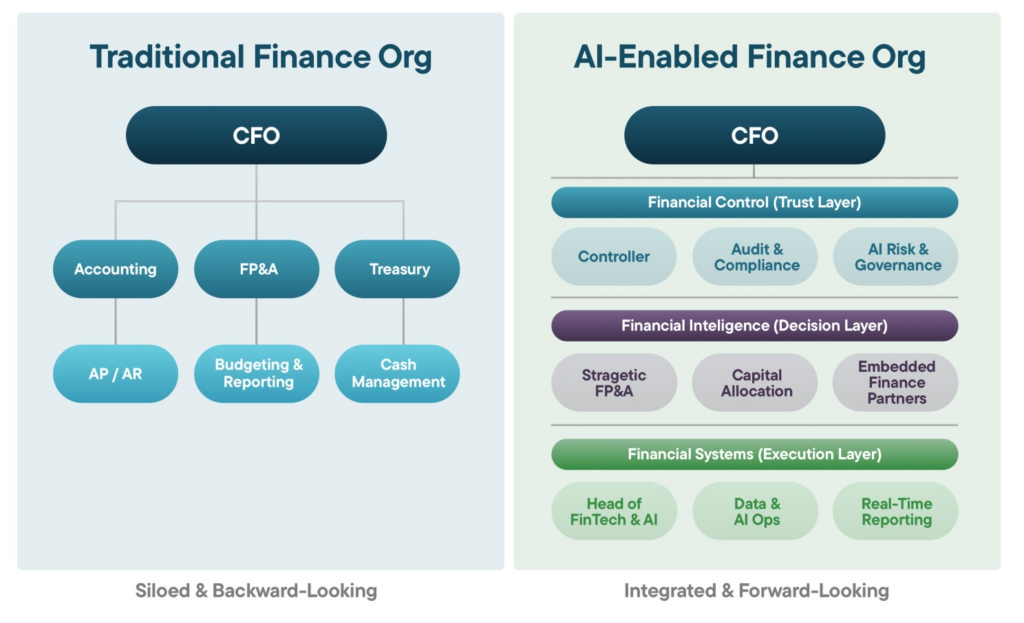
Across these layers, some finance roles get reimagined as agents absorb the work underneath them. Others emerge for the first time.
Reimagined roles take on new responsibility as agents absorb the execution layer.
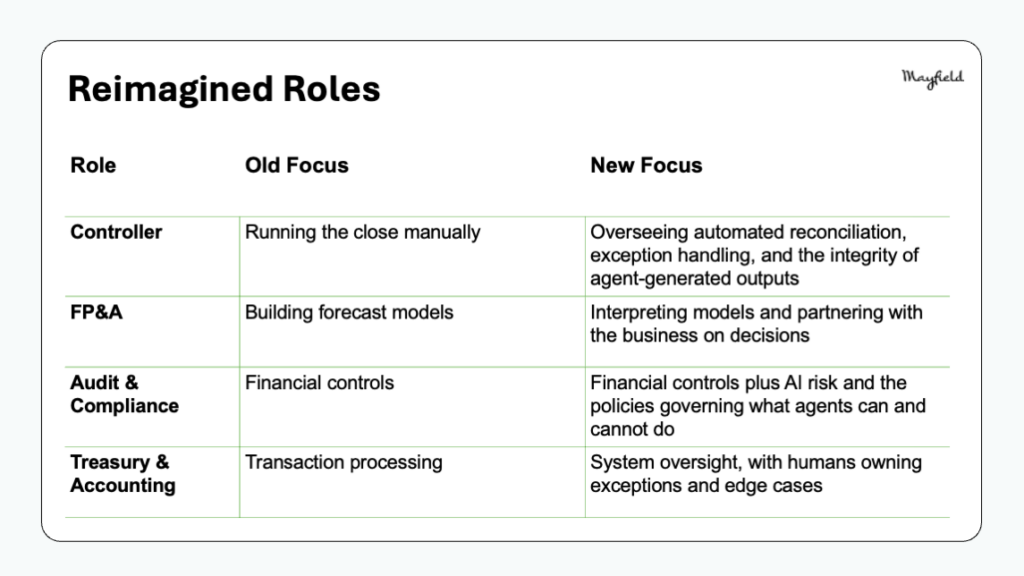
Emerging roles fill gaps that didn’t exist in 2025 org charts:
The resulting org chart is flatter, more cross-functional, and more decision-oriented than the traditional finance hierarchy of Accounting, FP&A, and Treasury. Headcount drops, but the talent profile rises, because every role left in finance is closer to the decision than to the data.
Most CFOs will adopt agents. A smaller number will redesign their organizations around them. The difference shows up in five structural shifts.
The bar is rising. Not because accounting got harder, but because the role expanded.
AI agents absorb financial execution, but the advantage still belongs to leaders who set direction, define standards, and interpret what the system is learning.
The CFOs who emerge strongest from this transition will build organizations that allocate capital faster, maintain financial trust more consistently, and translate insights into action with clarity. Their teams will be smaller, more focused, and have higher leverage. Their financial systems will feel precise and intentional even as AI scales every decision.
This is part 3 of a series on the Future of CXOs in the AI Era. Part 1 covered the Architect CMO. Part 2 covered the Revenue Orchestrator.