

Recursive self-improvement is the load-bearing assumption in almost every long-range forecast about AI, and one of the strongest pieces of evidence we have for it comes from a board game.
In October 2017, David Silver, Demis Hassabis, and their colleagues at DeepMind published AlphaGo Zero in Nature. The system was given the rules of the board, a set of random weights, and, unlike its predecessors, no human game samples.
It learned Go by playing itself.
The improvements blew past anything a human teacher could have produced. In three days, it beat the version that had beaten Lee Sedol, 100 games to zero. In 21 days, it matched AlphaGo Master. In 40 days, it exceeded every previous version of itself.
But the conditions under which it happened were narrow, and the extrapolation we’re building on now drops half of them. In this blog, I want to cover three points:
AI providing feedback to AI produces very sharp improvements. It does so particularly in environments where the combinatorial possibilities are too many for a human mind to navigate.
Go is the perfect case. With roughly 10^170 legal positions, it’s precisely the condition under which a machine playing against itself generates better feedback than a grandmaster could.
That’s what changed when the teacher was removed: the source of the feedback, not the nature of the game. The true limit had always been the teacher. Remove it, and the limit goes too. What remains is a system exploring a space faster than any person can explain it.
To be clear, none of this diminishes the achievement. The self-play result was real, the mechanism behind it is sound, and the people who built it were right about what they were seeing.
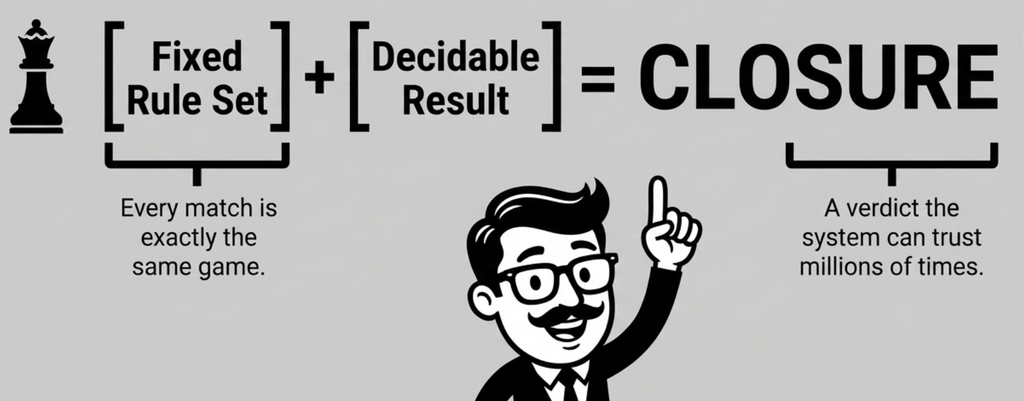
Scale is the condition everyone repeats. The second one is closure, and it is the one that often gets dropped.
Closure means two things. First, the rules of Go are complete before the first stone is placed, so nothing new can enter the game while it is being played.
Second, those rules provide a clear way to determine the winner from the final board position, with no room for interpretation. The verifier is the scoring system applying those rules to the board.
Go’s vast number of possibilities is why the human had to go. Closure is why there was still something to learn against once the human was gone.
Now take the domains most of us actually work in. They run on language and human interaction. The possibilities in language are infinite, and they are not explicit.
Whatever is written is one thing, and whatever is not written also means something to the human brain.
I am modeling what you are thinking, you are modeling what I am thinking, both of us are wrong in ways neither of us can fully see, and the thing we call “understanding” lives in that gap.
A space like that cannot be enumerated, and not for want of compute. There is no complete list of positions, no rule set that closes, and no unambiguous, verifiable signal for who won the exchange.
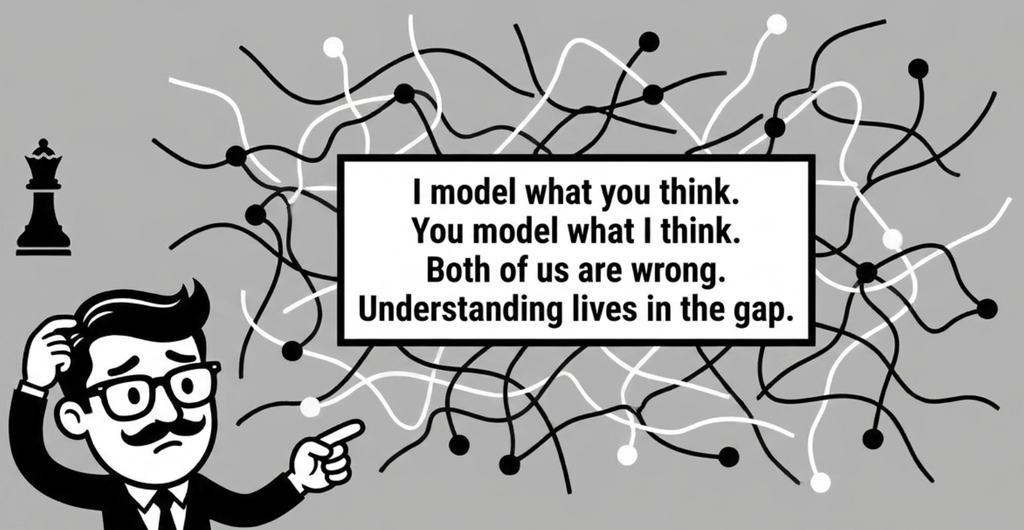
When the verifier is a proxy rather than a rule, the loop optimizes the proxy.
In math or basic coding, self-training works because success is absolute. A formal proof checks out, or it doesn’t. A test the model cannot reach passes or fails. The AI gets a clear signal on what to improve.
Language offers no such signal, so the industry substituted human approval. Researchers examining the preference data found that agreeing with the user was among the strongest predictors of a good rating, and the models learned precisely that.
Across a range of reward models, 30 to 40 percent of tested prompts scored a confident wrong answer above a correction, and the effect grew as training pressure increased. Writing stricter grading criteria reduces this without ending it. In one study, answers scoring highest on the rubric were rated worse by judges who weren’t using it.
That is the system doing exactly what it was designed to do. Give it a flawed proxy for quality, and it gets better at the proxy.
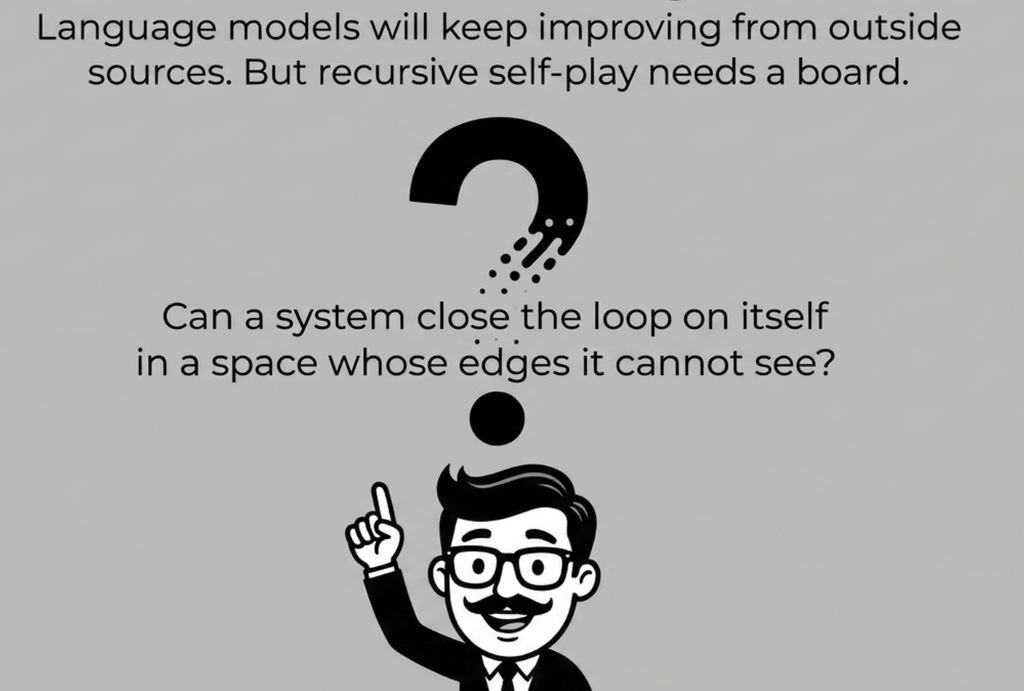
I am not claiming a proven ceiling, and I am not predicting that language models stop improving. They will keep improving, and the improvement will keep coming from somewhere.
Consider what a self-improving system would need here: a target, a comparison, and a verdict. None of the three is available.
So what would the system be improving against? What would tell it that this exchange went better than the last one, and better by how much?
I have not seen the argument for why it would work. I have only seen the analogy, and an analogy is not a mechanism. Self-play needs a board. Because what is a system supposed to improve against when there is no board and no way to know who won?
Where does my argument break? What would a reliable verifier for human language actually look like? I’d love to hear your take.