


The best AI agent is not the most autonomous one.
It is the one given the right autonomy—and the right authority—for the job.
Today, we call everything an “agent,” from systems that need approval for every action to systems that plan, adapt, and execute for hours. That leaves developers, companies, and users unable to answer three basic questions:
The autonomous vehicle industry solved this problem with the L1-L5 framework, which describes how responsibility shifts from the driver to the machine. We propose an equivalent framework for AI: an A1-A5 ladder where real-time human supervision goes down as autonomy goes up, and governance gets stronger at every rung.
It maps how Collaborative Intelligence takes shape, with humans and agents working together, and the human role moving up as agents take on more.
The AI model supplies the reasoning, perception, and planning. The agent is the complete vehicle: the model combined with memory, goals, credentials, tools, and the ability to act.
The Internet is the road system, but those roads were built for humans, websites, and APIs. They were never designed for agents that discover services, negotiate with counterparties, spend money, and hand off work to other agents. The emerging Agentic Web has to supply what roads eventually got: lanes, maps, traffic rules, licenses, registration, insurance, and accident investigation.
A car can have some automation without being fully self-driving, and an AI system can be an agent without being an independent one. A system that only produces information (e.g. a chatbot) is A0. The ladder starts the moment it can act.
Bottom line: Every agent on the ladder can act. What changes from rung to rung is how much a human has to monitor it.
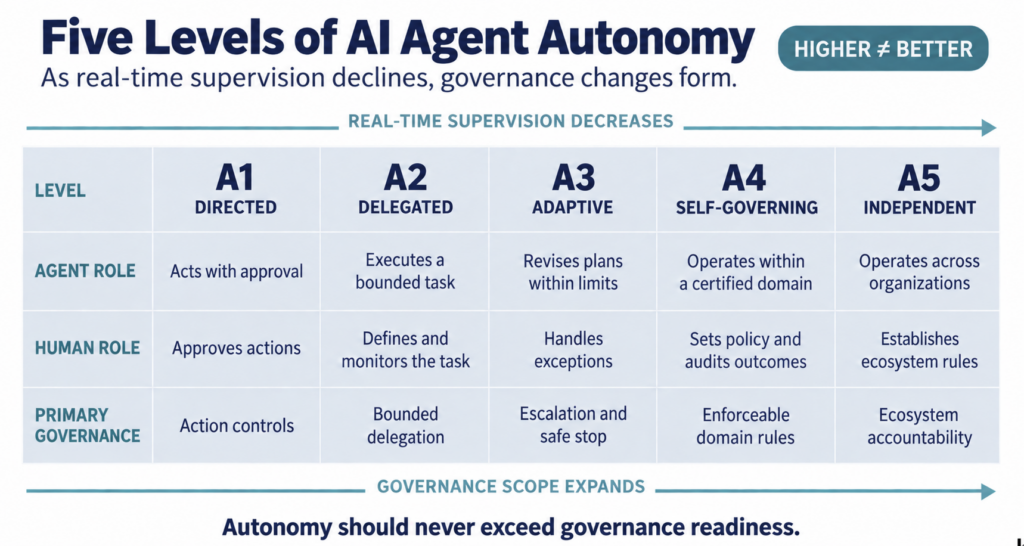
A1, Directed. The human is still driving, monitoring every step and approving decisions. A travel agent at this level searches for flights, but you decide the destination, choose among the itinerary choices, and approve the purchase. Governance means restricted tools, visible actions and explicit approval. The core rule is that assistance never quietly becomes execution.
A2, Delegated. The agent gets a bounded goal and carries out several steps without asking each time. It books a flight within your dates, your preferred airlines and a $1,000 limit. Governance means scoped credentials, spending limits and automatic expiration. Handing an agent a task should never mean handing it all of your permissions.
A3, Adaptive. The flight gets canceled. An A2 agent reports the failure. An A3 agent finds alternatives, weighs the trade-offs and rebooks within your original limits. If every option means changing the destination, going over budget or sharing personal data with an unfamiliar service, it stops and escalates. This is the agent version of the self-driving handoff problem: the system has to recognize the edge of its competence early enough for a human to step in safely.
A4, Self-Governing. The agent runs without routine supervision inside a defined operating domain. A procurement agent negotiates with approved suppliers, places orders within budget and resolves routine disputes with no one watching each transaction. Humans shift from supervising actions to governing the system. They set policy, certify the agent for its domain, audit its behavior and investigate incidents.
A5, Independent. The agent works across organizations self-navigating on the open internet and changing environments with unknown potentially incompatible protocols. It discovers services, evaluates counterparties, negotiates terms and coordinates with other agents. At this level no single user or platform can keep it safe, so governance has to move to the whole ecosystem: verifiable identities, portable reputations, standard delegation credentials, dispute resolution and clear legal responsibility.
Bottom line: An A5 agent executes on its own, but its authority still comes from the person or organization it represents. Autonomy describes how independently an agent operates. Authority decides where, when, how and for whom it may act.
Every step from A1 to A5 moves the human up a level.
Moving from A1 to A5 is often described as taking the human out of the loop. That description misses what actually happens. The human role stays and moves up a level.
At A1, people govern individual actions. At A2, they define and monitor the task. At A3, they handle exceptions. At A4, they write policy and certify the operating domain. At A5, they build the institutions, laws and accountability systems that independent agents work within.
This is Collaborative Intelligence at every rung. People stay in the partnership while their job shifts from approving actions to writing the rules.
Bottom line: As real-time supervision drops, governance has to move from the individual user into the agent, its environment and the institutions around it.
More capable models make more autonomy possible. An agent that understands context, builds plans and recovers from failures needs less supervision.
The loop runs in both directions. Once an agent is allowed to operate, it gains access to tools, feedback, memory and other agents. It learns which plans work, which counterparties are reliable and which strategies hold up under pressure. Organizations will grant more independence as agents get better, and agents will get better as they operate more independently.
That flywheel is why capability should never automatically turn into authority. A highly capable model may belong at A1 because the cost of a mistake is severe. A simpler agent can run safely at A4 inside a narrow, well-controlled domain. The right level depends on risk, reversibility, operating domain and how mature the surrounding governance is.
Bottom line: Intelligence determines what an agent can do. Governance determines what it should be allowed to do.
The goal is appropriate autonomy for each agent, and A5 is not the right target for every one. Some systems should stay at A1 permanently. Others are safe at A4 inside a narrow domain and unsafe beyond it.
Every deployed agent should make eight facts visible: its autonomy level, the principal it represents, its operating domain, the authority it has received, the tools and data it can reach, its financial and time limits, how it escalates and stops safely, and who is responsible for its actions.
No agent should operate at a higher autonomy level than its governance environment can safely support.
Transportation scaled because vehicles evolved alongside roads, standards, licensing, insurance and law, long before any car was perfectly safe. Agents will follow the same pattern. A1 and A2 agents can lean on human supervision. A3 agents need reliable handoffs. A4 agents need enforceable operating domains. A5 agents need a working Agentic Web.
That is where the next wave of company building sits. Agent identity, delegation credentials, action receipts, monitoring and conformance testing are the picks and shovels of the Agentic Web. Founders who build these rules of the road will decide how fast every other agent can safely move.
Bottom line: Governance is what makes greater autonomy possible.
Every enterprise is putting agents to work. Very few can say which rung those agents are on, or what it would take to move them up one.
The winning organizations will not be those that deploy the most autonomous agents. They will be those who can assign the right autonomy to each task, and prove that their permissions, controls, and accountability systems are ready for it.
For those interested in exploring the framework further, you can read Ramesh Raskar’s blog on media.mit.edu that examines the five levels of AI agent autonomy and the parallels with autonomous vehicles.