If I were running a legacy SaaS company today, I wouldn’t be sleeping much.
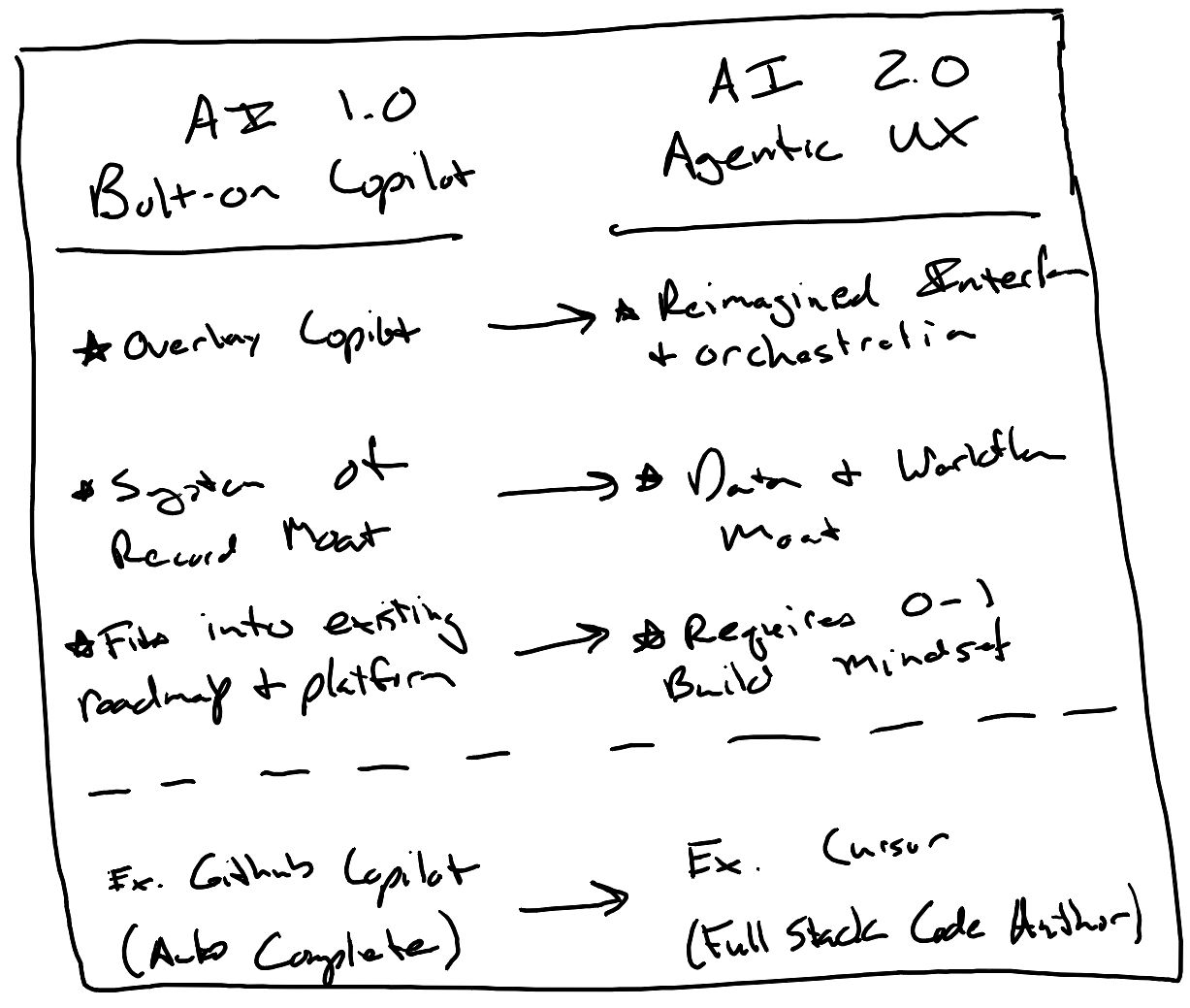
For legacy SaaS startups, pivoting to an AI-native company is an existential challenge, testing the core of the Innovator’s Dilemma. To their credit and courage, most SaaS CEOs are taking action, yet far too incremental, taking an “AI 1.0” approach by adding a copilot to their existing product. Real transformation lies in “AI 2.0″—reimagining the fundamental user interaction from the ground up.
Why the alarm bells are ringing?
AI 1.0 ≠ transformation. Most SaaS incumbents bolt on a “copilot”. Nice demo, small impact.
AI 2.0 re-imagines the interface and workflow. Think GitHub Copilot vs Cursor: autocomplete add-on vs. full-stack code co-author that rewrites files, reasons across repos, and adapts to any model — developers feel the difference instantly.
The system-of-record moat is eroding. SaaS data model-based moat that created stickiness for the last two decades—is being replaced by conversational, intent and agentic based systems. Example: CRM goes from a database to completing RFPs and follow-up emails.
Why Legacy SaaS default to AI 1.0?
SaaS CEOs overestimate stickiness of the current UX and data model. Customers will migrate.
Underestimate CIO/CTO AI mandates (new AI budgets are cannibalizing legacy line items).
Culture favors incremental roadmaps over zero-to-one bets.
How Legacy SaaS can build for AI 2.0?
1. Redesign the interface. Start with the work-to-be-done, not the existing SaaS interface.
2. Build an orchestration layer for agentic workflows, tool calling, and human in the loop. Your current middleware gives a head start; extend it.
3. Staff for 0→1. Put founder-type product & engineering leaders, perhaps in an autonomous pod. Protect them from quarterly roadmap gravity.
4. Incentivize Customer Migration. Ensure incentives of GTM teams are aligned to upgrading and moving existing customers over to the new platform.
Leadership test
Ultimately, this is a test of leadership. The SaaS CEOs and Founders who win will be those with the conviction to build for a new reality, even if it means disrupting their own successful products.