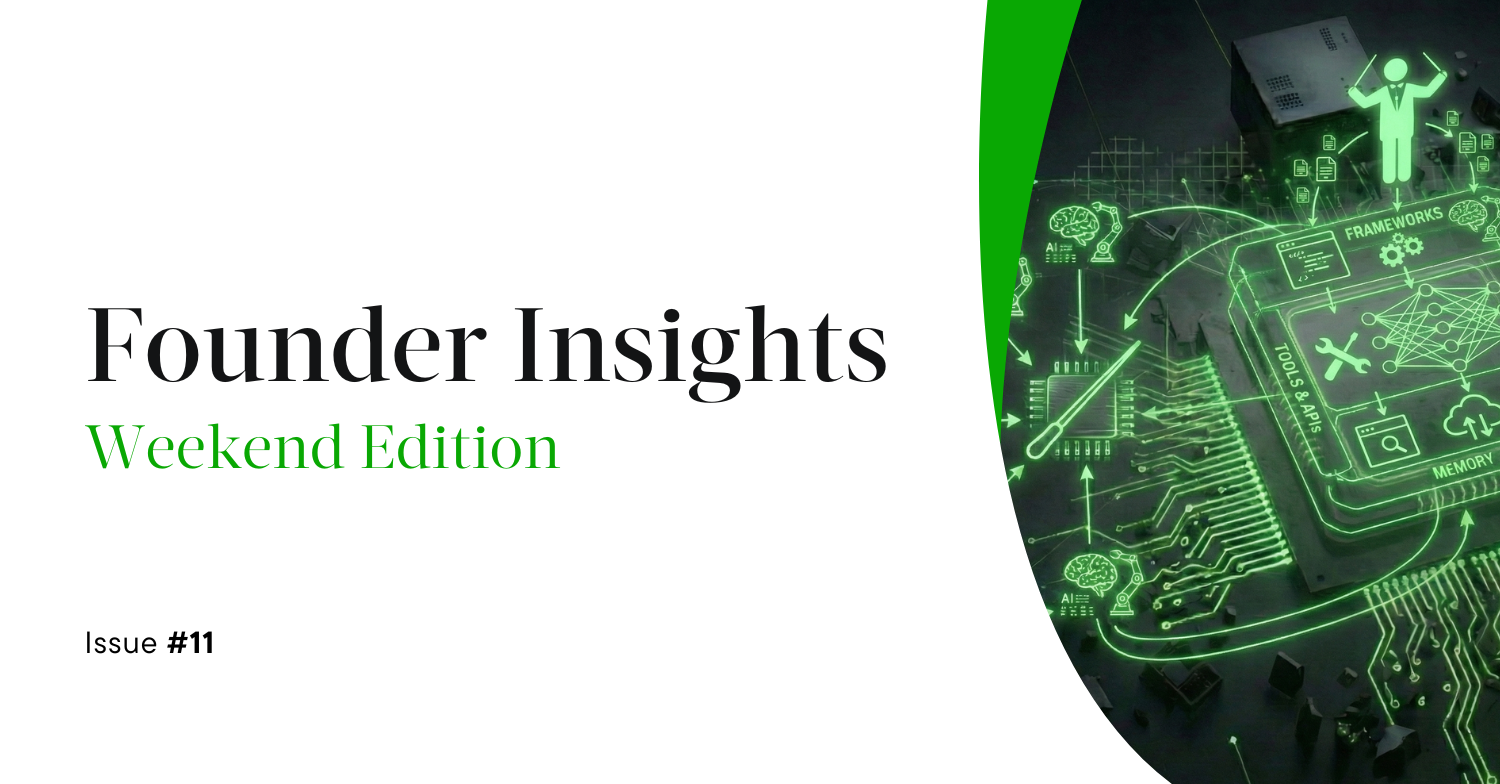
This week, the signals converged around a clear shift: AI is moving from assistive tools toward coordinated systems built to execute. The theme is agentic orchestration, as companies focus less on individual copilots and more on how fleets of AI agents operate continuously, interact with one another, and assume real responsibility within business processes.
Infrastructure shows this shift becoming concrete. NVIDIA introduced the Nemotron model family, designed for persistent, multi-agent workflows, and rolled out standardized AI factory designs to support repeatable, always-on deployment. Security and governance are moving up the stack as well, with Palo Alto Networks and Google Cloud expanding protections for agentic systems as enterprises push agents into production environments.
In the enterprise, orchestration is replacing experimentation. Salesforce brought Agentforce directly into ChatGPT to power autonomous sales workflows. Zoom expanded AI Companion beyond meetings into agent-driven task execution across the workplace. Anthropic opened Agent Skills as a standard, pointing toward interoperable, reusable agent capabilities rather than isolated implementations.
Capital, research, and policy followed the same direction. Large rounds for Databricks, Lovable, and PolyAI reflect conviction behind platforms designed to deploy and monetize agents at scale. Research continues to clarify when multi-agent systems outperform single models, from security testing to scientific reasoning. New foundations and public-sector initiatives signal growing urgency around standardizing how agent systems are built, managed, and trusted.
AI continues to advance quickly, but this week made the direction clear. The next phase will be defined by how well organizations orchestrate fleets of agents across infrastructure, data, and governance, not just by incremental gains in model capability.
Here is your Saturday guide to the signals shaping the future of AI:
Infrastructure
NVIDIA debuts the Nemotron 3 model family for multi-agent orchestration, introducing Nano, Super, and Ultra variants optimized for persistent agent workflows with higher throughput and reduced context drift, positioning the models for large-scale, always-on AI assistant and agent systems. Click here
Palo Alto Networks and Google Cloud expand their partnership to secure agentic AI deployments by integrating Prisma AIRS with Google Cloud’s AI stack to protect AI agents, models, and data as enterprises move agent systems into production. Click here
NVIDIA rolls out repeatable AI factory data center designs, partnering with Siemens, Schneider Electric, and Trane to standardize power, cooling, and control architectures using digital twins, aiming to speed deployment and scale multi-gigawatt AI infrastructure more efficiently. Click here
Enterprise
Wipro and Microsoft sign a three-year AI partnership centered on agents, emphasizing large-scale Copilot rollouts and Wipro’s Agent Marketplace, marking a shift from standalone copilots to full agent ecosystems for enterprise customers. Click here
Salesforce launches Agentforce Sales inside ChatGPT to let sellers prioritize deals, plan accounts, and update Salesforce directly from a ChatGPT conversation, reducing workflow friction and bringing autonomous sales agents into daily CRM work. Click here
Zoom rolls out AI Companion 3.0 with agentic automation and browser access, expanding beyond meeting summaries into low-code workflows, federated model orchestration, and proactive task execution across Zoom Workplace, signaling a push to make AI agents a daily work surface rather than a meeting add-on. Click here
Anthropic makes Agent Skills an open standard, opening up its Claude Skills framework so enterprises and developers can share, deploy, and manage reusable agent capabilities more easily, reinforcing momentum toward interoperable, production-ready agent ecosystems. Click here
Capital Flows
Lovable raises $330 million at a $6.6 billion valuation as vibe-coding goes mainstream with the Stockholm-based startup tripling its valuation in five months as investors back its text-to-app platform, which has surpassed $200M in ARR in its first year and signals strong capital conviction behind agent-driven software creation tools. Click here
Databricks raises $4 billion at a $134 billion valuation to double down on AI agents, signaling strong investor conviction as the company scales databases and platforms purpose-built for building, deploying, and monetizing enterprise AI and agentic applications. Click here
PolyAI raises $86 million at a $750 million valuation to scale voice AI for customer service, as the London startup expands automated phone agents across energy, banking, and hospitality, signaling strong investor demand for AI that can handle high call volumes and replace manual support. Click here
NVIDIA acquires SchedMD, steward of the Slurm scheduler, bringing the widely used open-source workload manager deeper into NVIDIA’s AI stack while keeping it vendor-neutral, reinforcing Slurm’s role as core infrastructure for scheduling large-scale AI training and inference workloads. Click here
Salesforce agrees to acquire Qualified to bring agentic marketing into Agentforce, adding “always-on” website agents that qualify inbound traffic, capture intent, and schedule meetings to turn web engagement into pipeline. Click here
Research
OpenAI launches FrontierScience to measure AI’s scientific reasoning, showing fast gains in physics, chemistry, and biology while underscoring that models are becoming collaborators in research, not independent scientists. Click here
ARTEMIS AI agent beats 9 of 10 human penetration testers in live security research, as a Stanford and CMU study shows multi-agent AI matching top human results at far lower cost, pointing to scalable, continuous AI-driven security testing. Click here
Google research clarifies when multi-agent AI beats single agents, showing that single agents work better for sequential tasks, while coordinated multi-agent systems outperform on parallel workloads like financial analysis. Click here
AI diagnoses a hard-to-detect heart condition from a 10-second EKG, showing how narrowly trained models are expanding the scope of tasks that healthcare agents could autonomously handle or triage. Click here
Policy
The U.S. Energy Department signs AI deals with Big Tech for the Genesis Mission, partnering with Microsoft, Google, NVIDIA, OpenAI, and others to deploy AI models and infrastructure across national labs to accelerate scientific research and energy innovation. Click here
U.S. House passes SPEED Act to fast-track AI infrastructure permits, approving a bill backed by companies like OpenAI, Microsoft, and Micron that tightens environmental review timelines to accelerate AI data center and energy projects. The bill now moves to the Senate for consideration. Click here
Linux Foundation launches the Agentic AI Foundation to standardize open agent infrastructure, bringing Anthropic’s MCP, Block’s goose, and OpenAI’s AGENTS.md under neutral governance to accelerate interoperable, open standards for building and deploying agentic AI systems at scale. Click here
Global AI Strategy
SCALE AI commits a record $129 million to accelerate applied AI deployment in Canada, backing 44 new projects across healthcare, energy, infrastructure, and media as public–private capital flows into agentic and generative AI systems to strengthen domestic competitiveness and digital sovereignty. Click here
The U.S. government launches “Tech Force” to hire AI talent, an Office of Personnel Management program to recruit 1,000 early-career software engineers, data scientists, and AI specialists for two-year roles across federal agencies. Click here
OpenAI hires former UK chancellor George Osborne to lead its $500 billion Stargate project, appointing him as managing director of OpenAI for Countries to oversee partnerships with national governments on AI infrastructure and data center development outside the US. Click here
Accenture and Palantir expand global AI partnership, launching a joint business group to help enterprises integrate siloed data, scale AI adoption, and improve operational decision making across industries. Click here
Talent Signals
Each week, we spotlight key roles tied to the themes shaping this week’s AI headlines, connecting talent to the companies driving the news.
Sema4.ai is focused on deploying long-running AI agents inside enterprise workflows. As organizations move from pilots to always-on agent systems, Sema4 is building the orchestration, control, and governance layers needed to operate agents reliably. The team is hiring across Engineering, Product, and AI roles to support production deployments in regulated and complex environments. Click here
LangChain provides core infrastructure for building and operating agentic applications. As multi-agent systems become more common, LangChain is expanding its platform for orchestration, evaluation, observability, and deployment. The company is hiring across Engineering, Product, and Developer Experience to support teams running agents in production rather than demos. Click here
CrewAI is building an open framework for coordinating multiple AI agents to execute real tasks together. As interest grows in agent collaboration, workflows, and task delegation, CrewAI is hiring across Engineering and Product roles to support developers building multi-agent systems. Their work reflects the shift toward coordinated agents rather than standalone models. Click here
You can see all the opportunities at Mayfield-backed AI companies here, and across the broader ecosystem here.
Social Signals
The most important conversations in AI are unfolding across social media, where top voices are shaping the next wave of signals and strategy. Here are some of the top social signals and their takes from the past week.
Aaron Levie (Click here) — “We will soon get to a point… that almost any time something doesn’t work with an AI agent in a reasonably sized task, you will be able to point to a lack of the right information that the agent had access to. This is why context engineering is the future.” Levie expands on the challenge of building agents that behave like an “insanely smart human” who shifts roles constantly, forgets between tasks, and can only hold a limited amount in working memory. The signal emphasizes that the hard work now lies in search, retrieval, ranking, system prompts, and efficient context management, reinforcing why information delivery, not raw model intelligence, is becoming the defining constraint in agentic AI systems.
Andrew Ng (Click here) — “As amazing as LLMs are, improving their knowledge today involves a more piecemeal process than is widely appreciated.” Ng pushes back on both AGI hype and dismissal narratives, arguing that while LLMs are more general than prior systems, they remain far less general than humans. He outlines how progress now depends on labor-intensive, data-centric approaches, from curating domain-specific datasets to building RL environments for narrow skills. The signal reframes frontier AI advancement as a long-term engineering effort rather than a near-term AGI leap, underscoring that sustained, incremental work will continue to drive meaningful gains.
Alex Prompter (Click here) — “Can LLMs actually discover science, or are they just good at talking about it?” Prompter highlights a new Harvard–MIT paper that evaluates models across the full scientific discovery loop, from hypothesis formation to experimental revision, rather than surface-level benchmarks. The findings are sobering: while LLMs can propose hypotheses, they struggle with iterative experimentation, causal reasoning, and abandoning incorrect theories. The signal underscores a critical gap in today’s AI narratives, reinforcing that scientific intelligence is not the same as language fluency, and that true discovery requires feedback, memory, and the ability to revise beliefs when evidence contradicts them.
To go deeper, subscribe to my monthly Founder Insights newsletter, where I share lessons from the frontlines of company building, perspectives on AI’s future, and our industry’s road ahead.
↓ Drop a note in the comments with the areas of AI you want us to explore next.