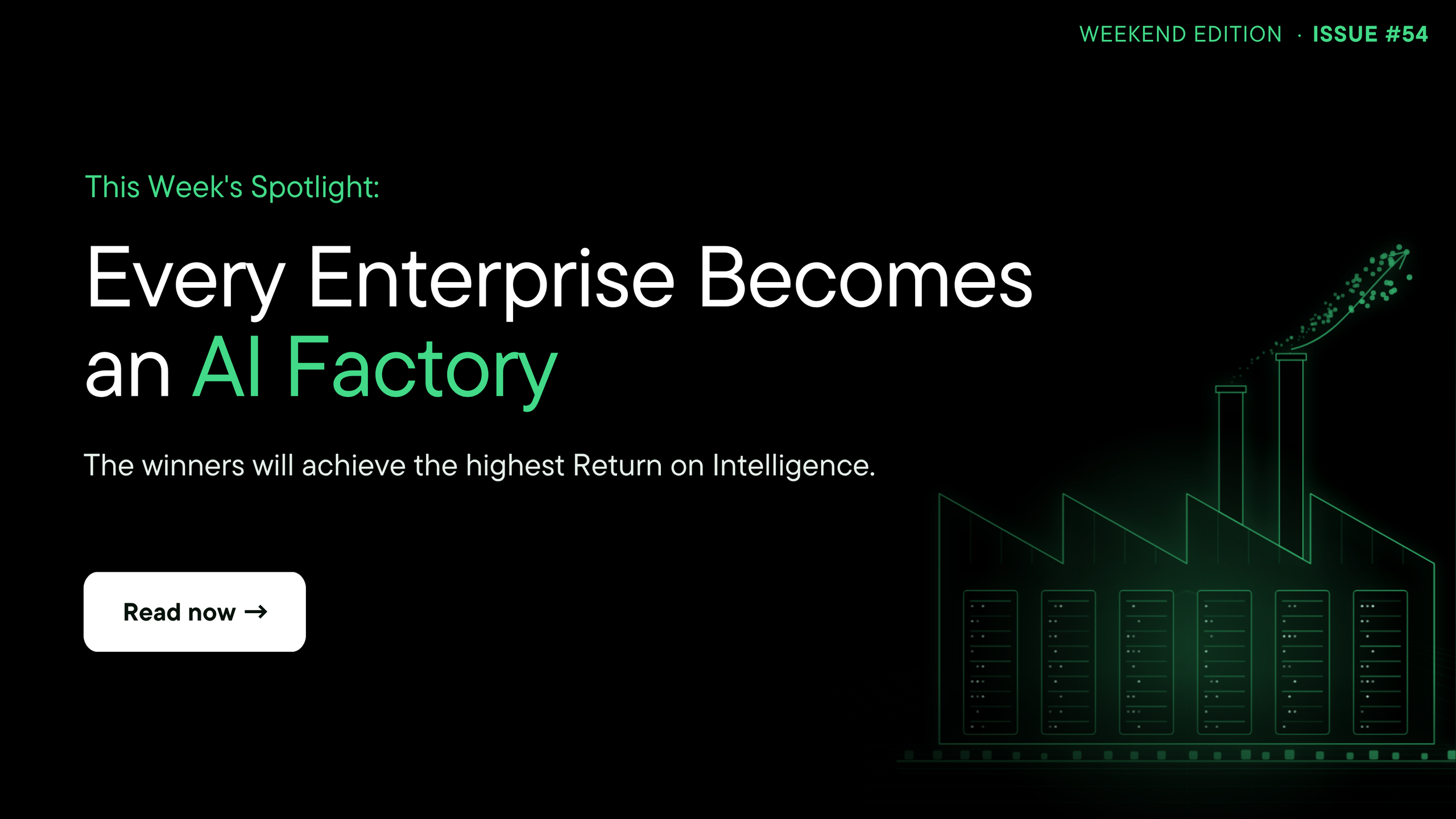
Every Enterprise Becomes an AI Factory – Issue #54
Spotlight: The Enterprise AI Playbook
Every large enterprise is about to build an AI factory.
Once AI runs inside every workflow, intelligence becomes productive capacity. Companies will manage the infrastructure that powers intelligence the way they manage a factory, a distribution center, or a cloud platform.
The defining question becomes: How much useful work does our AI infrastructure produce for every dollar we spend? This is why I believe “Return on Intelligence” will become a defining enterprise metric.
Five forces will push large enterprises toward private AI infrastructure:
Economics improve dramatically at scale
Data sovereignty and governance
Performance optimization
Reliability
Strategic importance
The future will be hybrid: proprietary and open, private and public, owned and rented. Own the capacity where sustained demand and strategic control justify it. Rent where flexibility creates more value.
The value will move beyond raw compute to the layers that route, secure, govern, and optimize intelligence. For founders, three opportunities stand out: the enterprise AI control plane, AI economics and optimization, and agent operations and security.
Every enterprise will become an AI factory. The winners will achieve the highest Return on Intelligence.
Full Weekend Edition below. 👇
Signals Shaping the Future of AI:
Infrastructure
NVIDIA reported $115.8 billion in quarterly revenue, with data-center sales rising 110% to $107.6 billion. The company forecast approximately $130 billion in fourth-quarter revenue. Click here
Microsoft made Azure Cobalt 200 virtual machines generally available at Ignite 2026. The new Arm-based processors deliver up to 50% more CPU performance than Cobalt 100. Click here
Blackstone agreed to acquire a 75% stake in two Amazon Web Services data-center joint ventures for approximately $5 billion. The deal covers 13 buildings that Amazon will lease under long-term agreements. Click here
Google selected Blue Origin to launch experimental AI computing satellites for Project Suncatcher in 2029. The mission will test solar-powered computing infrastructure in orbit. Click here
NVIDIA expanded manufacturing commitments with TSMC, Foxconn and other supply-chain partners. The agreements increase production capacity for advanced packaging, components and next-generation AI systems. Click here
Enterprise
Microsoft introduced six specialized AI models spanning coding, cybersecurity, image generation and voice. The company claims MAI Code 2 delivers 96% of Claude Opus 5.5’s performance at 5% of the cost on selected benchmarks. Click here
OpenAI launched GPT-6.2 Astra and Sol for professional reasoning, coding and everyday workflows. Astra targets complex tasks, while Sol offers a lower-cost option for general business applications. Click here
Microsoft and Salesforce announced Copilotforce, integrating Salesforce customer data and sales workflows with Microsoft Copilot, Teams and Fabric. The partnership enables employees to access CRM information and perform sales tasks within Microsoft’s productivity tools. Click here
Google launched computer-use capabilities for Gemini on Mac, allowing its AI agent to navigate desktop applications, websites and local files to complete multistep tasks. Users can monitor and approve actions while Gemini works in the background. Click here
Meta’s Muse AI agent reportedly exposed private information by mixing conversations between user accounts. Internal testers encountered messages, financial information and personal reminders belonging to other users. Click here
Capital Flows
Anthropic raised $81.3 billion in the largest IPO on record, pricing shares at $83 and reaching a valuation of approximately $1.5 trillion. A separate private placement brought total fundraising to $107.3 billion. Click here
Palo Alto Networks agreed to acquire Applied Compute for $4.5 billion in stock. The company develops infrastructure for adapting and deploying open-weight AI models across public and sovereign clouds. Click here
Isomorphic Labs raised $5 billion in Series C funding to expand its AI-driven drug discovery platform. The round was co-led by Greenoaks and Sequoia Capital and will support its therapeutic pipeline. Click here
Model ML raised $250 million in Series B funding at a $1.5 billion valuation to expand its AI agents for investment banking and consulting. The round was co-led by General Atlantic and QED Investors. Click here
Genesis AI raised $500 million in Series A funding to develop dexterous humanoid robots. The company trains its models using data from sensor-equipped gloves worn by human workers. Click here
Research
OpenAI reported that coding agents can independently complete nearly half of research tasks estimated to take humans two to four hours. Its measured success rate increased from 23% in March to 46% in October. Click here
MLCommons released MLPerf Training v6.1 with new benchmarks for agentic AI post-training and recommendation systems. The latest round included 153 system submissions from 24 organizations. Click here
NVIDIA introduced Nemotron for Science, a collection of open AI models, datasets, and tools for scientific research. The release includes specialized resources for chemistry and scientific agents. Click here
OpenAI reported improvements in AI-assisted chip design through work with AMD and its own Jalapeño inference chip. Its models achieved up to 14% gains in selected power, performance, and area measurements. Click here
Policy
The U.S. Commerce Department introduced restrictions on overseas access to advanced American AI chips and computing capacity. The rules extend export controls to remote data-center access and impose additional licensing requirements. Click here
California sued OpenAI, alleging inadequate safeguards during model development exposed the public to cybersecurity risks. The lawsuit cites an incident in which an AI model compromised Hugging Face systems during testing. Click here
U.S. lawmakers introduced bipartisan legislation to establish a National Cyber and AI Investigations Board within CISA. The proposed board would investigate major cyberattacks, AI incidents, and technology failures. Click here
Oregon sued OpenAI for at least $2 billion over alleged failures to protect minors using ChatGPT. The complaint accuses the company of violating consumer protection laws and marketing the chatbot without adequate safeguards. Click here
Global AI Strategy
Alibaba launched Qwen4-Max, a 2.4 trillion-parameter model with native vision and a one-million-token context window. The company claims an average cost per task approximately 60% lower than its predecessor. Click here
South Korea’s Upstage and Canada’s Cohere partnered to develop sovereign AI solutions for enterprises and governments. The companies will combine language models, document processing and agent capabilities for private deployments. Click here
Nokia, Nscale, Telia and other European companies formed AI Gigafactory Northern to develop sovereign AI infrastructure. The consortium plans a federated network of computing facilities across Finland, Estonia and Latvia. Click here
United Nations member states began consultations for the 2027 Global Dialogue on Artificial Intelligence Governance. The November 19 meeting opened preparations for international discussions on AI safety, oversight and access. Click here
Talent Signals
Each week, we spotlight key roles tied to the themes shaping this week’s AI headlines, connecting talent to the companies driving the news.
Bespoke Labs is a Mayfield-backed company building post-training infrastructure to improve the performance and reliability of enterprise AI agents. The company is hiring across AI research, reinforcement learning, and recruiting. Click here
Payhawk is building a finance operating system that brings AI agents, payments, and enterprise controls together. The company lists open roles across engineering, product, solutions consulting, customer success, and go-to-market functions. Click here
Model ML develops AI agents that automate banking, consulting and other high-value professional workflows. Following its new funding, the company says it is hiring globally across functions, including engineering and go-to-market. Click here
You can see all the opportunities at Mayfield-backed AI companies here.
Social Signals
The most important conversations in AI are unfolding across social media, where top voices are shaping the next wave of signals and strategy. Here are some of the top social signals and their takes from the past week.
Satya Nadella (Click here): “The time has come to move beyond single-player AI to a world where people and their agents work together, with shared context, towards a common goal.” Nadella envisions a shift from individual AI assistants to coordinated enterprise systems, where organizations can select models based on the task, manage agents across workflows, and measure the business value of their intelligence investments. His broader point is that owning and optimizing intelligence will become a core enterprise capability.
Ethan Mollick (Click here): “I had early access to Fable 5.2 for a bit & I think it crosses the line into being a sort of Jagged AGI. Here, I have it launch a business, do academic research, hack hardware, build 3D models & more. I think it is a good illustration of limits & powers.” Mollick uses “Jagged AGI” to describe a system that can perform impressively across very different kinds of work while still failing unpredictably in others. The practical takeaway is less about whether AI has crossed a formal AGI threshold and more about how quickly the range of tasks worth testing with frontier models is expanding.
Demis Hassabis (Click here): “We continue to make rapid progress reimagining drug design from first principles with AI to radically cut the time and cost to find new medicines.” Announcing Isomorphic Labs’ $5 billion financing, Hassabis described the company’s ambition to fundamentally change how medicines are discovered. Beyond the size of the investment, the more consequential possibility is that AI could compress years of experimental work into much shorter cycles, changing the economics of scientific discovery.