


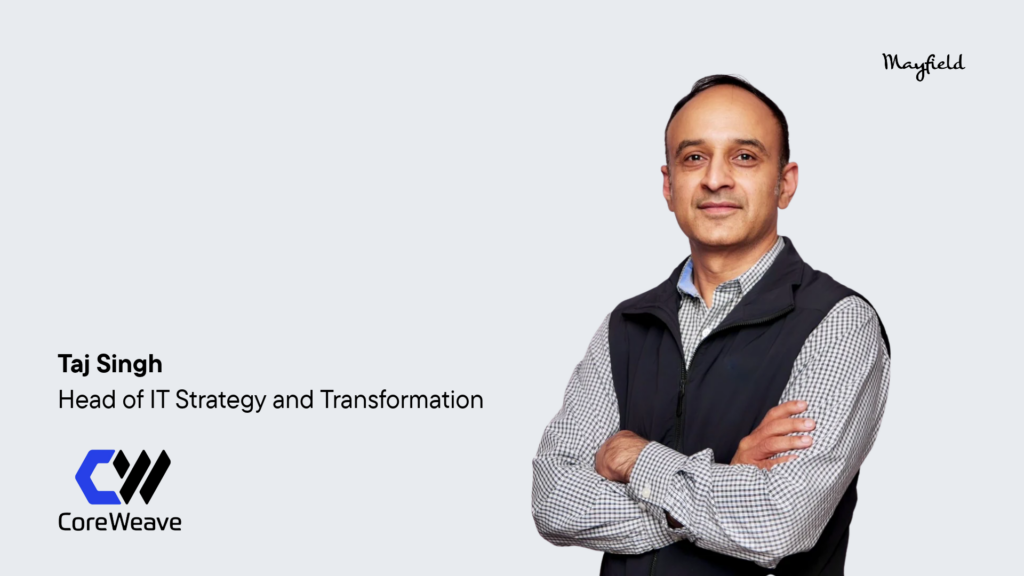
Our latest CXO Insight Call with Taj Singh, Head of IT Strategy and Transformation at CoreWeave, offered a candid look at what it takes to rebuild IT for the agentic enterprise, including the experiments that worked, the failures that forced progress, and the capabilities still under construction.
During Taj’s tenure, CoreWeave has grown from approximately 500 to nearly 4,000 employees. Even with an AI-native starting point, the hard work involves data, leadership, organizational ownership, and rethinking processes.
Five insights stood out from our conversation:
1. The real measure of transformation is how much the work changes.
CoreWeave employees have created approximately 100 agents outside IT, and IT has productized and secured more than 50 enterprise-grade agents. Yet Taj considers only five truly transformational. These agents change how work happens across people and systems: resolving hiring-data errors between recruiting and HR, or letting employees scan equipment with a phone to initiate receiving, compliance steps, and ERP submission. The value comes from rethinking the handoffs and responsibilities within a process.
2. AI adoption is a business leadership responsibility.
Taj described a substantial adoption gap between departments with active business leadership engagement and those without it. CoreWeave periodically reports departmental adoption to its e-staff and board, creating visibility and accountability. IT can provide the platform and support, but business leaders must own how their teams use it.
3. Real use cases can become the forcing function for better data.
An emergency parts-ordering agent didn’t perform well because essential vendor information was stranded in spreadsheets. That prompted the team to build a supporting data-cleansing agent. A concrete business need gave the data work urgency and direction, revealing which gaps needed attention.
4. Scaling agents requires new roles and shared accountability.
Agent operations engineers and AI enablement leads are emerging alongside forward-deployed engineers. Business teams own local initiatives, with IT providing shared capabilities and guardrails. AI Ambassadors and hackathons help employees turn firsthand knowledge of a problem into something useful. Building the organization to run these agents is becoming as important as building the agents themselves.
5. Product thinking means questioning the process itself.
Taj challenged sequential workflows that preserve old handoffs and approvals. Start with the desired outcome, then reconsider which steps can happen in parallel, which can disappear, and where human judgment adds value. His team speaks with an actual end user every week to keep that work grounded.
One of the most valuable parts of the discussion was Taj’s openness about what remains unfinished, including the manual work still involved in security and the evaluation capabilities still to come. His framing: 2026 is the year of volume; 2027 is the year of value and scale.
For me, this made the CIO’s shift from operator to product leader tangible. It changes how you hire, what you measure, and how deeply you understand the work your organization performs.