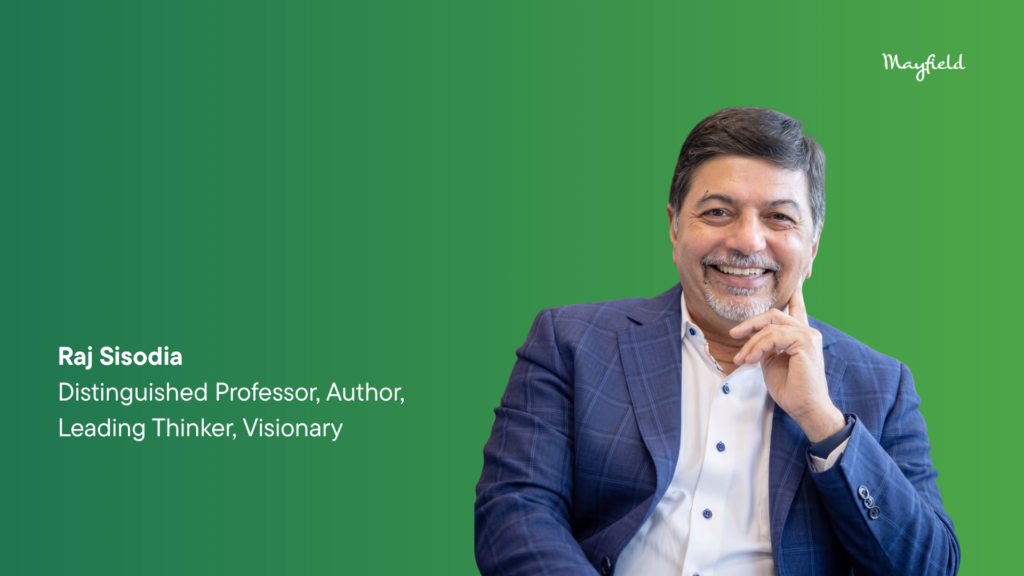
Raj offered a deeply optimistic way to frame this moment: AI can do far more than improve efficiency. It can help organizations unlock creativity, deepen relationships, serve stakeholders better, and free people to do more meaningful and distinctly human work.
His central message:
AI is a mirror and a multiplier. It does not supply our values; it scales them.
Key takeaways
Conscious Capitalism is an operating system for the AI-first enterprise. Its four pillars—higher purpose, stakeholder integration, conscious leadership, and a conscious culture—provide a practical lens for deciding how AI should be used.
Move from substitution to amplification to elevation. AI can automate tasks. More importantly, it can amplify what people accomplish and ultimately elevate what only humans bring: judgment, creativity, empathy, imagination, connection, and wisdom.
The productivity numerator matters. If AI liberates 20–30% of an organization’s capacity, leaders should first ask what new customer needs, experiences, products, and businesses that capacity can now address.
Purpose must precede productivity. AI gives organizations greater capability. Purpose determines what that capability is used to create.
The CIO mandate is expanding. The CIO is becoming an enterprise architect, human-potential multiplier, trust steward, and value creator—helping design the AI-first enterprise from first principles.
Conscious AI must become operational. Raj outlined six principles: purpose before deployment, stakeholders before optimization, augmentation before elimination, human accountability, transparency and trust, and continuous learning after launch.
Questions for every leadership team
What are we ultimately trying to make possible with AI?
What new value can liberated human capacity create?
Who benefits, and whose perspective could improve the outcome?
How can AI help us become more creative, caring, purposeful, and worthy of trust?
Conscious Capitalism, by John Mackey and Raj Sisodia—the foundational framework and four pillars.
Firms of Endearment, by Raj Sisodia, David Wolfe, and Jagdish Sheth—the performance case for stakeholder-oriented companies.
Healing Leaders, by Raj Sisodia and Nilima Bhat—how personal growth can strengthen leadership and organizational health.
Incorruptible, by Eric Ries—how governance and organizational design can preserve purpose as companies scale.
Trust., by Dominique Shelton Leipzig—a practical framework for responsible AI, innovation, privacy, and data leadership.
For additional information about Conscious Capitalism—or to arrange a one-on-one follow-up conversation—please contact Hitesh Shah, Director at RSM US and a board member of Conscious Capitalism, Inc., at hitesh.shah@rsmus.com.