


This article is part of our Future of AI series from Imagination in Action 2025 Silicon Valley Summit — where founders, leaders, and investors explored what’s next for AI. Explore the magazine.
Companies are incorporating AI into almost every work process imaginable: assembly lines, space robots, hospital systems, and even mental health support. But rather than eliminating humans or their jobs, the most strategic AI companies want to work alongside them.
AI innovators need to balance the role of AI agents and humans in our work. For many, the goal is to design systems, tools and environments that will enable AI agents to complement what we do, rather than replace us. Rather than automation, these companies are focused on augmentation.
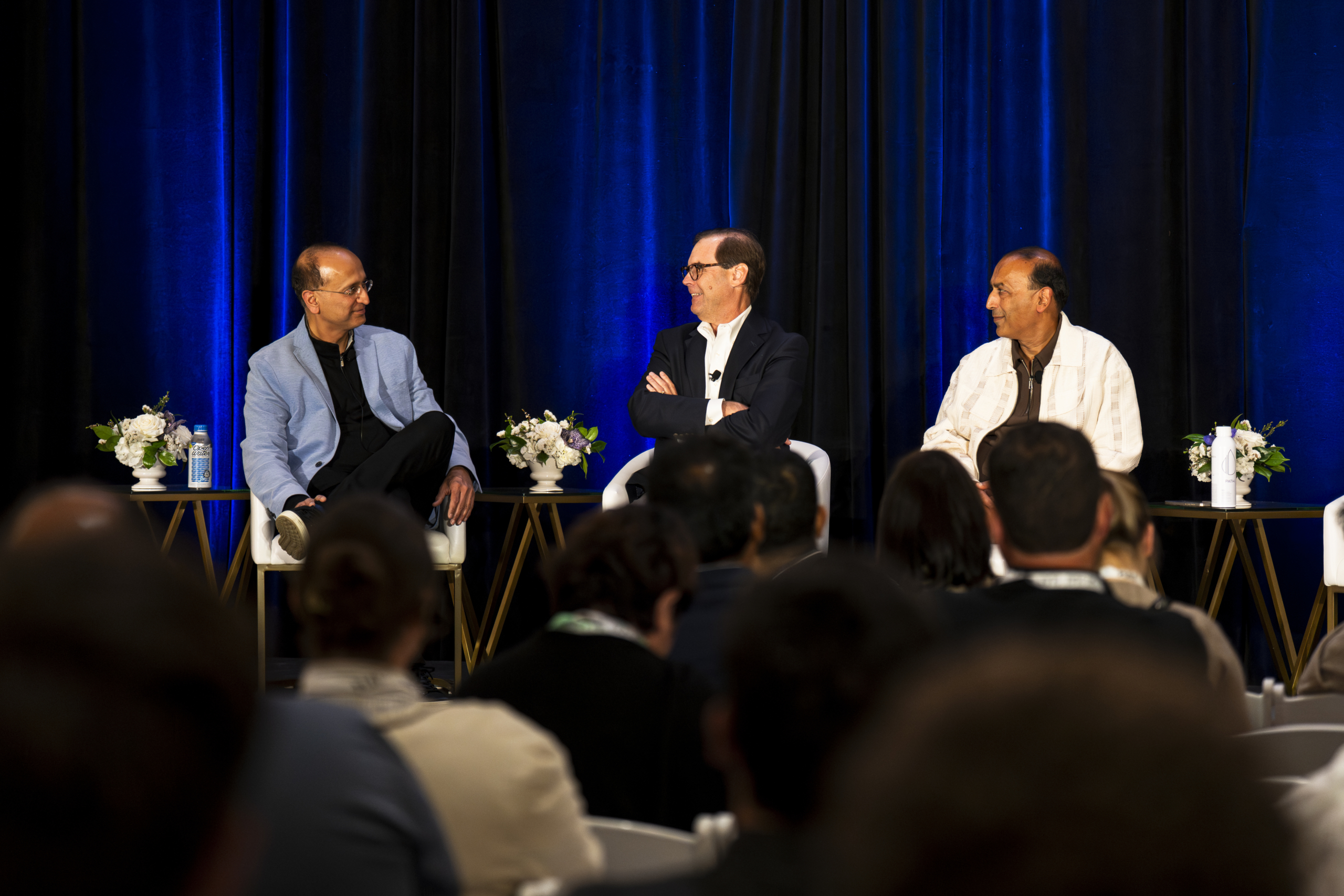
“One of the biggest opportunities—beyond the hardware—is the rise of AI teammates,” said Navin Chaddha, managing partner at Mayfield, at the recent Imagination in Action summit.
AI pioneers are excited about opportunities to connect more of the physical aspects of our world with these digital companions. The human-AI agent relationship could be further developed through extended and augmented reality interfaces, wearables and other embodied robotics.
If done right, this points to a future where AI agents and robots are more adaptive, context-aware, and seamlessly integrated into daily life and work.
Understanding AI agents
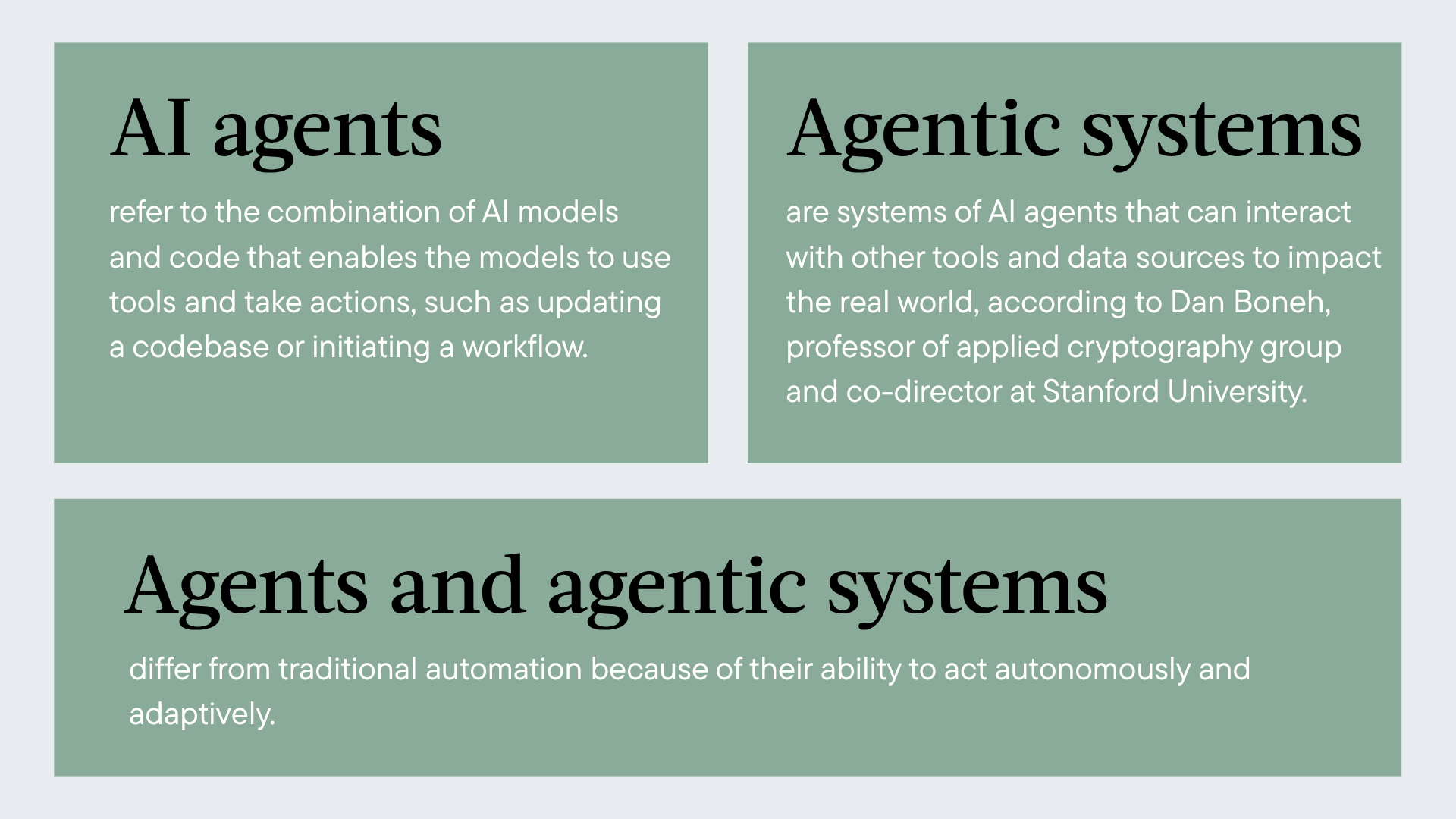
AI agents and agentic systems may seem futuristic, but are already becoming widespread in the real world.
An autonomous vehicle, for instance, is an agentic system that integrates perception, planning and a deep understanding of the world to operate.
Not all agents are created equal. Experts break down the types of AI teammates or digital companions based on their roles and expertise within a company. For instance, some can be considered comparable to interns: They need to be given clear instructions and a development path with small tasks. As agents gain experience and reliability, they may eventually be delegated more work and granted greater autonomy, like a junior employee.
Other expert agents might fill specialized roles, such as managing literature searches, generating hypotheses, and planning experiments in a virtual lab setting. In this context, there may be a designated AI “professor” agent and a group of “student” agents in the research team. That’s what James Zou, associate professor of biomedical data science at Stanford University, is currently building with his virtual lab replica, so that AI agents can work with each other in different domains.
Although “discovery rate is accelerated,” AI isn’t yet trained to always ask the right questions. It’s up to humans to retrain the models and change their reward objectives, Zou said.
The key to successful enterprise agents
Many startup founders are embracing the idea of an “agentic-first” startup, where AI agents significantly outnumber human employees, handling many tasks previously reserved for humans, such as product design, coding, sales, fulfillment, and customer support, leading to exceptionally high revenue per employee.
Yet a recent finding from MIT’s Networked Agents and Decentralized AI initiative showed a 95% failure rate for enterprise AI solutions. Only about 5% of AI pilot programs saw rapid revenue acceleration, while the majority remain stuck with no impact on revenue.
The issue seemed to be a “learning gap” in most organizations, because they weren’t adapting their workflows to incorporate AI properly.
Lisa Dolan, managing director at Link Ventures, believes adoption in the enterprise has been hard because of the different verticals across a company. Dolan points to needing more training for agents in order to overcome the learning gap, building trust over time and then rolling them out into different verticals as they get better at low-level tasks.
“What I’m really interested in is the end-to-end workflow, adoption and training, similar to how you would train a junior employee,” Dolan said. She believes this iterative process could help bridge the “missing link” in current enterprise adoption, particularly if companies are hesitant to give agents autonomy when they haven’t proven themselves on simpler problems.
In another conversation with Gamiel Gran, chief commercial officer at Mayfield, CIOs of several organizations shared their perspectives on how AI will change enterprise technologies.
For example, Naveen Zutshi, CIO of Databricks, explained how the company has focused on building an AI agent’s knowledge base for handling customer support. The AI needs to be able to answer specific questions from that environment, as opposed to just generic questions. So Databricks’ goal for the software was building case routing, case forwarding, and case forecasting that utilized deep customer and product knowledge specific to the company.
Scaling with humans at the center
If the idea is for AI to augment human capabilities, we have to view the process like a relationship. It moves beyond a simple dynamic of a user and their tools to a more integrated and collaborative partnership, which spans the entire lifecycle of AI, from initial training and design to ongoing collaboration, supervision and evaluation.
In all cases, experts agree that humans need to be at the center of these changes, including providing human input for training and refining AI models, as well as ensuring that their outputs are aligned with human intent and preferences. Companies like Anthropic have begun to train their models on user feedback to better understand how to support different customers and use cases.
In discussion with Chaddha, Rob Bearden, founder of Cloudera and current CEO of enterprise AI company Sema4.ai, suggested that many businesses are trying to understand the role of agentic technology and determine its use cases. The key is to understand where it fits in the stack, which components to use, and how to unlock it at scale—then repeating the application of AI across supply chain, product, and customer engagement.
Bearden noted that agentic AI may convey lasting advantages to its early adopters, comparable to the way other transformative enterprise technologies have worked. “This is a force multiplier opportunity,” Bearden said. “If you do it right, there’s a huge benefit.”
Brian Elliot, CEO of AI development platform Blitzy AI, emphasized the importance of establishing trust and regulatory compliance with autonomous decision-making agents. He advised forming a responsible AI framework and technical documentation where we can clearly trace an agent’s actions.
In short, humans-in-the-loop—keeping people involved in key decisions—is critical to mitigating risks in enterprise data and IP.
Companies also need to ensure that non-technical employees are fully engaged with the technology. The companies that succeed with agentic AI will be those that enable subject matter experts, who are often non-technical, to bring their contextual knowledge into the agent-building process.
“AI agents are a force multiplier. If you do it right, there’s a huge benefit.”
Rob Bearden, Sema4.ai
From education to scientific research, AI agents are already being deployed as experts to leverage specialized data, models and contextual knowledge to perform tasks that traditionally require deep human expertise. These early deployments show great promise.
Take DeepMind, the AI research and product team within Alphabet, which is using a system of agents as research assistants in discovering new targets for liver fibrosis. Another example is the AI foundation Open Athena’s software engineers and AI experts, who are working with academic labs to build scientific models for weather and plant genomics. These approaches help academia and enterprise develop more AI training to advance their specific fields.
The big picture? AI benefits society when builders understand the people they’re building for.
Building security and responsibility
As many cybersecurity experts mentioned, a whole new level of security needs to be in place when we employ AI.
“What we’re moving towards now is where the security engineer’s job will be to train the machine,” said Heather Adkins, VP of security engineering at Google. “The security person becomes a guide, an orchestrator making decisions for the business with the business context.”
Some agentic systems raise significant security concerns. An agent could be tricked into taking harmful actions or exposing sensitive data. Depending on the agent’s access privileges, that could be quite harmful—for example, some AI agents can read and send corporate emails autonomously.

Moinul Khan, CEO of AI security company Aurascape, warns of the major blind spot in how enterprises are handling the hundreds of new AI tools, including agents, being used by employees. While organizations have firewalls to keep bad actors out and web proxies to keep data safe, these traditional security stacks are often completely inadequate for the new challenges posed by AI.
Security leaders also have to understand how hackers have evolved with AI, and that many are already starting to use agents to automate the process of finding security flaws and exploiting them.
Job market impact—and opportunity
AI agents are poised to fundamentally reshape the labor market. Significant job disruption and displacement will take place in some areas.
“The history of automation says that jobs change. The people who invest in and participate in that change learn to harness and surf that change, and they do great,” said Astro Teller, co-founder and CEO of X at Alphabet. “People who resist that change tend to do less great.”

The most repetitive, routine tasks are likely to be replaced by agents in the near future. This will impact the ratio of humans to AI teammates at some companies, and some roles may see a reduction.
However, other roles could actually see growing employment, according to a study by Stanford and ADP. The researchers found a 13% employment decline in the most AI-exposed occupations, but also found that “entry-level employment has declined in applications of AI that automate work, but not those that most augment it.”
This means many employees will need reskilling. AI literacy will become embedded into many jobs. And the nature of many jobs will change completely, as new tasks involving agents are created, opening new opportunities for employment that we haven’t yet imagined.
Another shift is that many employees will shift from being individual contributors to becoming managers of different agents. Consider a security engineer, who may go from tracking hackers and deploying patches to training and overseeing a fleet of security agents.
Looking ahead, Madhavi Sewak, distinguished research engineer at DeepMind predicts the multi-agent model may be temporary: “Think about a year out, you’re probably just going to have the one agent that does all of these tasks for you.” The goal is making agents available so users can have easier lives without dealing with technical complexity.
The potential is enormous, and the possibilities are only starting to come to light.
As Mayfield’s Chaddha said, “If you look at these digital teammates, which will collaborate with humans to take us to superhuman levels, in five to seven years, this [could be] a $3 to $6 trillion dollar market.”
“Jobs change. The people who invest in and participate in that change learn to harness and surf that change, and they do great.”
Astro Teller, Alphabet
Founder Takeaways
Explore The Future of AI | This article is part of our Future of AI series from Imagination in Action 2025 Silicon Valley Summit — where founders, leaders, and investors explored the next revolution of AI. We explored how AI is changing scientific research, creating new startup economics, straining power grids, and challenging us to rethink everything from enterprise software to regulatory frameworks. Dive into the Future of AI magazine to see the full picture.

