



The next big AI category may not be another app. It may be you.
In my last newsletter, I shared why the moat in enterprise AI is moving above the model. Models are becoming a programmable ingredient. The durable value sits in proprietary data, context, memory, evaluations, workflow, and distribution.
That argument does not stop at the enterprise. It runs straight into your personal life.
The first era of software gave us applications. The first era of generative AI gave us intelligence on demand. Ask a question and get an answer. We can now research, reason, write, and code with systems that make cognition abundant and available everywhere. I have described this shift as Cognition-as-a-Service.
But I believe we are entering the next chapter: Personal AI.
Personal AI is more than an assistant. It is a persistent AI representation of you. It understands who you are, remembers your history, knows your preferences and relationships, recognizes your current context, anticipates what you need, and increasingly acts on your behalf.
Most AI assistants today begin with a prompt: What can I help you with? Personal AI begins somewhere else: I know you, I understand what is happening, and here is what needs to happen next.
The path from assistant to personal AI has five stages:
1. Answer me — Intelligence. The AI knows a lot about the world, but I supply the context.
2. Remember me — Memory. It remembers my preferences, relationships, history, and previous decisions.
3. Understand me — Context. It understands what is happening across my email, calendar, messages, documents, applications, and eventually, the physical world.
4. Do it for me — Agency. It sends the email, updates the reservation, purchases the item, schedules the meeting, and completes the workflow.
5. Handle it — Autonomy. I establish boundaries and delegate an entire category of responsibility. The AI determines what needs to happen and handles it.
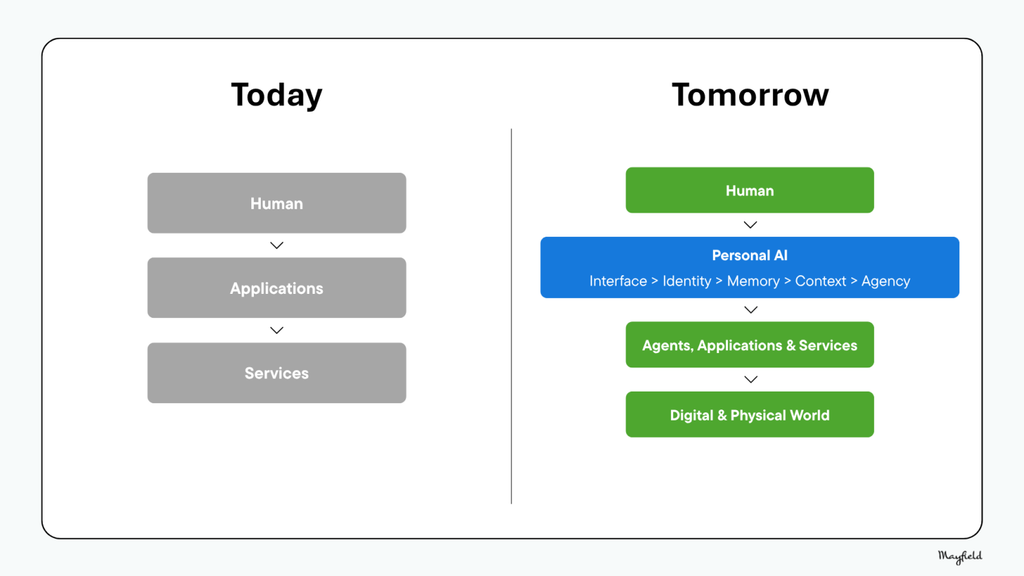
For decades, humans have been the orchestration layer for software. We open one application to communicate, another to travel, another to shop, another to manage money, and another to get work done.
That will invert with Personal AI. Intelligence begins operating software on our behalf. The user states an intent, and Personal AI selects the tools and performs the work.
Personal AI is the transition from intelligence on demand to intelligence that works persistently for you.
Inside the Personal AI stack are 5 layers:
1. Identity: Who am I?
The foundation is a persistent representation of the individual. Who matters to me? What are my goals? What do I care about? What are my preferences?
2. Memory: What have you learned about me?
Memory has to go past storing facts, progressing from facts to preferences to patterns to relationships to decisions, and eventually to judgment.
Each interaction can make the next one better: More use → More context → Better memory → Better decisions → More successful actions → Greater trust → More delegation → More use.
3. Context: What is happening now?
Memory describes the past. Context describes the present. Which emails matter? What commitments have I made? What project am I working on? What am I waiting for? The richer the context, the less we have to explain ourselves every time we interact with AI.
4. Agency: What can you do for me?
This is where Personal AI moves from intelligence to outcomes. Book the flight. Make the reservation. Respond to the important email.
5. Trust: What can I let you do?
This may be the most important layer. An AI with no access to my life is safe but only marginally personal. An AI that can read my communications, understand my relationships, spend my money, and communicate as me can be extraordinarily valuable. It can also be extraordinarily consequential when it gets something wrong. Trust earns continued use.
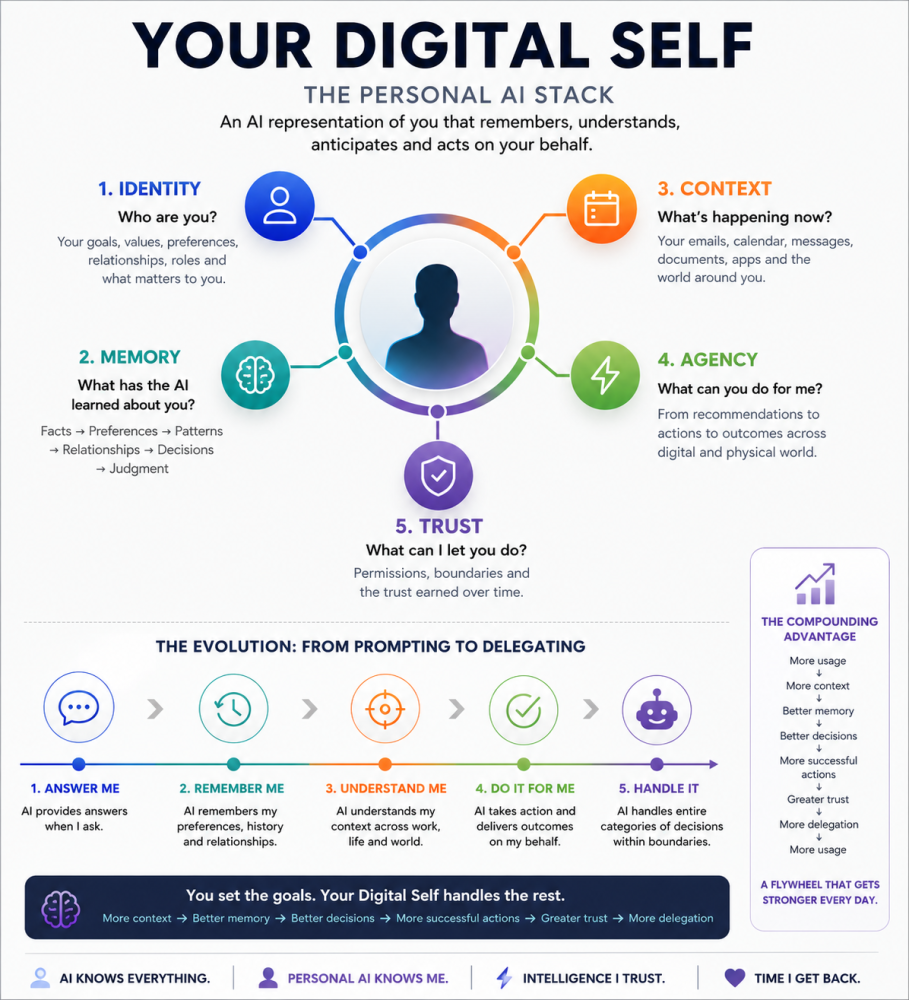
The five stages describe what a user experiences. The five layers describe what must be built beneath to deliver it. Memory, context, and agency appear in both because each stage is unlocked by the layer beneath it.
Models, tools, and applications sit under this stack. A single task may pass through several providers, but your identity, relationships, preferences, history, permissions, and trust persist.
If the ultimate product is a digital self, Hello Haven’s ambition is to make that self portable.
Haven is designed as a digital twin, not another assistant. An assistant remembers what you asked it to do. Haven aims to learn how you decide: your preferences, relationships, permissions, patterns, and past choices.
Ask two Havens to order groceries for the same dish, and they will produce different carts. One might choose different brands. Another might make the meal gluten-free without being reminded. That is the difference between storing instructions and learning judgment.
Each user has a private memory graph that sits above models, tools, and applications. Haven can select the right combination for each task while the person’s identity and context remain intact. You can reach it by phone, text, email, voice, web, or the app, but the surface is secondary. Your memory, permissions, and judgment travel with you.
The longer-term vision is simple: Sign in with Haven, and your life comes with you.
The same digital twin could eventually be embedded in an application, a television, a car, a connected device, or a robot. The interface changes; the person’s context does not.
The best way to understand Haven is to try it for yourself: http://my.hellohaven.ai/gethaven
Six-time founder Frank Addante is building Hello Haven as an operating system for your life. We first backed Frank at Rubicon Project in 2007. Nearly two decades later, we have partnered with him again at the inception stage. He co-founded Haven with Duc Chau and is coming out of stealth today.
That is the bet: models will change, and interfaces will multiply, while memory, judgment, permissions, and trust continue to compound around the individual.
I have long believed that the real return on technology is the Rise of the Individual. Personal AI could be one of the purest expressions of that idea.
Its purpose is to remove administrative and cognitive burdens so we can spend more time on what humans do best: building relationships, creating, judging, leading, and imagining.
Your digital self is the ultimate AI product.
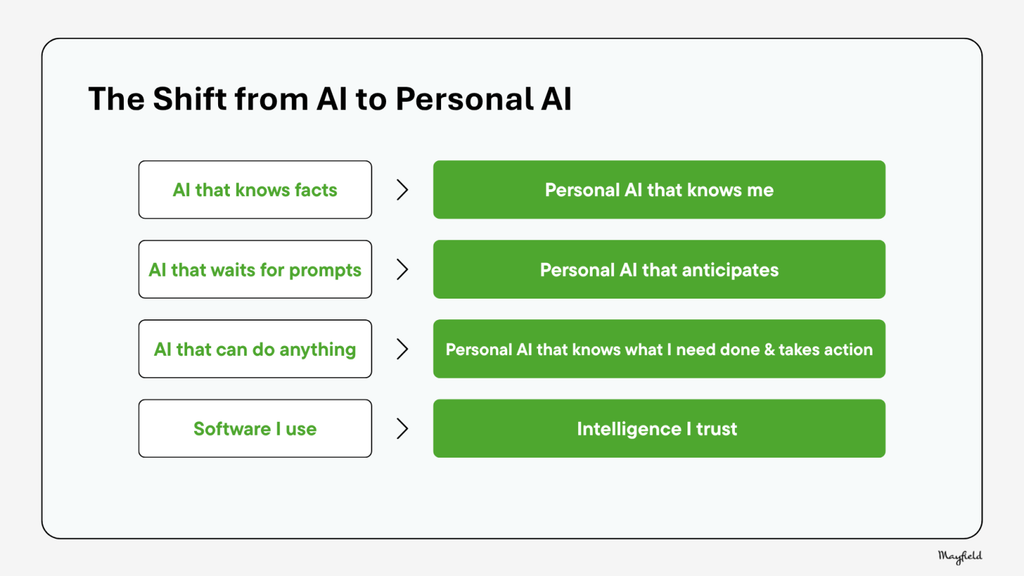
The technology can be impressive on day one. The relationship takes time. Memory must become judgment, action must become reliable, and autonomy must expand one permission at a time.
The strongest products may use the same underlying models as everyone else. Their advantage will come from deeper context, more useful memory, more reliable agency, and enough trust for users to delegate increasingly important decisions and tasks.
What have you delegated to AI – and what are you unwilling to hand over? Reply below in the comments.


