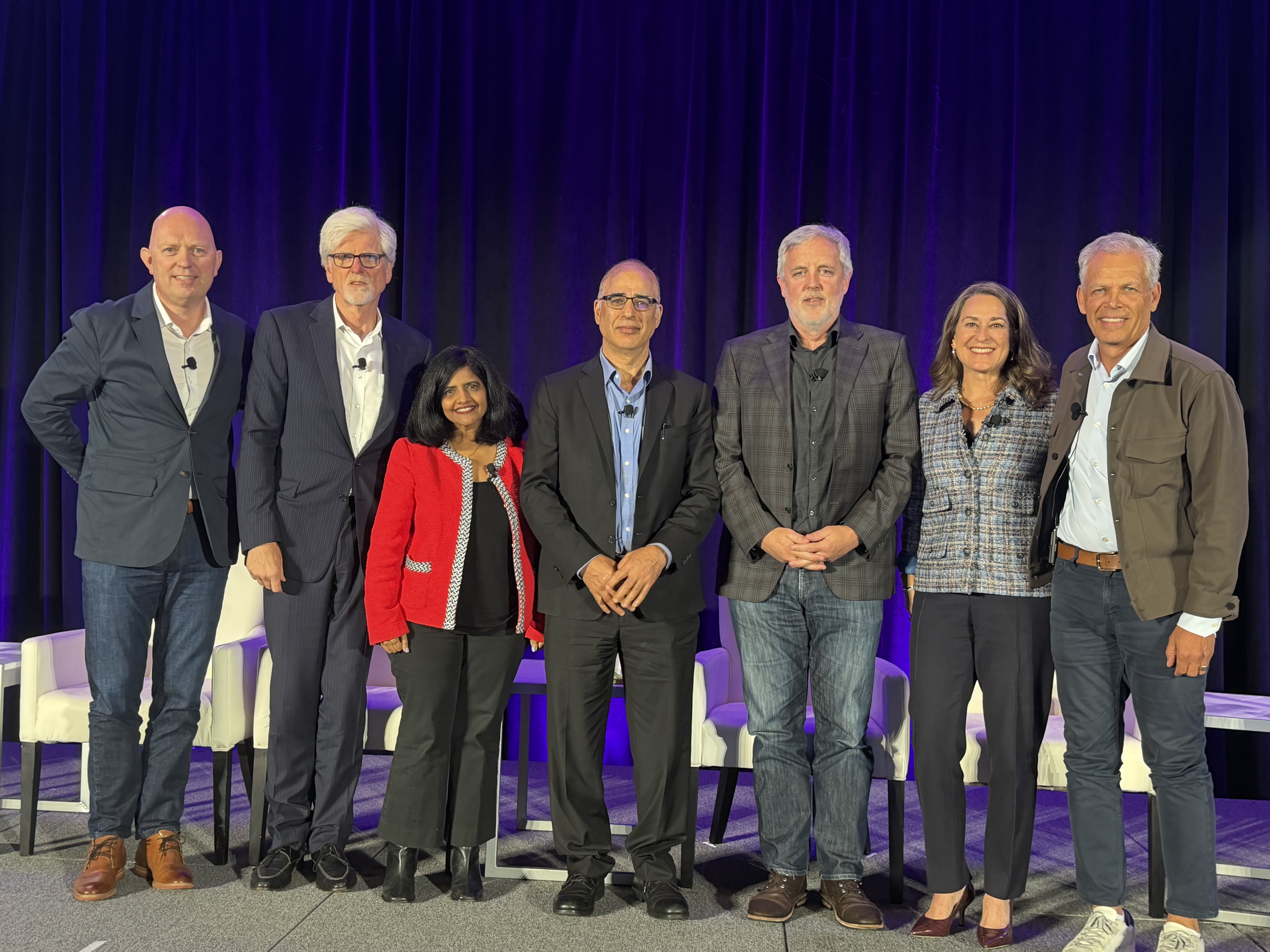
Today at GAI World in Boston, I moderated a main-stage conversation on “The AI Leadership Imperative” with six technology leaders working across professional services, life sciences, healthcare, retail, and enterprise technology. Paul Baier and John Sviokla ran an amazingly insightful event – packed full of executive level insights for leaders.
The clearest signal from the discussion: enterprise AI is moving beyond pilots and productivity tools. The harder work—and the larger opportunity—is redesigning how the organization operates.
A few takeaways:
Start with the process. Map and improve the work before adding automation and AI. Applying AI to a broken process can conceal the underlying problem and leave governance playing catch-up.
Redesign from a blank sheet. Ask how the work would be organized if automation and agents were available from the outset. That opens the door to parallel, multi-agent workflows instead of simply accelerating old, sequential processes.
Look beyond productivity. The largest gains may come from changing the operating model or business model—not just completing existing tasks faster. Boards should be asking what the organization can now do differently.
Be deliberate about build versus buy. A company that is not a software development organization should not become one by accident. AI makes building easier, but ownership, security, maintenance, and product lifecycle costs remain real.
Put governance inside execution. One model discussed was a Results Delivery Office that tracks what is being delivered, the outcomes it produces, how work is changing, and how it is secured. Governance cannot be added at the end.
Build fluency without creating fear. “Everyone must know how to use AI” is a more productive mandate than requiring everyone to use it in the same way. Pair that expectation with reskilling so people can move into agent design and other higher-value roles.
The CIO’s leadership role is expanding along with the technology. CEOs and boards need someone who can explain complex systems plainly, correct misconceptions, make decisions amid ambiguity, and remain hands-on enough to separate understanding from noise.
Thank you to Ramesh Razdan of Bain & Company, Anjana Harve of Astellas Pharma, Jaap van Riel of KnitWell Group, Thor Wallace of NETSCOUT, Nathan McBride of Xilio Therapeutics, and Jacqui Nevils of Fresenius Medical Care for such a candid and practical conversation.